Ch. 5 - Systems and Matrices
Lial - College Algebra 13th Edition
Lial13th EditionCollege AlgebraISBN: 9780136881063Not the one you use?Change textbook
Chapter 6, Problem 35

Solve each system of equations. State whether it is an inconsistent system or has infinitely many solutions. If a system has infinitely many solutions, write the solution set with x arbitrary.
5x - 5y - 3 = 0
x - y - 12 = 0

Verified step by step guidance
1
Rewrite each equation in the system in the form \(Ax + By = C\) to clearly identify coefficients and constants. For the first equation, add 3 to both sides to get \$5x - 5y = 3\(. For the second equation, add 12 to both sides to get \)x - y = 12$.
Observe the relationship between the two equations. Notice that the first equation has coefficients 5 and -5, and the second has coefficients 1 and -1. Check if the first equation is a multiple of the second by comparing the ratios of the coefficients: \(\frac{5}{1}\) and \(\frac{-5}{-1}\).
If the ratios of the coefficients of \(x\) and \(y\) are equal, check the ratio of the constants on the right side of the equations. Compare \(\frac{3}{12}\). If this ratio is not equal to the coefficient ratios, the system is inconsistent (no solution). If it is equal, the system has infinitely many solutions.
If the system has infinitely many solutions, express one variable in terms of the other using one of the equations. For example, from \(x - y = 12\), solve for \(x\) as \(x = y + 12\) or for \(y\) as \(y = x - 12\).
Write the solution set using a parameter (such as \(t\)) to represent the arbitrary variable. For example, let \(y = t\), then \(x = t + 12\), and express the solution set as \(\{(x, y) | x = t + 12, y = t, t \in \mathbb{R} \}\).

Verified video answer for a similar problem:

This video solution was recommended by our tutors as helpful for the problem above.
Video duration:
2m
Was this helpful?

Key Concepts

Here are the essential concepts you must grasp in order to answer the question correctly.

Solving Systems of Linear Equations

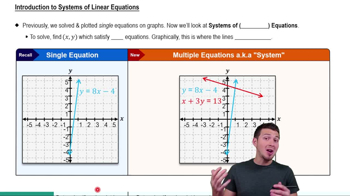
A system of linear equations consists of two or more linear equations with the same variables. Solving the system means finding all variable values that satisfy every equation simultaneously. Methods include substitution, elimination, and graphing, which help determine if solutions exist and what they are.
Recommended video:
Guided course
4:27
Introduction to Systems of Linear Equations

Types of Solutions for Systems

Systems of equations can have one unique solution, infinitely many solutions, or no solution (inconsistent). A unique solution occurs when lines intersect at one point, infinitely many when lines coincide, and no solution when lines are parallel and distinct.
Recommended video:
Guided course
6:19
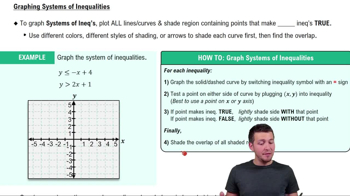
Systems of Inequalities

Expressing Solutions with Parameters

When a system has infinitely many solutions, the solution set is expressed using a parameter (often x or t) to represent the free variable. This allows writing dependent variables in terms of the parameter, describing all possible solutions compactly.
Recommended video:
Guided course
05:09
Introduction to Algebraic Expressions