Ch. 5 - Systems and Matrices
Lial - College Algebra 13th Edition
Lial13th EditionCollege AlgebraISBN: 9780136881063Not the one you use?Change textbook
Chapter 6, Problem 18

Solve each nonlinear system of equations. Give all solutions, including those with nonreal complex components. See Examples 1–5.
y=x2+6x+9y=x^2+6x+9
x+2y=2x+2y=-2

Verified step by step guidance
1
Start with the given system of equations: \(y = x^{2} + 6x + 9\) and \(x + 2y = -2\).
Substitute the expression for \(y\) from the first equation into the second equation to eliminate \(y\). This gives: \(x + 2(x^{2} + 6x + 9) = -2\).
Expand and simplify the equation: \(x + 2x^{2} + 12x + 18 = -2\). Combine like terms to get a quadratic equation in terms of \(x\).
Bring all terms to one side to set the quadratic equation equal to zero: \$2x^{2} + 13x + 20 = 0$.
Solve the quadratic equation using the quadratic formula: \(x = \frac{-b \pm \sqrt{b^{2} - 4ac}}{2a}\), where \(a = 2\), \(b = 13\), and \(c = 20\). After finding the values of \(x\), substitute each back into the original equation for \(y\) to find the corresponding \(y\) values.

Verified video answer for a similar problem:

This video solution was recommended by our tutors as helpful for the problem above.
Video duration:
5m
Was this helpful?

Key Concepts

Here are the essential concepts you must grasp in order to answer the question correctly.

Nonlinear Systems of Equations

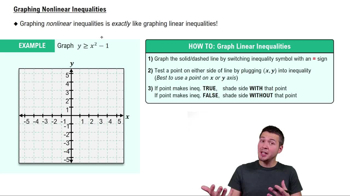
A nonlinear system involves at least one equation that is not linear, such as quadratic or higher-degree polynomials. Solving these systems requires methods beyond simple substitution or elimination used for linear systems, often involving substitution of one equation into another to reduce the system to a single-variable equation.
Recommended video:
Guided course
3:21
Nonlinear Inequalities

Substitution Method

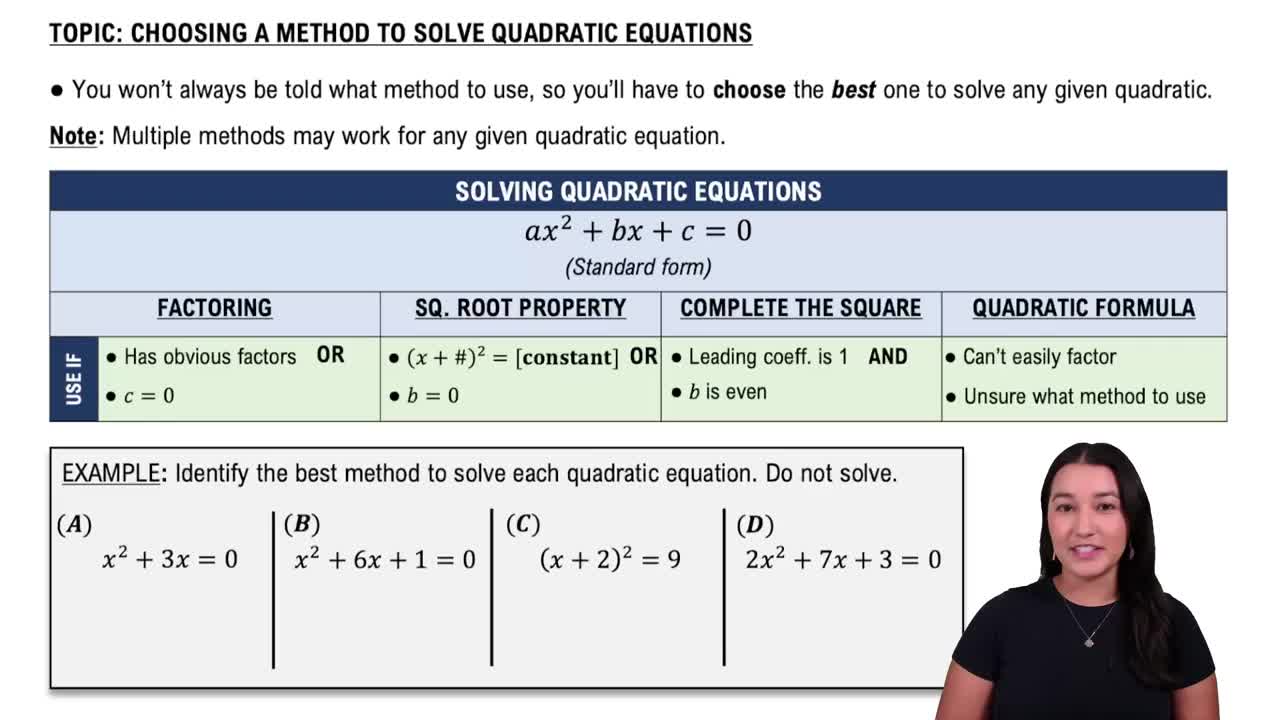
The substitution method involves solving one equation for one variable and substituting that expression into the other equation. This reduces the system to a single equation with one variable, which can then be solved using algebraic techniques, including factoring or the quadratic formula.
Recommended video:
04:03
Choosing a Method to Solve Quadratics

Complex Solutions

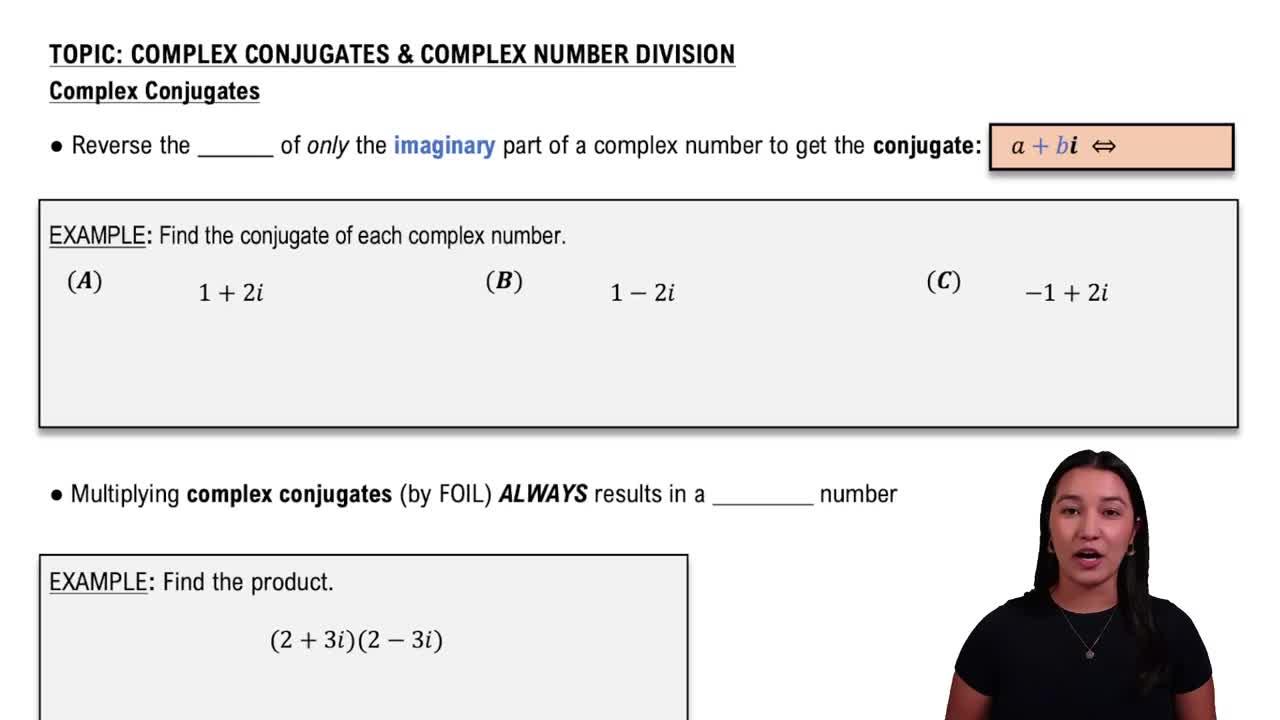
When solving polynomial equations, solutions may include complex numbers if the discriminant is negative. Complex solutions have a real part and an imaginary part, and it is important to include these when the problem specifies all solutions, not just real ones.
Recommended video:
05:33
Complex Conjugates