Ch. R - Review of Basic Concepts
Lial - College Algebra 13th Edition
Lial13th EditionCollege AlgebraISBN: 9780136881063Not the one you use?Change textbook
Chapter 1, Problem 122

Factor out the least power of the variable or variable expression. Assume all variables represent positive real numbers. See Example 8. 6r-2/3-5r-5/3

Verified step by step guidance
1
Identify the terms in the expression: \(6r^{-\frac{2}{3}} - 5r^{-\frac{5}{3}}\).
Determine the powers of \(r\) in each term: the first term has \(r^{-\frac{2}{3}}\) and the second term has \(r^{-\frac{5}{3}}\).
Find the least power (smallest exponent) of \(r\) between \(-\frac{2}{3}\) and \(-\frac{5}{3}\). Since \(-\frac{5}{3} < -\frac{2}{3}\), the least power is \(r^{-\frac{5}{3}}\).
Factor out \(r^{-\frac{5}{3}}\) from each term: write each term as a product involving \(r^{-\frac{5}{3}}\). For the first term, express \(r^{-\frac{2}{3}}\) as \(r^{-\frac{5}{3}} \times r^{\left(-\frac{2}{3} + \frac{5}{3}\right)}\).
Rewrite the expression as \(r^{-\frac{5}{3}}\) times the simplified terms inside parentheses, and simplify the exponents inside the parentheses to complete the factoring.

Verified video answer for a similar problem:

This video solution was recommended by our tutors as helpful for the problem above.
Video duration:
3m
Was this helpful?

Key Concepts

Here are the essential concepts you must grasp in order to answer the question correctly.

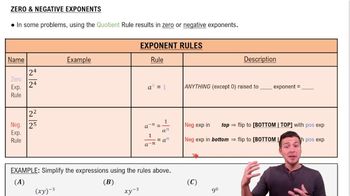
Negative Exponents

Negative exponents indicate the reciprocal of the base raised to the positive exponent. For example, r^(-2/3) means 1 divided by r^(2/3). Understanding this helps in rewriting expressions to factor or simplify them correctly.
Recommended video:
Guided course
6:37
Zero and Negative Rules

Factoring Out the Least Power

Factoring out the least power involves identifying the smallest exponent of the variable in all terms and factoring it out as a common factor. This simplifies the expression by reducing the powers inside the parentheses.
Recommended video:
04:10
Powers of i

Properties of Exponents

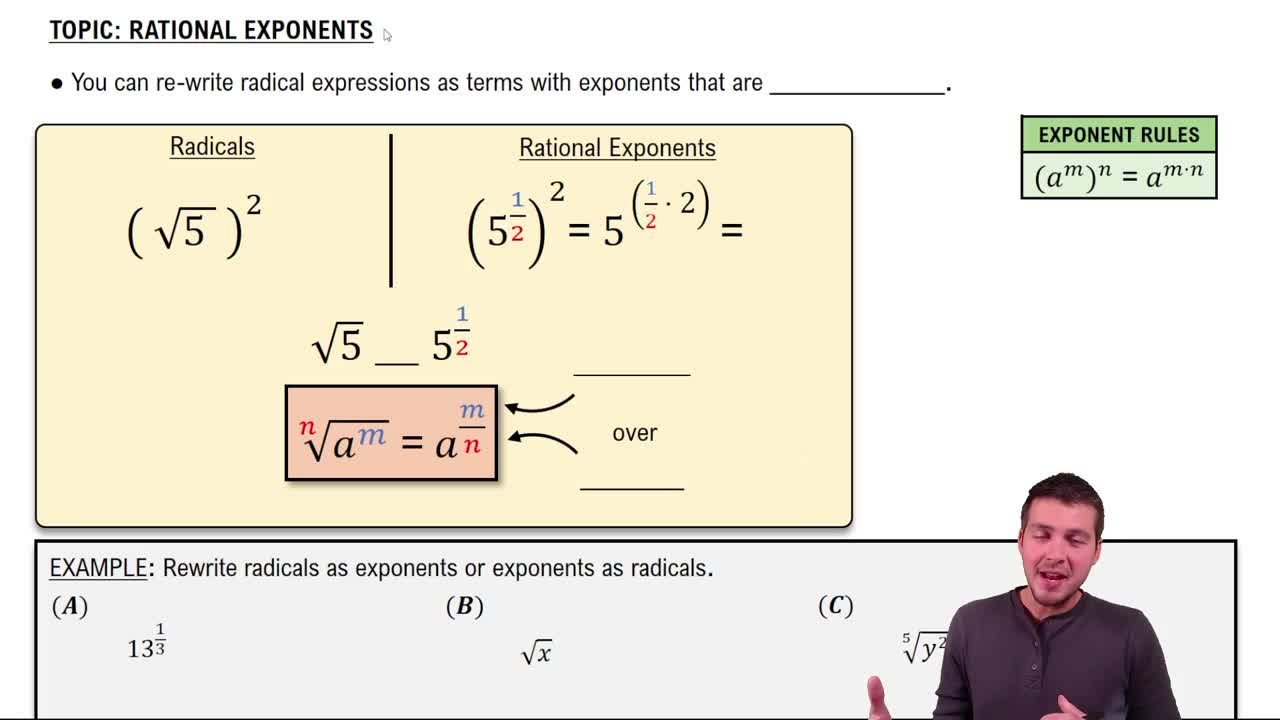
Properties of exponents, such as a^m / a^n = a^(m-n), allow manipulation of terms with exponents during factoring. These rules are essential for combining, dividing, or factoring expressions involving variables with fractional or negative exponents.
Recommended video:
Guided course
04:06
Rational Exponents