Ch. R - Review of Basic Concepts
Lial - College Algebra 13th Edition
Lial13th EditionCollege AlgebraISBN: 9780136881063Not the one you use?Change textbook
Chapter 1, Problem 47

Write each expression without negative exponents, and evaluate if possible. Assume all variables represent nonzero real numbers. -a-3

Verified step by step guidance
1
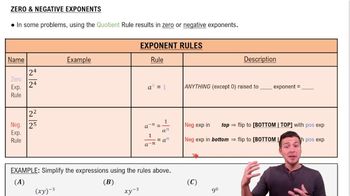
Recall the rule for negative exponents: for any nonzero number \(a\) and integer \(n\), \(a^{-n} = \frac{1}{a^n}\). This means a negative exponent indicates the reciprocal of the base raised to the positive exponent.
Apply this rule to the expression \(-a^{-3}\). The negative exponent on \(a\) means we rewrite \(a^{-3}\) as \(\frac{1}{a^3}\).
Rewrite the entire expression by replacing \(a^{-3}\) with \(\frac{1}{a^3}\), so the expression becomes \(-\frac{1}{a^3}\).
Since the expression now has no negative exponents, it is written without negative exponents as required.
Evaluate the expression only if a specific value for \(a\) is given; otherwise, this is the simplified form assuming \(a \neq 0\).

Verified video answer for a similar problem:

This video solution was recommended by our tutors as helpful for the problem above.
Video duration:
1m
Was this helpful?

Key Concepts

Here are the essential concepts you must grasp in order to answer the question correctly.

Negative Exponents

A negative exponent indicates the reciprocal of the base raised to the corresponding positive exponent. For example, a⁻³ equals 1 divided by a³. Understanding this allows rewriting expressions without negative exponents by moving factors between numerator and denominator.
Recommended video:
Guided course
6:37
Zero and Negative Rules

Exponent Rules

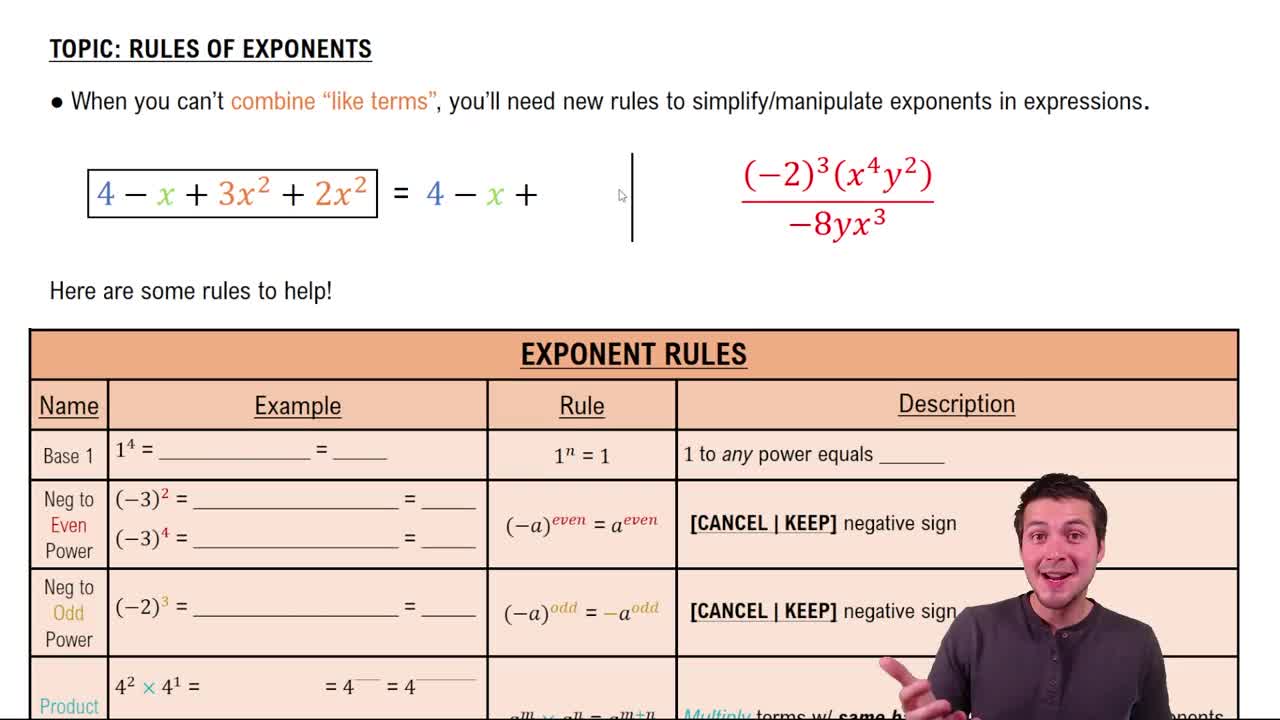
Exponent rules govern how to manipulate powers, including product, quotient, and power of a power rules. These rules help simplify expressions and rewrite them in equivalent forms, essential for removing negative exponents and evaluating expressions correctly.
Recommended video:
Guided course
7:39
Introduction to Exponent Rules

Evaluating Expressions with Variables

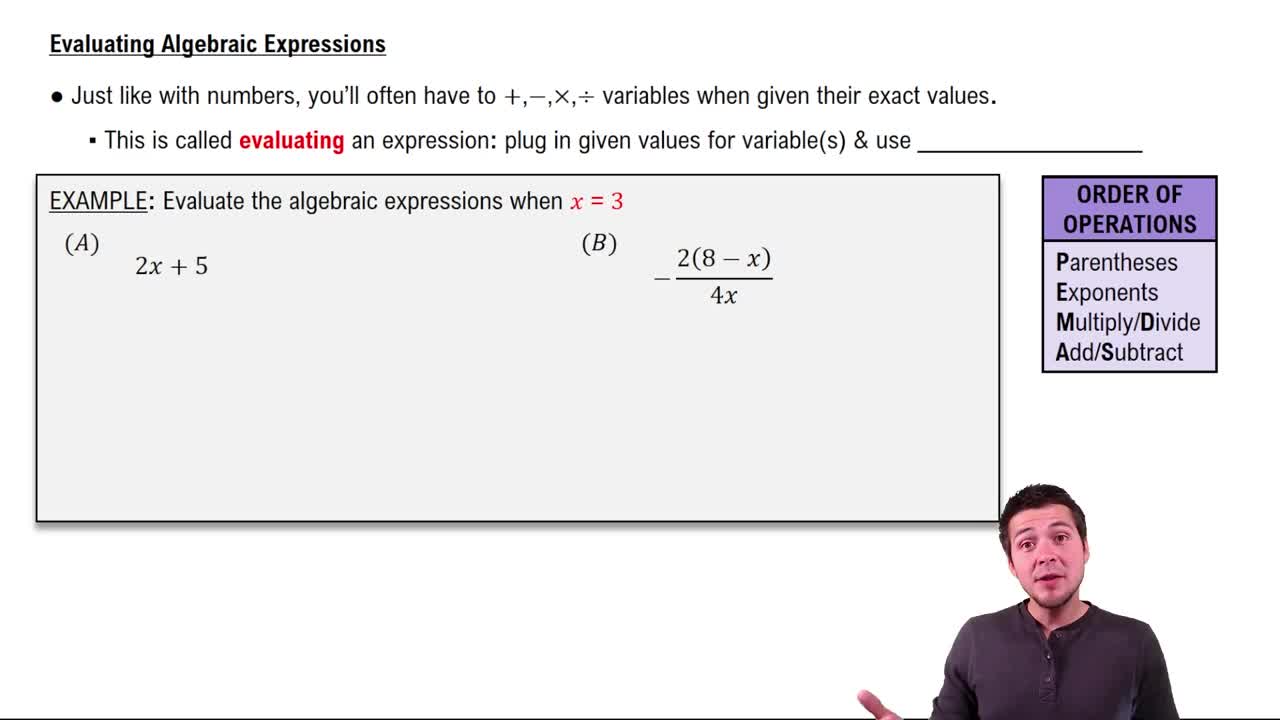
When variables represent nonzero real numbers, expressions can be simplified but not numerically evaluated without specific values. Recognizing this helps in simplifying expressions correctly and understanding when evaluation is possible or not.
Recommended video:
Guided course
03:11
Evaluating Algebraic Expressions