Ch. 4 - Inverse, Exponential, and Logarithmic Functions
Lial - College Algebra 13th Edition
Lial13th EditionCollege AlgebraISBN: 9780136881063Not the one you use?Change textbook
Chapter 5, Problem 81

Solve each equation. Give solutions in exact form. log2 (log2 x) = 1

Verified step by step guidance
1
Start by understanding the equation: \(\log_2 (\log_2 x) = 1\). This means the logarithm base 2 of another logarithm base 2 of \(x\) equals 1.
Rewrite the equation by setting an inner variable: let \(y = \log_2 x\). Then the equation becomes \(\log_2 y = 1\).
Solve for \(y\) by converting the logarithmic equation to its exponential form: \(y = 2^1\).
Substitute back \(y = \log_2 x\) to get \(\log_2 x = 2\).
Solve for \(x\) by rewriting the logarithmic equation in exponential form: \(x = 2^2\).

Verified video answer for a similar problem:

This video solution was recommended by our tutors as helpful for the problem above.
Video duration:
3m
Was this helpful?

Key Concepts

Here are the essential concepts you must grasp in order to answer the question correctly.

Properties of Logarithms

Understanding the properties of logarithms, such as the definition log_b(a) = c means b^c = a, is essential. This allows you to rewrite logarithmic equations into exponential form to solve for the variable.
Recommended video:
5:36
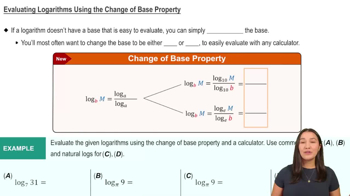
Change of Base Property

Domain Restrictions of Logarithmic Functions

Logarithmic functions are only defined for positive arguments. When solving nested logarithmic equations like log_2(log_2 x), you must ensure both the inner and outer logarithm arguments are positive to find valid solutions.
Recommended video:
3:51
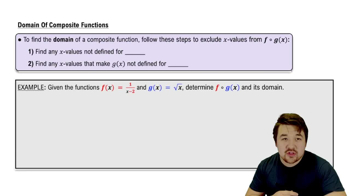
Domain Restrictions of Composed Functions

Solving Nested Logarithmic Equations

Solving equations with nested logarithms involves working from the outer logarithm inward. First, isolate the inner logarithm, then solve the resulting simpler logarithmic or exponential equation step-by-step.
Recommended video:
5:02
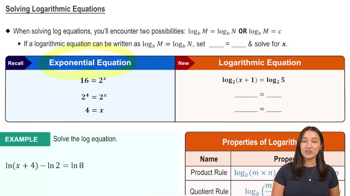
Solving Logarithmic Equations