Ch. 3 - Polynomial and Rational Functions
Lial - College Algebra 13th Edition
Lial13th EditionCollege AlgebraISBN: 9780136881063Not the one you use?Change textbook
Chapter 4, Problem 25

Find a polynomial function ƒ(x) of least degree with real coefficients having zeros as given. √3, -√3, 2, 3

Verified step by step guidance
1
Identify the zeros of the polynomial function: \( \sqrt{3}, -\sqrt{3}, 2, 3 \). Since the polynomial has real coefficients, these zeros can be used directly to form factors.
Write the factors corresponding to each zero. For a zero \( r \), the factor is \( (x - r) \). So the factors are \( (x - \sqrt{3}), (x + \sqrt{3}), (x - 2), (x - 3) \).
Group the conjugate pair \( (x - \sqrt{3}) \) and \( (x + \sqrt{3}) \) to form a quadratic factor by multiplying them: \( (x - \sqrt{3})(x + \sqrt{3}) = x^2 - (\sqrt{3})^2 = x^2 - 3 \).
Write the polynomial function as the product of the quadratic factor and the remaining linear factors: \( f(x) = (x^2 - 3)(x - 2)(x - 3) \).
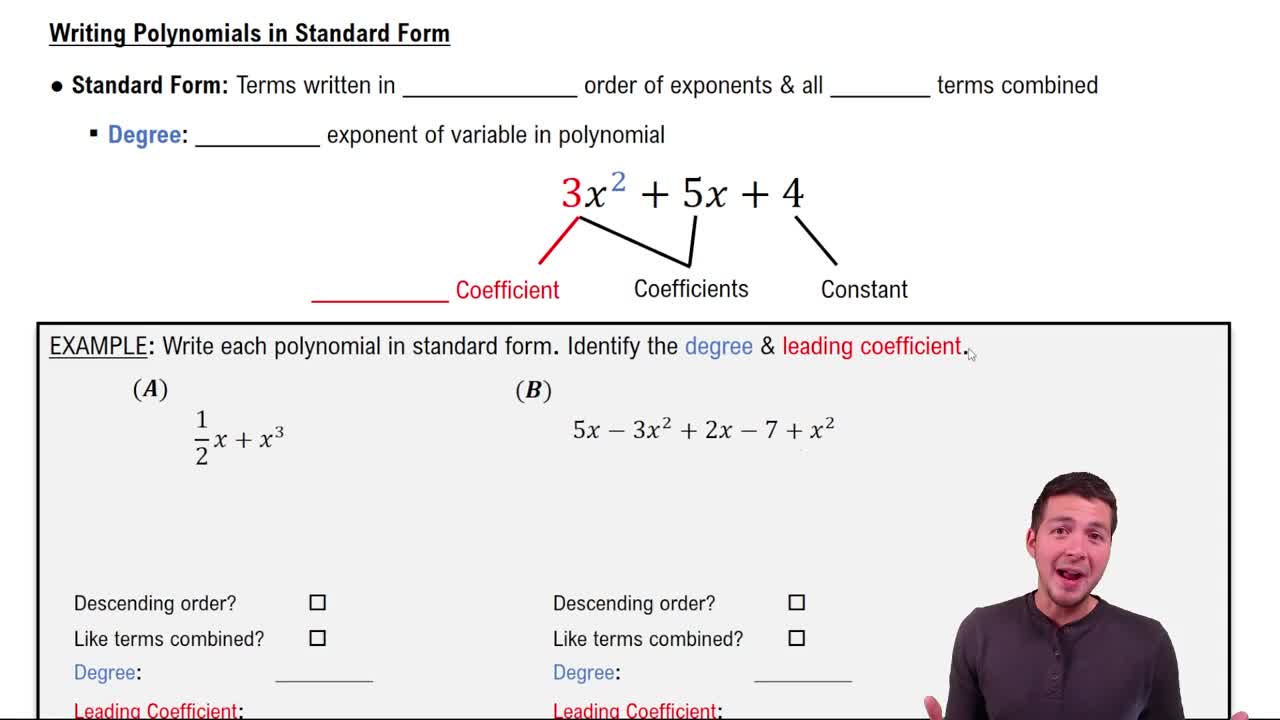
Expand the factors step-by-step if needed: first multiply \( (x - 2)(x - 3) \), then multiply the result by \( (x^2 - 3) \) to get the polynomial in standard form.

Verified video answer for a similar problem:

This video solution was recommended by our tutors as helpful for the problem above.
Video duration:
4m
Was this helpful?

Key Concepts

Here are the essential concepts you must grasp in order to answer the question correctly.

Polynomial Zeros and Factors

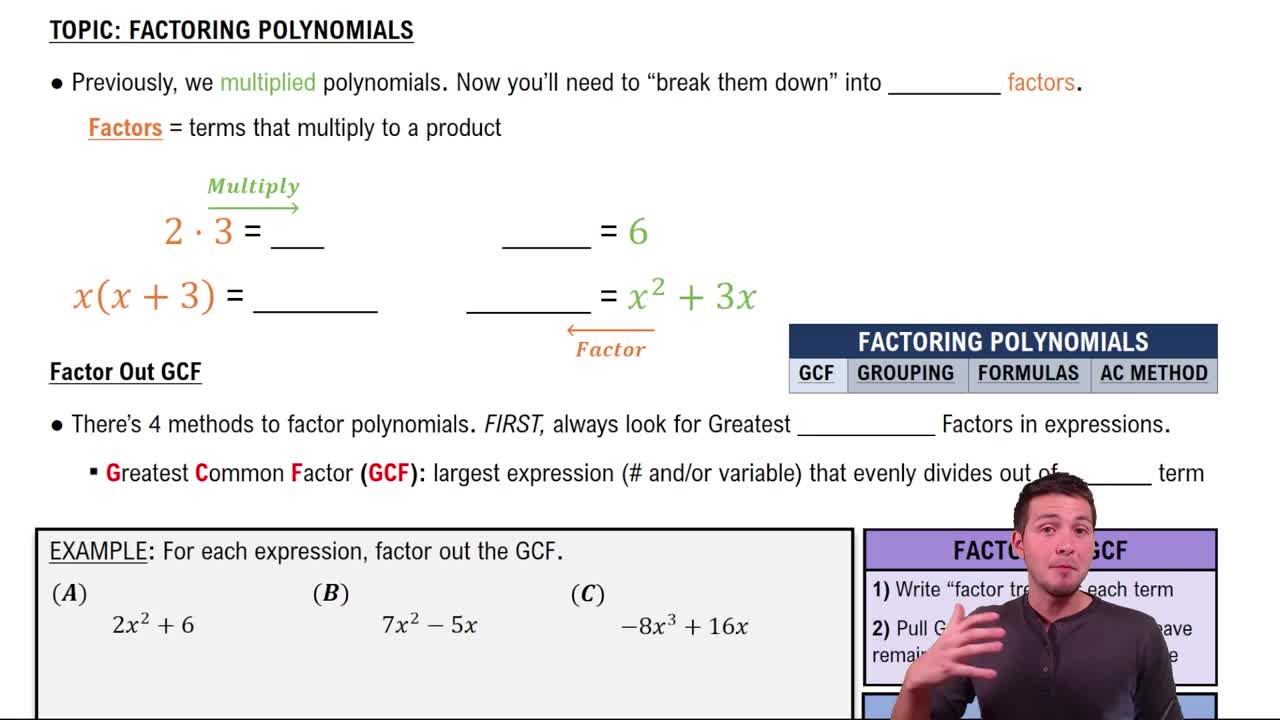
Each zero of a polynomial corresponds to a factor of the form (x - zero). For example, if √3 is a zero, then (x - √3) is a factor. To find the polynomial, multiply all factors corresponding to the given zeros.
Recommended video:
Guided course
07:30
Introduction to Factoring Polynomials

Real Coefficients and Conjugate Pairs

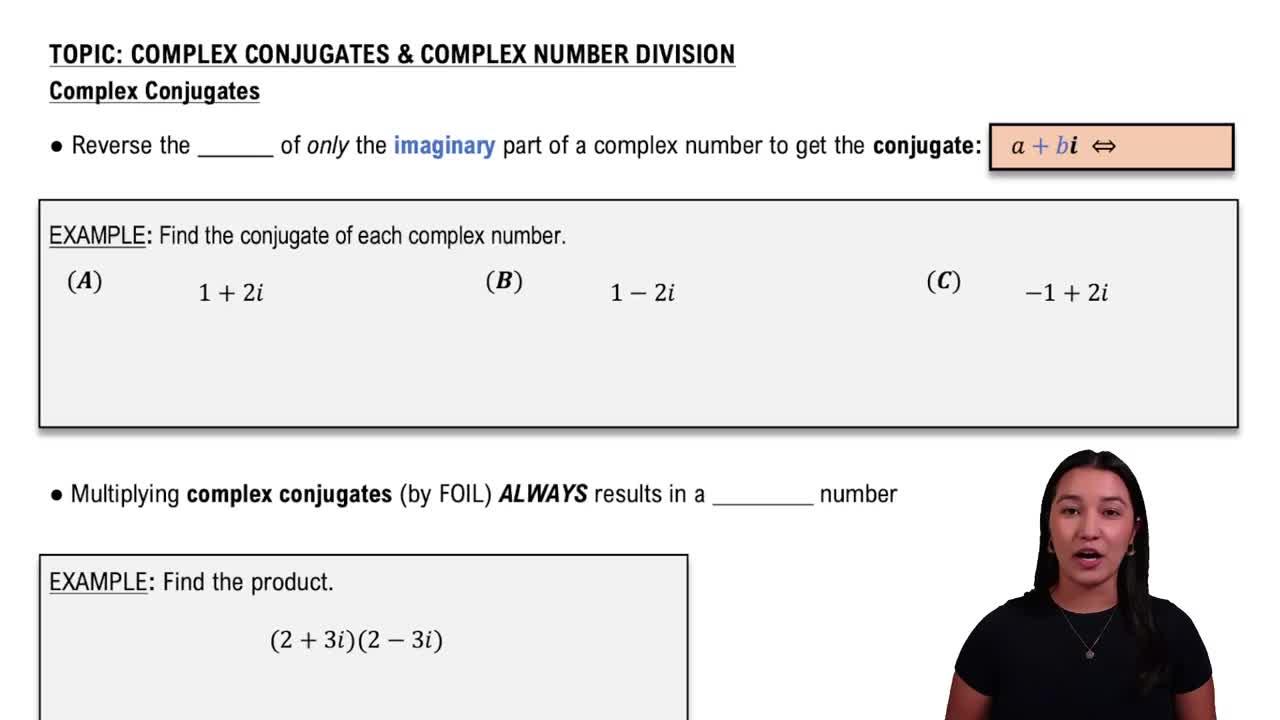
When a polynomial has real coefficients, irrational zeros like √3 must appear in conjugate pairs (√3 and -√3) to ensure the product results in real coefficients. This guarantees the polynomial remains with real numbers only.
Recommended video:
05:33
Complex Conjugates

Least Degree Polynomial

The polynomial of least degree that has the given zeros is formed by using each zero exactly once as a factor. This ensures the polynomial is the simplest (lowest degree) that satisfies the zero conditions.
Recommended video:
Guided course
05:16
Standard Form of Polynomials