Ch. R - Review of Basic Concepts
Lial - College Algebra 13th Edition
Lial13th EditionCollege AlgebraISBN: 9780136881063Not the one you use?Change textbook
Chapter 1, Problem 59

Factor each polynomial. See Examples 5 and 6. 9a2-16

Verified step by step guidance
1
Recognize that the polynomial \$9a^2 - 16\( is a difference of squares because it can be written as \)(3a)^2 - 4^2$.
Recall the difference of squares factoring formula: \(x^2 - y^2 = (x - y)(x + y)\).
Identify \(x = 3a\) and \(y = 4\) in the expression \$9a^2 - 16$.
Apply the formula to factor the polynomial as \((3a - 4)(3a + 4)\).
Write the final factored form: \((3a - 4)(3a + 4)\).

Verified video answer for a similar problem:

This video solution was recommended by our tutors as helpful for the problem above.
Video duration:
1m
Was this helpful?

Key Concepts

Here are the essential concepts you must grasp in order to answer the question correctly.

Difference of Squares

The difference of squares is a special factoring pattern where an expression is written as a^2 - b^2. It factors into (a - b)(a + b). Recognizing this pattern helps simplify polynomials like 9a^2 - 16 by identifying perfect squares and applying the formula.
Recommended video:
06:24
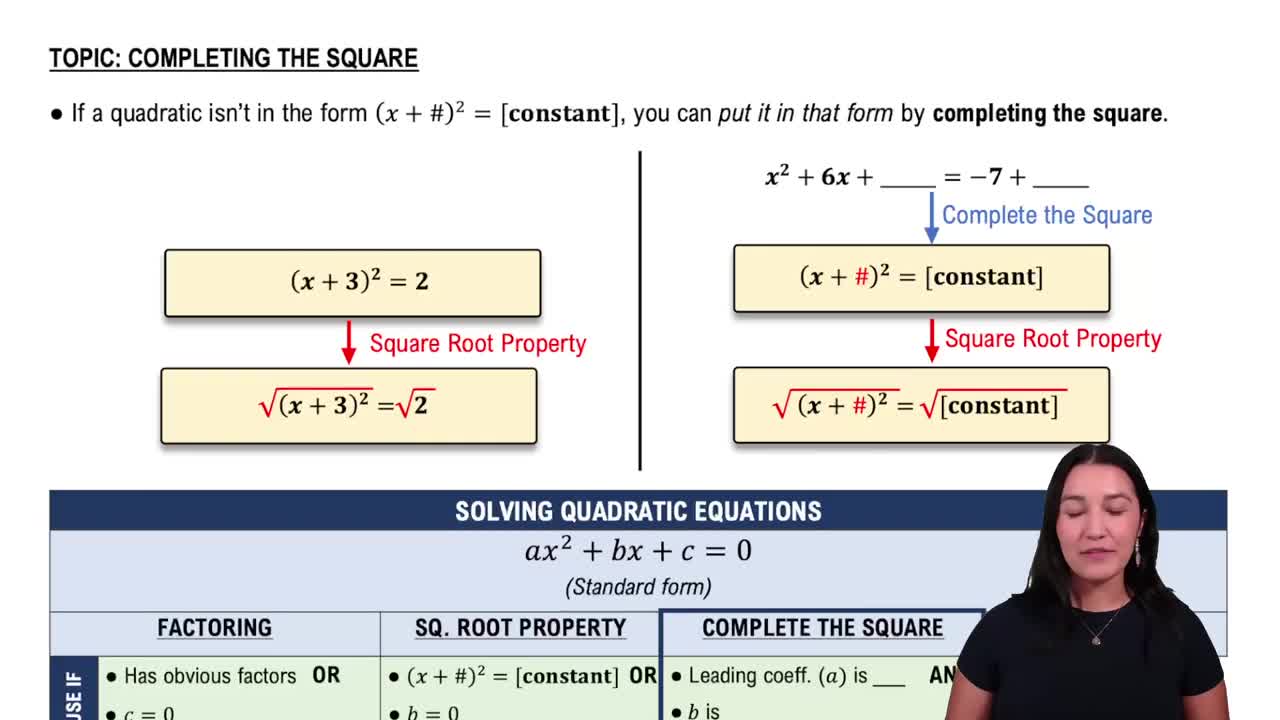
Solving Quadratic Equations by Completing the Square

Perfect Squares

Perfect squares are numbers or expressions that are squares of integers or variables, such as 9a^2 (which is (3a)^2) and 16 (which is 4^2). Identifying perfect squares is essential to apply the difference of squares factoring method correctly.
Recommended video:
06:24
Solving Quadratic Equations by Completing the Square

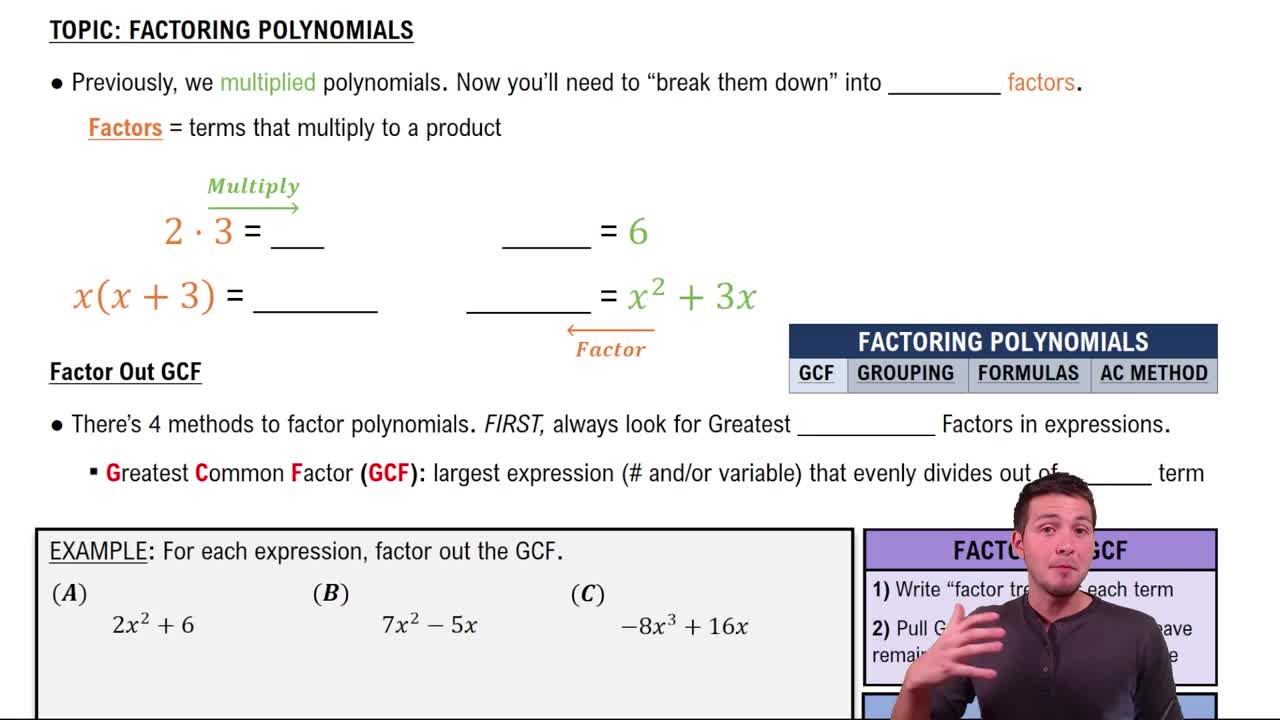
Factoring Polynomials

Factoring polynomials involves rewriting a polynomial as a product of simpler polynomials. This process simplifies expressions and solves equations. Recognizing patterns like difference of squares is a key step in factoring efficiently.
Recommended video:
Guided course
07:30
Introduction to Factoring Polynomials