Ch. 1 - Equations and Inequalities
Lial - College Algebra 13th Edition
Lial13th EditionCollege AlgebraISBN: 9780136881063Not the one you use?Change textbook
Chapter 2, Problem 18a

Identify each number as real, complex, pure imaginary, or nonreal com-plex. (More than one of these descriptions will apply.) √24

Verified step by step guidance
1
First, recognize that the number given is \( \sqrt{24} \). Since 24 is a positive real number, its square root is also a real number.
Simplify \( \sqrt{24} \) by factoring 24 into its prime factors: \( 24 = 4 \times 6 \). Then, \( \sqrt{24} = \sqrt{4 \times 6} = \sqrt{4} \times \sqrt{6} \).
Calculate \( \sqrt{4} \), which is 2, so \( \sqrt{24} = 2\sqrt{6} \). This is a real number because it is a product of real numbers.
Since \( \sqrt{24} \) is a real number and does not involve the imaginary unit \( i \), it is not complex in the sense of having an imaginary part, nor is it pure imaginary or nonreal complex.
Therefore, \( \sqrt{24} \) is classified as a real number (and also a complex number because all real numbers are a subset of complex numbers), but it is not pure imaginary or nonreal complex.

Verified video answer for a similar problem:

This video solution was recommended by our tutors as helpful for the problem above.
Video duration:
49s
Was this helpful?

Key Concepts

Here are the essential concepts you must grasp in order to answer the question correctly.

Real Numbers

Real numbers include all rational and irrational numbers that can be found on the number line. They encompass integers, fractions, and roots of positive numbers, such as √24, which is a positive real number because it represents a non-negative value.
Recommended video:
03:31
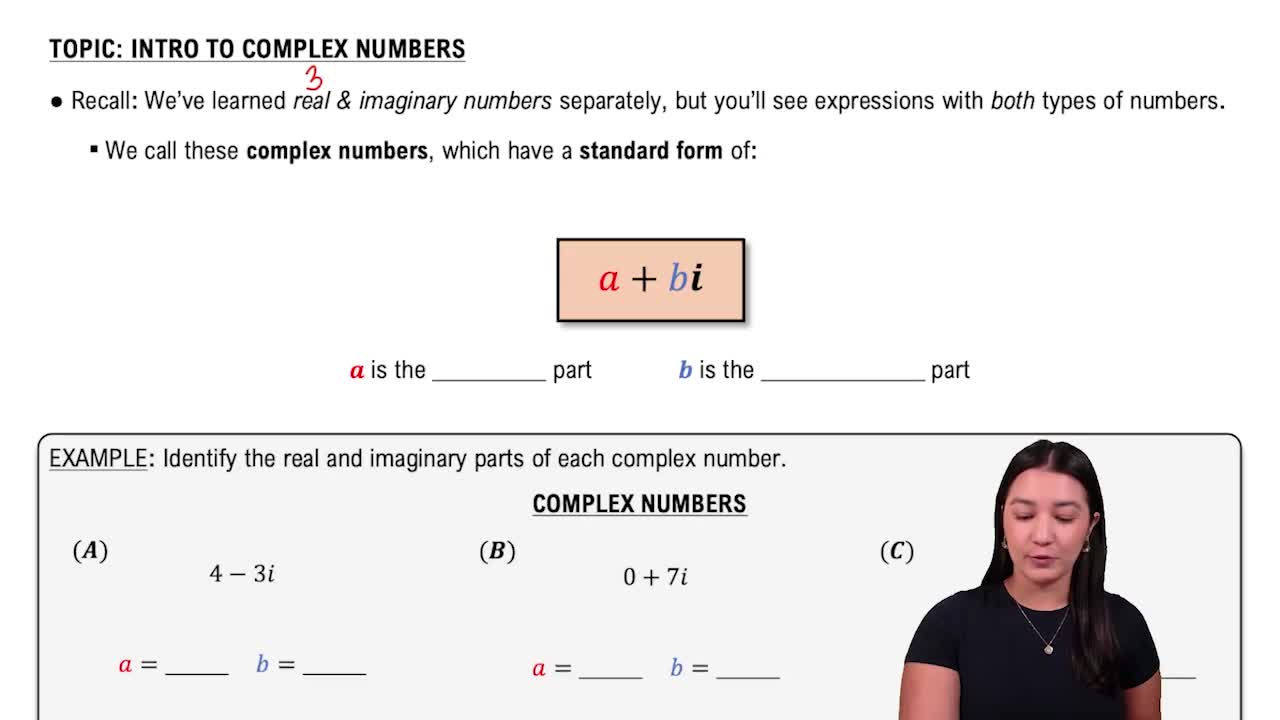
Introduction to Complex Numbers

Complex Numbers

Complex numbers are numbers in the form a + bi, where a and b are real numbers and i is the imaginary unit with i² = -1. Every real number is also a complex number with b = 0, so √24 can be considered a complex number with zero imaginary part.
Recommended video:
04:22
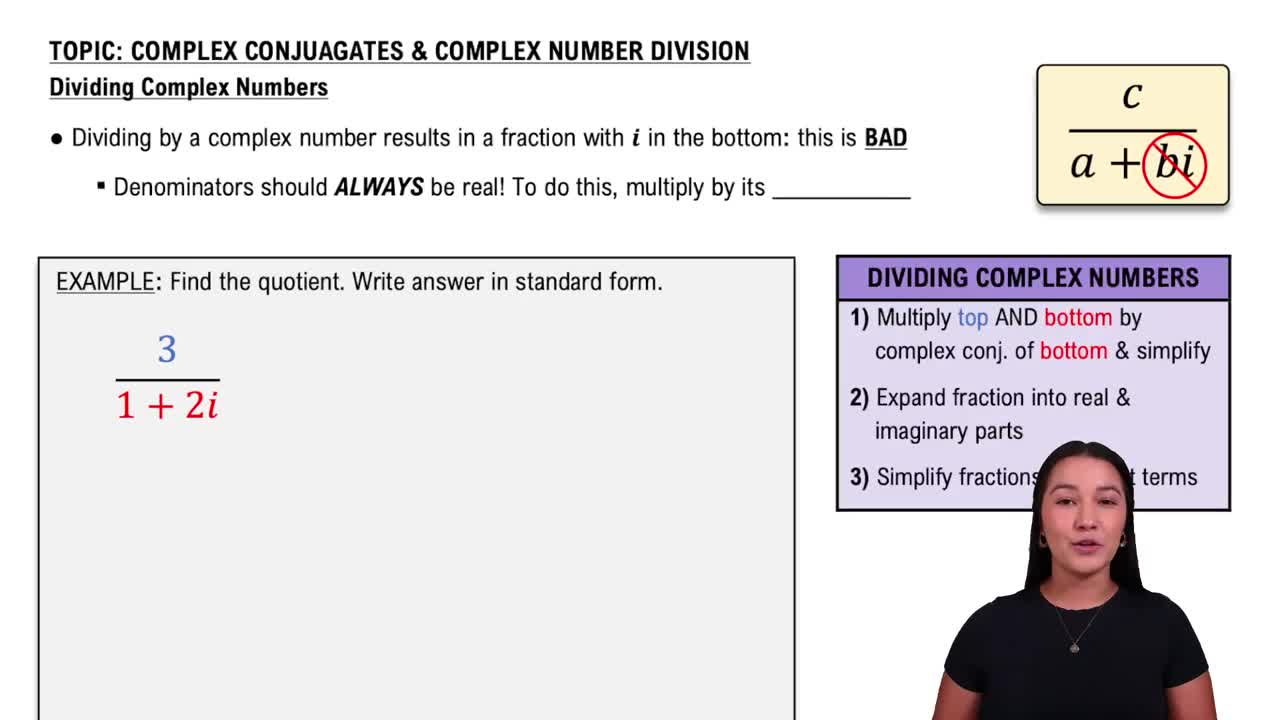
Dividing Complex Numbers

Pure Imaginary and Nonreal Complex Numbers

Pure imaginary numbers have the form 0 + bi where b ≠ 0, meaning they lie entirely on the imaginary axis. Nonreal complex numbers have a nonzero imaginary part. Since √24 has no imaginary part, it is neither pure imaginary nor nonreal complex.
Recommended video:
03:31
Introduction to Complex Numbers