Use the following facts. If x represents an integer, then x+1 represents the next consecutive integer. If x represents an even integer, then x+2 represents the next consecutive even integer. If x represents an odd integer, then x+2 represents the next consecutive odd integer. The difference of the squares of two positive consecutive odd integers is 32. Find the integers.
Ch. 1 - Equations and Inequalities

Chapter 2, Problem 17
Solve each equation. | (6x + 1)/ (x - 1) | = 3
Verified step by step guidance1
Recognize that the equation involves an absolute value expression: \(\left| \frac{6x + 1}{x - 1} \right| = 3\). Recall that \(|A| = B\) means \(A = B\) or \(A = -B\).
Set up two separate equations to solve: \(\frac{6x + 1}{x - 1} = 3\) and \(\frac{6x + 1}{x - 1} = -3\).
Solve the first equation \(\frac{6x + 1}{x - 1} = 3\) by multiplying both sides by \((x - 1)\) to eliminate the denominator, giving \$6x + 1 = 3(x - 1)$.
Solve the second equation \(\frac{6x + 1}{x - 1} = -3\) similarly by multiplying both sides by \((x - 1)\), resulting in \$6x + 1 = -3(x - 1)$.
For each equation, expand the right side, collect like terms, and solve for \(x\). Finally, check for any restrictions such as \(x \neq 1\) because the denominator cannot be zero.

Verified video answer for a similar problem:
This video solution was recommended by our tutors as helpful for the problem above.
Video duration:
2mWas this helpful?
Key Concepts
Here are the essential concepts you must grasp in order to answer the question correctly.
Absolute Value Equations
An absolute value equation involves expressions within absolute value bars, which represent the distance from zero on the number line. To solve, set up two separate equations: one where the expression equals the positive value, and one where it equals the negative value. This accounts for both possible cases of the absolute value.
Recommended video:
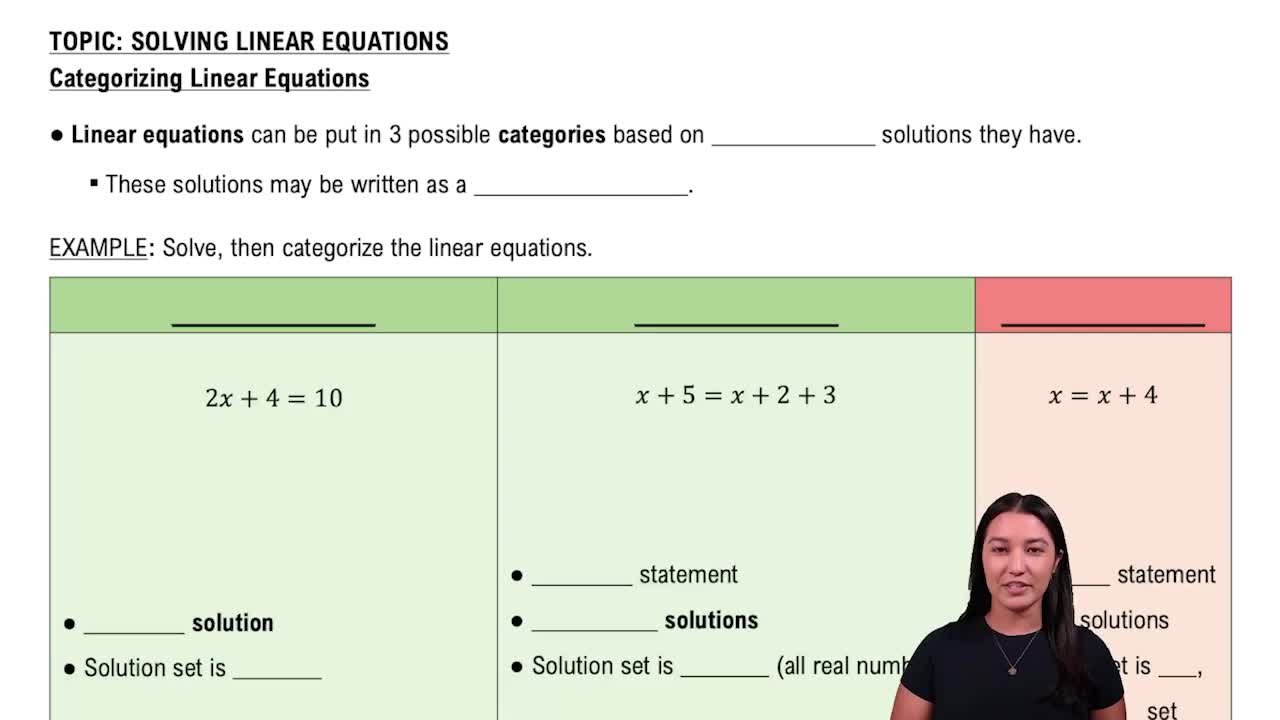
Categorizing Linear Equations
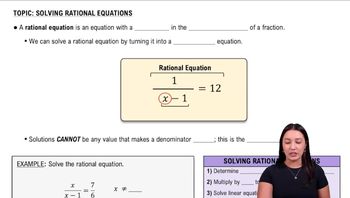
Solving Rational Equations
A rational equation contains variables in the denominator. To solve, first identify restrictions where the denominator is zero, then multiply both sides by the least common denominator to eliminate fractions. Afterward, solve the resulting equation while checking for extraneous solutions.
Recommended video:
Introduction to Rational Equations
Checking for Extraneous Solutions
Extraneous solutions arise when solving equations involving absolute values or rational expressions, especially after multiplying both sides by expressions containing variables. Always substitute solutions back into the original equation to verify their validity and discard any that do not satisfy the original equation.
Recommended video:
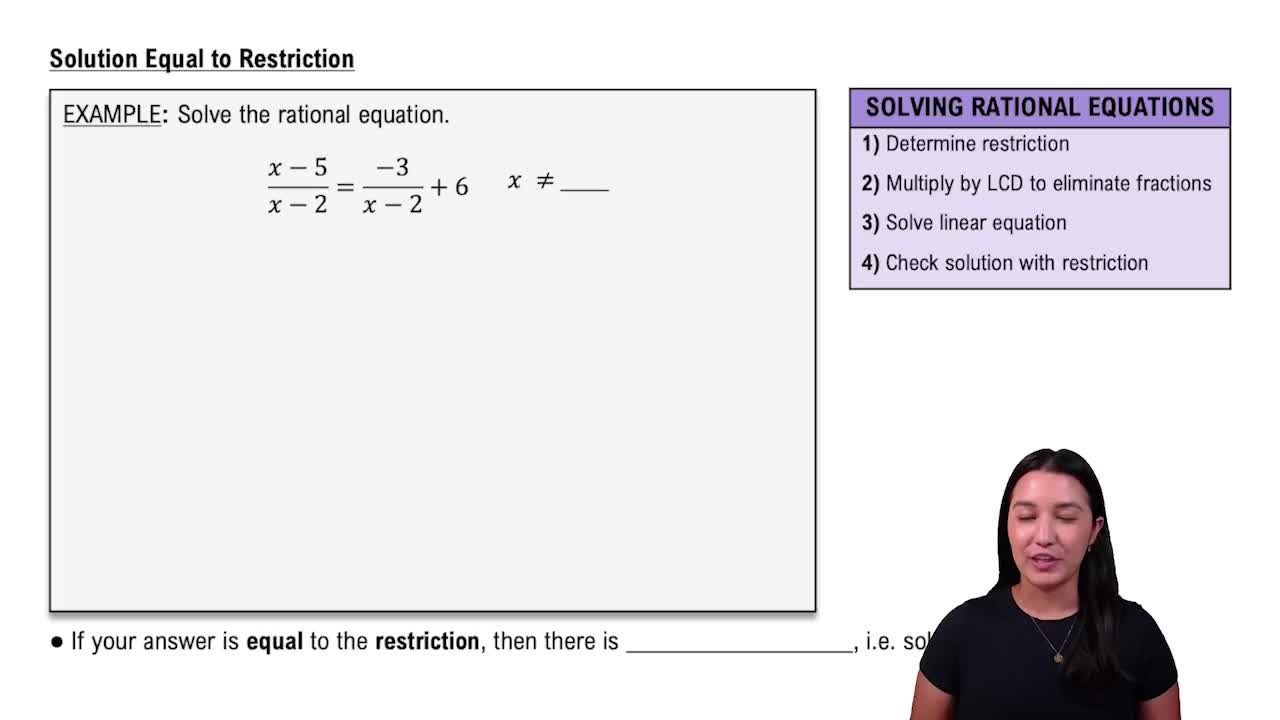
Restrictions on Rational Equations
Related Practice
Textbook Question
841
views
Textbook Question
Solve each inequality. Give the solution set in interval notation. 3(x+5)+1≥5+3x
961
views
Textbook Question
Solve each equation.
546
views
Textbook Question
Solve each equation. See Example 1. (2x+5)/2 - 3x/(x-2) = x
567
views
Textbook Question
Solve each equation. (4x+3)/4 - 2x/(x+1) = x
572
views
Textbook Question
Use the following facts. If x represents an integer, then x+1 represents the next consecutive integer. If x represents an even integer, then x+2 represents the next consecutive even integer. If x represents an odd integer, then x+2 represents the next consecutive odd integer. The difference of the squares of two positive consecutive even integers is 84. Find the integers.
853
views
