Ch. R - Review of Basic Concepts
Lial - College Algebra 13th Edition
Lial13th EditionCollege AlgebraISBN: 9780136881063Not the one you use?Change textbook
Chapter 1, Problem 113

Identify the property illustrated in each statement. Assume all variables represent real numbers. 6∙12+6∙15=6(12+15)

Verified step by step guidance
1
Look at the given expression: \(6 \times 12 + 6 \times 15 = 6(12 + 15)\). Notice that the number 6 is multiplied by both 12 and 15 separately on the left side.
Recognize that the expression shows a common factor (which is 6) being factored out from the sum of two products.
Recall the Distributive Property, which states that for any real numbers \(a\), \(b\), and \(c\), the following holds: \(a \times b + a \times c = a(b + c)\).
Compare the given expression to the Distributive Property formula and see that it matches exactly, where \(a = 6\), \(b = 12\), and \(c = 15\).
Conclude that the property illustrated by the equation \(6 \times 12 + 6 \times 15 = 6(12 + 15)\) is the Distributive Property.

Verified video answer for a similar problem:

This video solution was recommended by our tutors as helpful for the problem above.
Video duration:
1m
Was this helpful?

Key Concepts

Here are the essential concepts you must grasp in order to answer the question correctly.

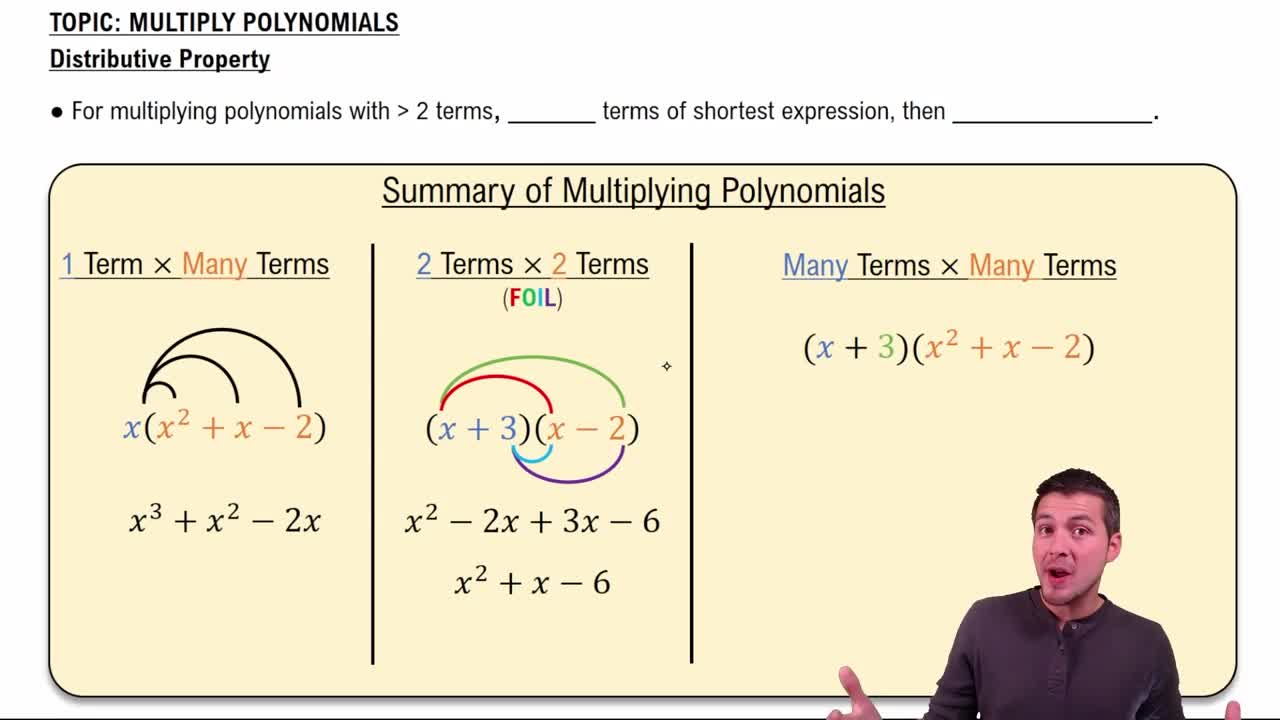
Distributive Property

The distributive property states that multiplying a number by a sum is the same as multiplying the number by each addend separately and then adding the products. In symbolic form, a(b + c) = ab + ac. This property allows simplification and factoring in algebraic expressions.
Recommended video:
Guided course
04:15
Multiply Polynomials Using the Distributive Property

Multiplication of Real Numbers

Multiplication of real numbers involves combining quantities to find their product. It is commutative and associative, meaning the order and grouping of factors do not affect the product. Understanding multiplication is essential to apply properties like distributive correctly.
Recommended video:
03:31
Introduction to Complex Numbers

Addition of Real Numbers

Addition of real numbers combines two or more numbers to get a sum. It is commutative and associative, allowing flexibility in grouping and order. Recognizing addition within expressions helps in applying properties such as the distributive property effectively.
Recommended video:
03:31
Introduction to Complex Numbers