Solve each problem. See Example 2. In the Apple Hill Fun Run, Mary runs at 7 mph, Janet at 5 mph. If they start at the same time, how long will it be before they are 1.5 mi apart?
Ch. 1 - Equations and Inequalities

Chapter 2, Problem 23
Solve each inequality. Give the solution set in interval notation. (1/3)x+(2/5)x-(1/2)(x+3)≤1/10
Verified step by step guidance1
First, write down the inequality clearly: \(\frac{1}{3}x + \frac{2}{5}x - \frac{1}{2}(x + 3) \leq \frac{1}{10}\).
Distribute the \(-\frac{1}{2}\) across the terms inside the parentheses: \(-\frac{1}{2} \times x\) and \(-\frac{1}{2} \times 3\) to get \(-\frac{1}{2}x - \frac{3}{2}\).
Combine like terms on the left side: add \(\frac{1}{3}x\), \(\frac{2}{5}x\), and \(-\frac{1}{2}x\) together by finding a common denominator and summing the coefficients.
After combining the \(x\) terms, rewrite the inequality as a linear inequality in the form \(Ax + B \leq C\), where \(A\), \(B\), and \(C\) are constants.
Isolate \(x\) by adding or subtracting constants on both sides and then dividing by the coefficient of \(x\). Remember to reverse the inequality sign if you multiply or divide by a negative number. Finally, express the solution set in interval notation.

Verified video answer for a similar problem:
This video solution was recommended by our tutors as helpful for the problem above.
Video duration:
4mWas this helpful?
Key Concepts
Here are the essential concepts you must grasp in order to answer the question correctly.
Solving Linear Inequalities
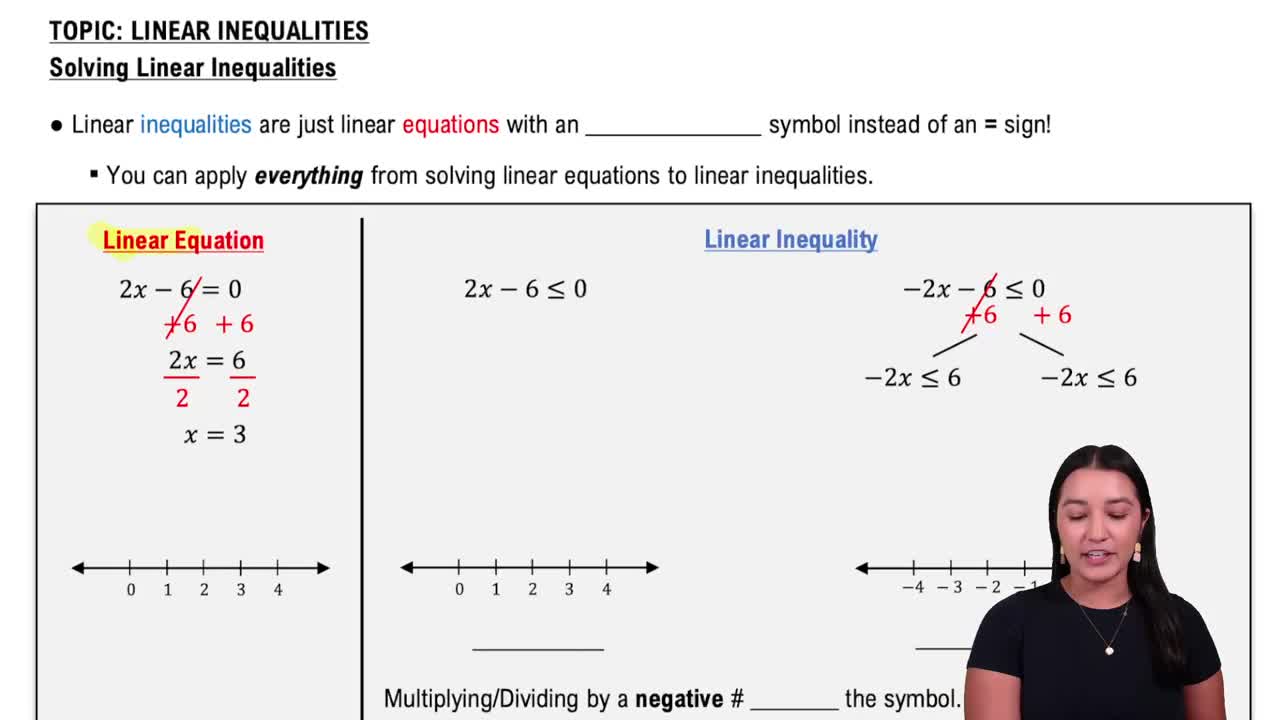
Linear inequalities involve expressions with variables raised to the first power and inequality signs. To solve them, isolate the variable on one side by performing algebraic operations like addition, subtraction, multiplication, or division, while carefully reversing the inequality sign when multiplying or dividing by a negative number.
Recommended video:
Linear Inequalities
Combining Like Terms and Distributive Property
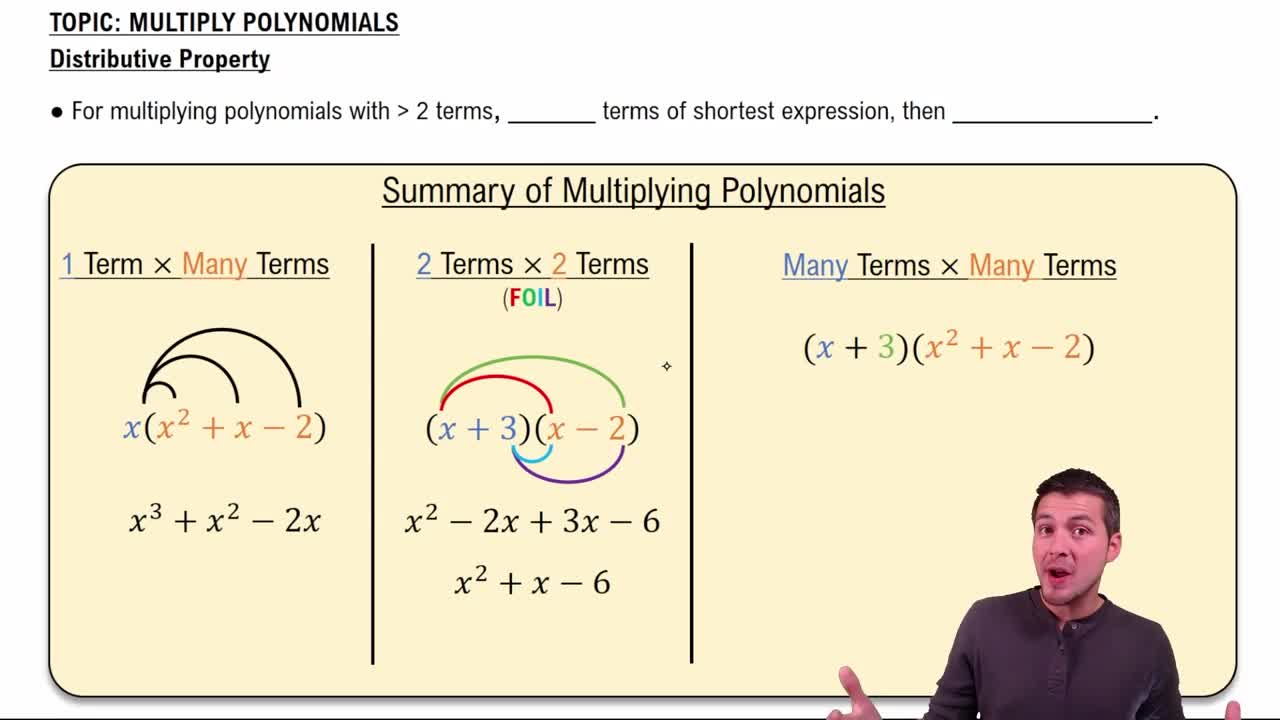
Combining like terms means adding or subtracting terms with the same variable and exponent. The distributive property allows you to multiply a single term across terms inside parentheses, e.g., a(b + c) = ab + ac. Both are essential for simplifying expressions before solving inequalities.
Recommended video:
Guided course
Multiply Polynomials Using the Distributive Property
Interval Notation
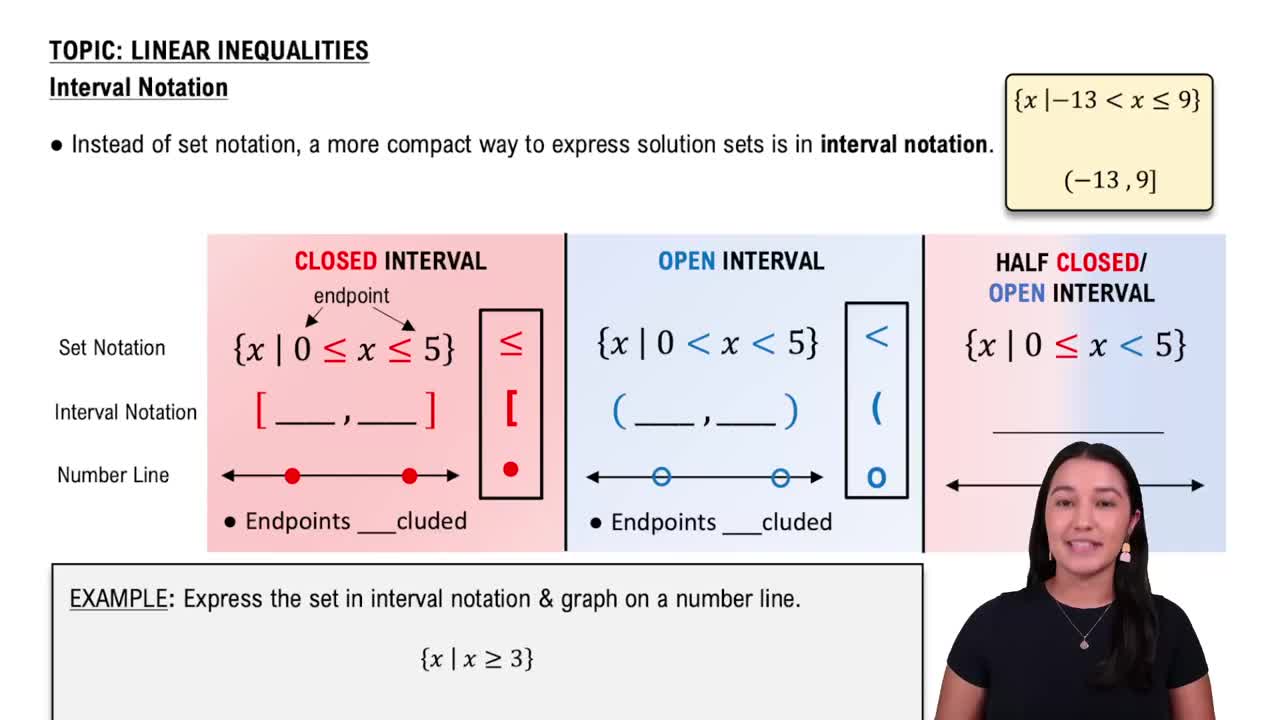
Interval notation is a concise way to represent solution sets of inequalities using parentheses and brackets. Parentheses indicate that an endpoint is not included, while brackets mean it is included. For example, [a, b) includes a but excludes b, clearly showing the range of values satisfying the inequality.
Recommended video:
Interval Notation
Related Practice
Textbook Question
707
views
Textbook Question
Dimensions of a Parking Lot. A parking lot has a rectangular area of 40,000 yd2. The length is 200 yd more than twice the width. Find the dimensions of the lot.
1190
views
Textbook Question
Write each number as the product of a real number and i. √-10
1667
views
Textbook Question
Solve each inequality. Give the solution set in interval notation. -(2/3)x-(1/6)x+(2/3)(x+1)≤4/3
1964
views
Textbook Question
Solve each equation. 0.2x - 0.5 = 0.1x+7
1036
views
Textbook Question
Solve each problem. See Example 2. Two planes leave Los Angeles at the same time. One heads south to San Diego, while the other heads north to San Francisco. The San Diego plane flies 50 mph slower than the San Francisco plane. In 1/2 hr, the planes are 275 mi apart. What are their speeds?
656
views