Ch. 1 - Equations and Inequalities
Lial - College Algebra 13th Edition
Lial13th EditionCollege AlgebraISBN: 9780136881063Not the one you use?Change textbook
Chapter 2, Problem 17

Solve each inequality. Give the solution set in interval notation. 3(x+5)+1≥5+3x

Verified step by step guidance
1
Start by expanding the left side of the inequality: \(3(x+5) + 1 \geq 5 + 3x\). Distribute the 3 to both \(x\) and 5, which gives \(3x + 15 + 1 \geq 5 + 3x\).
Combine like terms on the left side: \(3x + 16 \geq 5 + 3x\).
Next, subtract \$3x$ from both sides to isolate the constants: \(3x + 16 - 3x \geq 5 + 3x - 3x\), which simplifies to \(16 \geq 5\).
Analyze the resulting inequality \(16 \geq 5\). Since this is always true, it means the original inequality holds for all values of \(x\).
Therefore, express the solution set in interval notation as all real numbers: \((-\infty, \infty)\).

Verified video answer for a similar problem:

This video solution was recommended by our tutors as helpful for the problem above.
Video duration:
2m
Was this helpful?

Key Concepts

Here are the essential concepts you must grasp in order to answer the question correctly.

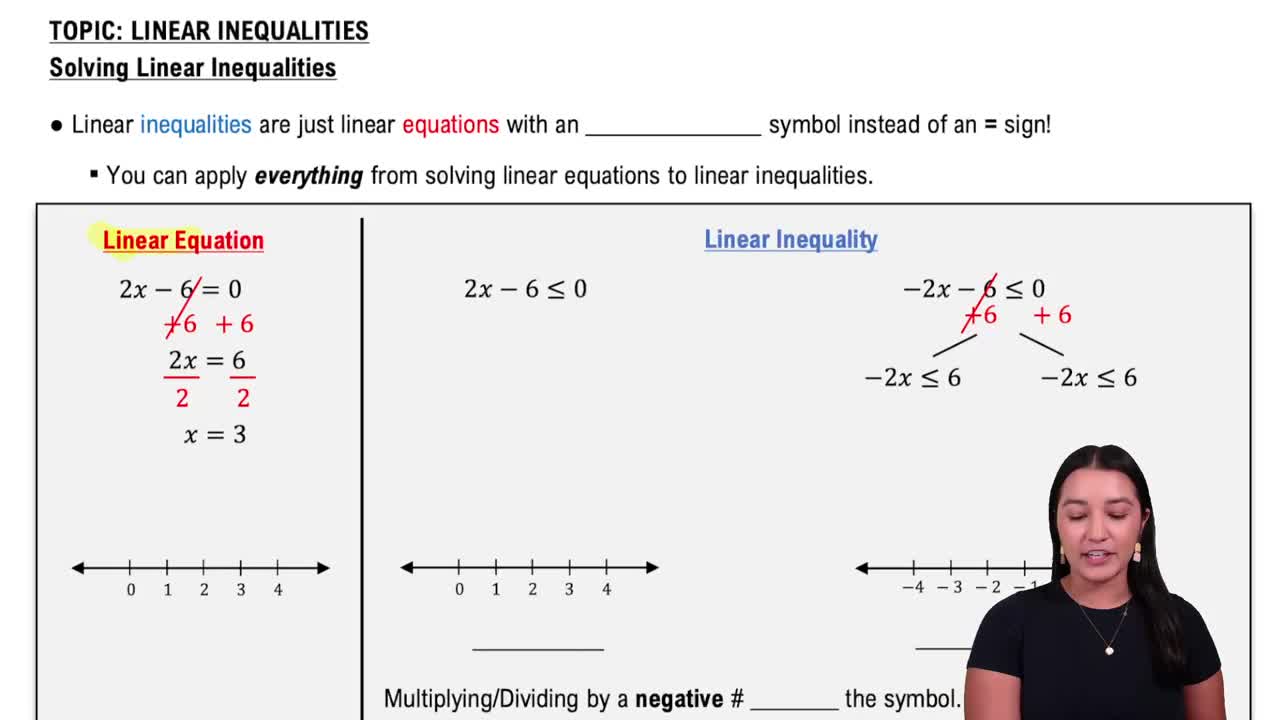
Solving Linear Inequalities

Solving linear inequalities involves isolating the variable on one side to find the range of values that satisfy the inequality. Similar to equations, operations like addition, subtraction, multiplication, and division are used, but special care is needed when multiplying or dividing by negative numbers, as this reverses the inequality sign.
Recommended video:
06:07
Linear Inequalities

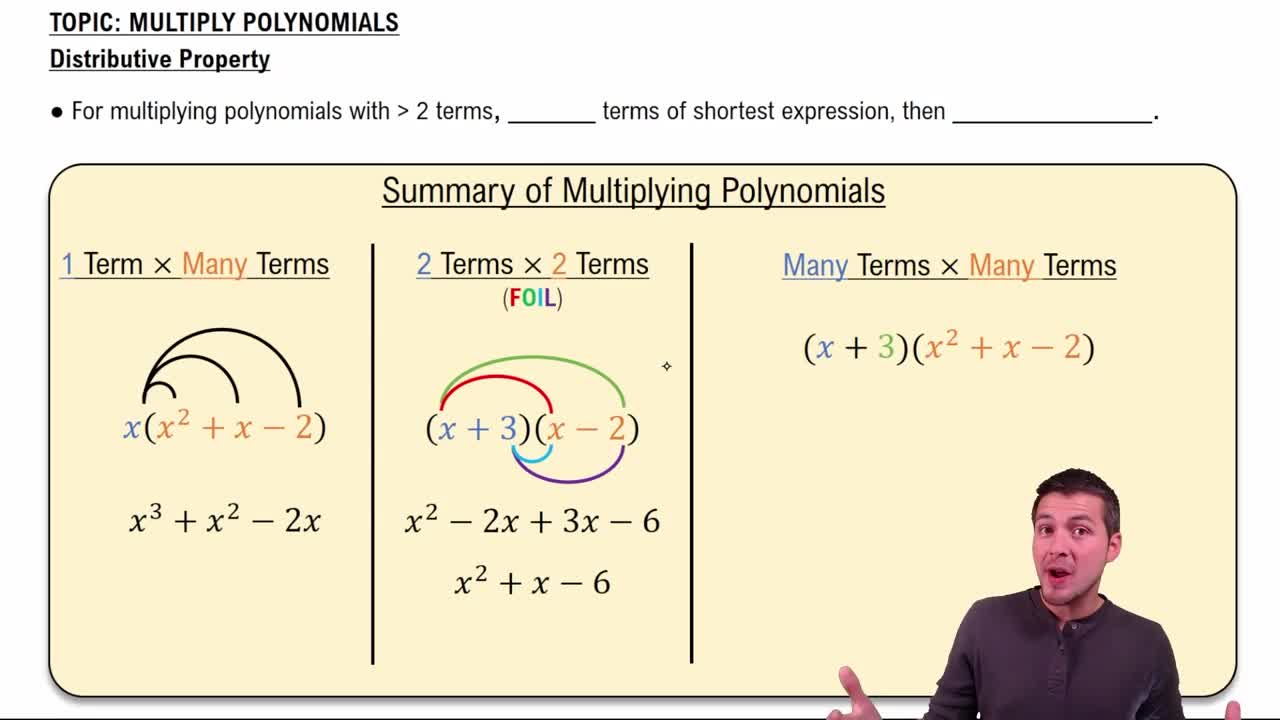
Distributive Property

The distributive property allows you to multiply a single term across terms inside parentheses, such as a(b + c) = ab + ac. This is essential for simplifying expressions before solving inequalities, ensuring all terms are combined correctly for easier manipulation.
Recommended video:
Guided course
04:15
Multiply Polynomials Using the Distributive Property

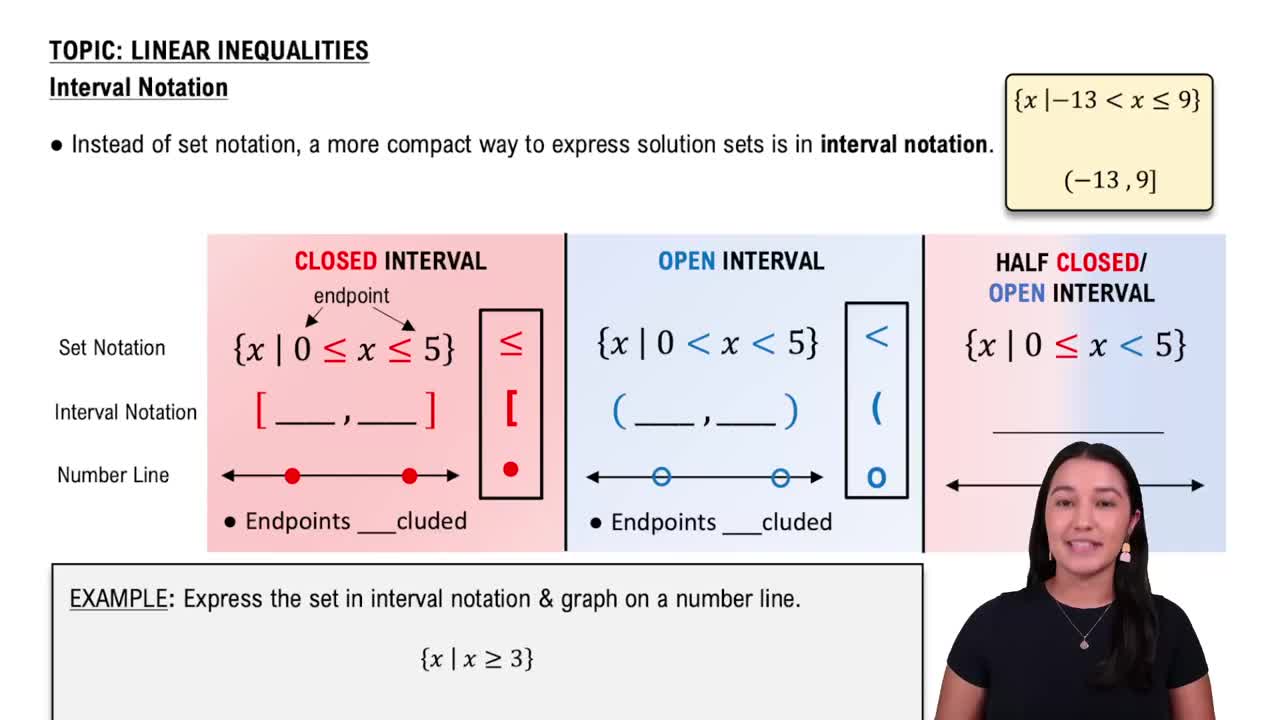
Interval Notation

Interval notation is a concise way to represent solution sets of inequalities using intervals. It uses parentheses for values not included (open intervals) and brackets for values included (closed intervals), clearly showing the range of solutions on the number line.
Recommended video:
05:18
Interval Notation