Ch. 3 - Polynomial and Rational Functions
Lial - College Algebra 13th Edition
Lial13th EditionCollege AlgebraISBN: 9780136881063Not the one you use?Change textbook
Chapter 4, Problem 84

Define the quadratic function ƒ having x-intercepts (1, 0) and (-2, 0) and y-intercept (0, 4).

Verified step by step guidance
1
Recall that a quadratic function with x-intercepts at points \((r_1, 0)\) and \((r_2, 0)\) can be expressed in factored form as: \[f(x) = a(x - r_1)(x - r_2)\] where \(a\) is a constant that affects the vertical stretch or compression of the parabola.
Substitute the given x-intercepts \(r_1 = 1\) and \(r_2 = -2\) into the factored form: \[f(x) = a(x - 1)(x + 2)\]
Use the y-intercept \((0, 4)\) to find the value of \(a\). Substitute \(x = 0\) and \(f(0) = 4\) into the equation: \[4 = a(0 - 1)(0 + 2)\]
Simplify the right side of the equation to solve for \(a\): \[4 = a(-1)(2) = -2a\] Then solve for \(a\) by dividing both sides by \(-2\): \[a = \frac{4}{-2}\]
Write the final quadratic function by substituting the value of \(a\) back into the factored form: \[f(x) = a(x - 1)(x + 2)\]

Verified video answer for a similar problem:

This video solution was recommended by our tutors as helpful for the problem above.
Video duration:
6m
Was this helpful?

Key Concepts

Here are the essential concepts you must grasp in order to answer the question correctly.

Quadratic Function Standard Form

A quadratic function is typically written as f(x) = ax^2 + bx + c, where a, b, and c are constants and a ≠ 0. This form helps identify the shape and position of the parabola on the coordinate plane.
Recommended video:
04:34
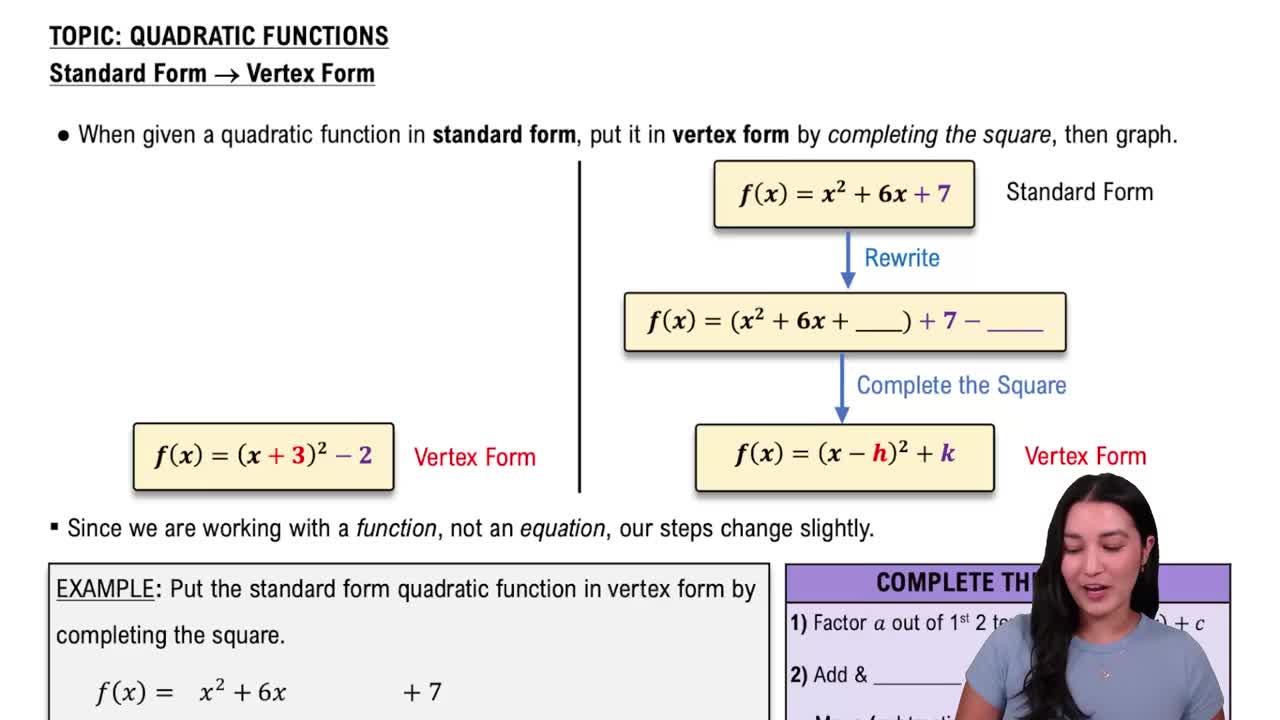
Converting Standard Form to Vertex Form

Using x-Intercepts to Find Factors

The x-intercepts of a quadratic function correspond to the roots of the equation f(x) = 0. If the roots are r1 and r2, the function can be expressed as f(x) = a(x - r1)(x - r2), which helps in constructing the quadratic from given zeros.
Recommended video:
Guided course
4:16
Factor Using the AC Method When a Is 1

Determining the Leading Coefficient Using the y-Intercept

The y-intercept is the value of f(x) when x = 0, which equals c in the standard form. By substituting x = 0 and the given y-intercept value into the factored form, we can solve for the leading coefficient a to fully define the quadratic function.
Recommended video:
Guided course
6:54
Cramer's Rule - 2 Equations with 2 Unknowns