Ch. 5 - Systems and Matrices
Lial - College Algebra 13th Edition
Lial13th EditionCollege AlgebraISBN: 9780136881063Not the one you use?Change textbook
Chapter 6, Problem 28

Graph each inequality. y ≤ log(x - 1) - 2

Verified step by step guidance
1
Identify the boundary curve by replacing the inequality with an equation: \(y = \log(x - 1) - 2\). This curve will help define the region for the inequality.
Determine the domain of the function \(y = \log(x - 1) - 2\). Since the logarithm is defined only for positive arguments, set \(x - 1 > 0\), which means \(x > 1\).
Plot the boundary curve \(y = \log(x - 1) - 2\) for values of \(x\) greater than 1. This curve will be the reference line for the inequality.
Since the inequality is \(y \leq \log(x - 1) - 2\), shade the region on the graph that lies below or on the boundary curve. This represents all points where \(y\) is less than or equal to the logarithmic expression.
Use a solid line to draw the boundary curve because the inequality includes equality (\(\leq\)), indicating points on the curve satisfy the inequality.

Verified video answer for a similar problem:

This video solution was recommended by our tutors as helpful for the problem above.
Video duration:
10m
Was this helpful?

Key Concepts

Here are the essential concepts you must grasp in order to answer the question correctly.

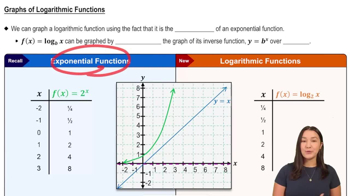
Logarithmic Functions

A logarithmic function is the inverse of an exponential function and is defined as y = log_b(x), where b is the base. It is only defined for positive arguments, meaning the input inside the log must be greater than zero. Understanding the shape and domain of logarithmic functions is essential for graphing inequalities involving logs.
Recommended video:
5:26
Graphs of Logarithmic Functions

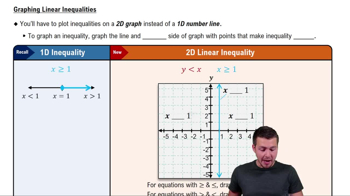
Inequalities and Their Graphs

Graphing inequalities involves shading the region of the coordinate plane that satisfies the inequality. For y ≤ f(x), the graph includes the curve y = f(x) and the area below it. Recognizing how to represent 'less than or equal to' on a graph is key to correctly illustrating the solution set.
Recommended video:
Guided course
7:02
Linear Inequalities

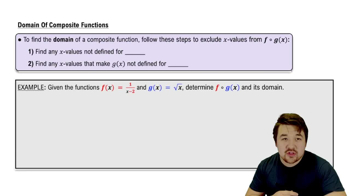
Domain Restrictions

The domain of the function y = log(x - 1) - 2 is restricted by the argument of the logarithm, which must be positive. This means x - 1 > 0, or x > 1. Identifying domain restrictions ensures the graph is only drawn where the function is defined, preventing errors in the solution.
Recommended video:
3:51
Domain Restrictions of Composed Functions