Start with the given equation: \(\frac{2x}{x-2} = 5 + \frac{4x^{2}}{x-2}\).
To eliminate the denominators, multiply every term on both sides of the equation by the common denominator \(x-2\) (noting that \(x \neq 2\) to avoid division by zero). This gives: \$2x = 5(x-2) + 4x^{2}$.
Distribute the 5 on the right side: \$2x = 5x - 10 + 4x^{2}$.
Rearrange all terms to one side to set the equation equal to zero: \$0 = 4x^{2} + 5x - 10 - 2x$.
Combine like terms to simplify the quadratic equation: \$0 = 4x^{2} + (5x - 2x) - 10\(, which simplifies to \)0 = 4x^{2} + 3x - 10$. From here, you can proceed to solve the quadratic equation using factoring, completing the square, or the quadratic formula.
Verified video answer for a similar problem:
This video solution was recommended by our tutors as helpful for the problem above
Video duration:
6m
Play a video:
0 Comments
Key Concepts
Here are the essential concepts you must grasp in order to answer the question correctly.
Rational Equations
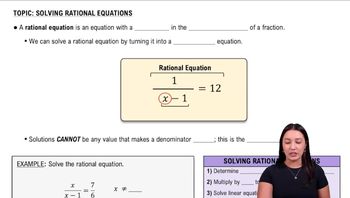
Rational equations involve expressions with variables in the denominator. Solving them requires finding a common denominator or eliminating denominators by multiplying both sides, while being careful to exclude values that make any denominator zero.
Domain restrictions are values that make the denominator zero, which are not allowed in the solution set. Identifying these values is crucial before solving to avoid extraneous solutions that do not satisfy the original equation.
After clearing denominators, the equation often reduces to a quadratic form. Solving quadratic equations involves factoring, completing the square, or using the quadratic formula to find the variable's values.

 6:09 minutes
 Verified step by step guidance
 05:56
05:56