error on line 1 at column 295: Unescaped '<' not allowed in attributes values
Below is a rendering of the page up to the first error.
Verified step by step guidance
1
Identify the function that needs to be graphed. If the function is not explicitly given, ensure that you have the correct expression or equation to work with.
Determine the domain of the function. This involves identifying all the possible input values (x-values) for which the function is defined.
Find the critical points of the function by taking its derivative and setting it equal to zero. Solve for x to find the points where the function's slope is zero, indicating potential maxima, minima, or points of inflection.
Evaluate the function at the critical points and endpoints of the domain to determine the corresponding y-values. This will help in understanding the behavior of the function at these key points.
Sketch the graph by plotting the critical points and any intercepts, and then draw the curve based on the behavior of the function as determined by its derivative and second derivative (if necessary). Consider asymptotic behavior and continuity to ensure an accurate representation.
Verified video answer for a similar problem:
This video solution was recommended by our tutors as helpful for the problem above
Video duration:
6m
Play a video:
0 Comments
Key Concepts
Here are the essential concepts you must grasp in order to answer the question correctly.
Function Graphing
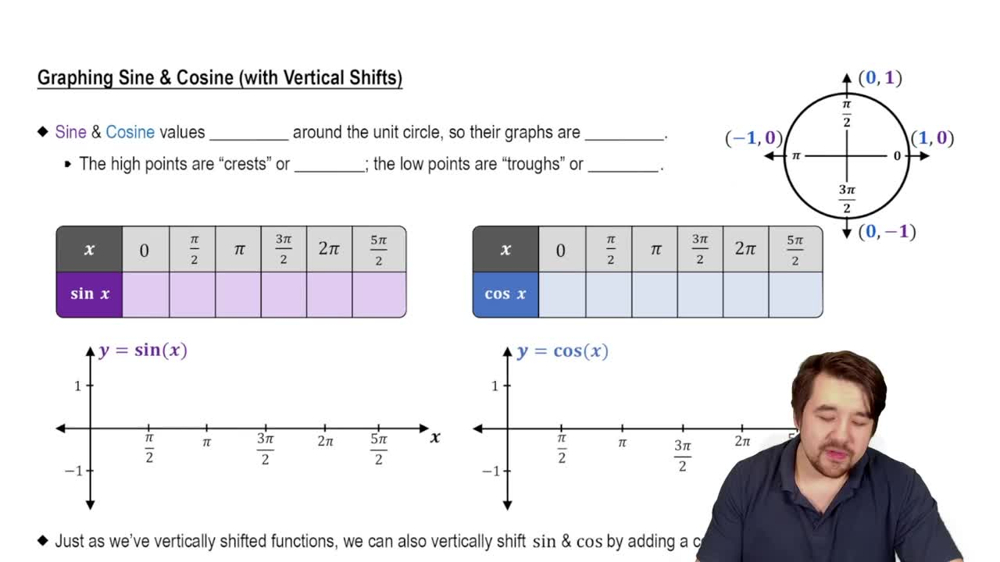
Graphing a function involves plotting points on a coordinate system that represent the relationship between the input (x-values) and output (y-values) of the function. Understanding how to interpret the function's equation and identify key features such as intercepts, slopes, and asymptotes is essential for accurate graphing.
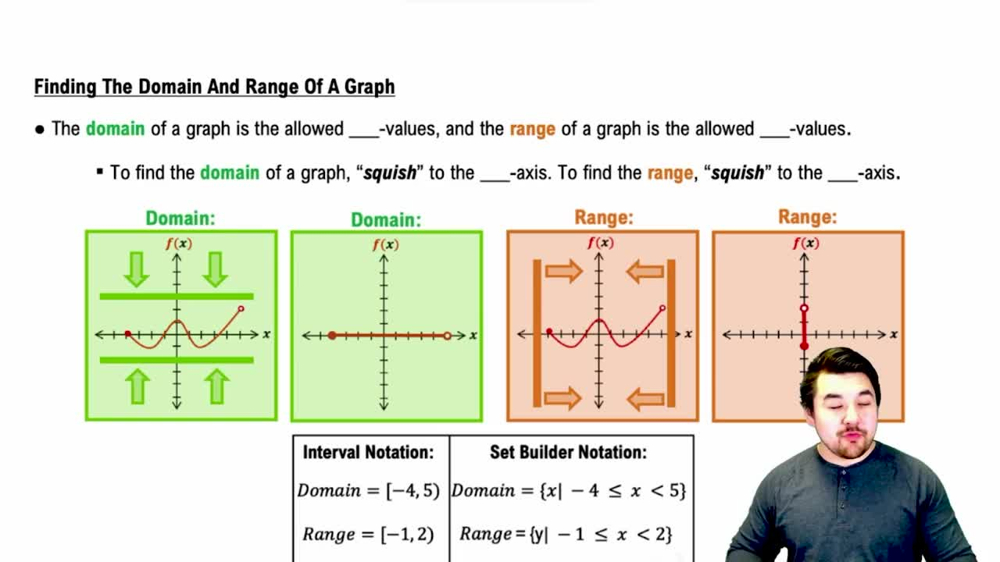
The domain of a function is the set of all possible input values (x-values) that the function can accept, while the range is the set of all possible output values (y-values). Identifying the domain and range helps in understanding the behavior of the function and ensures that the graph accurately represents the function's limitations.
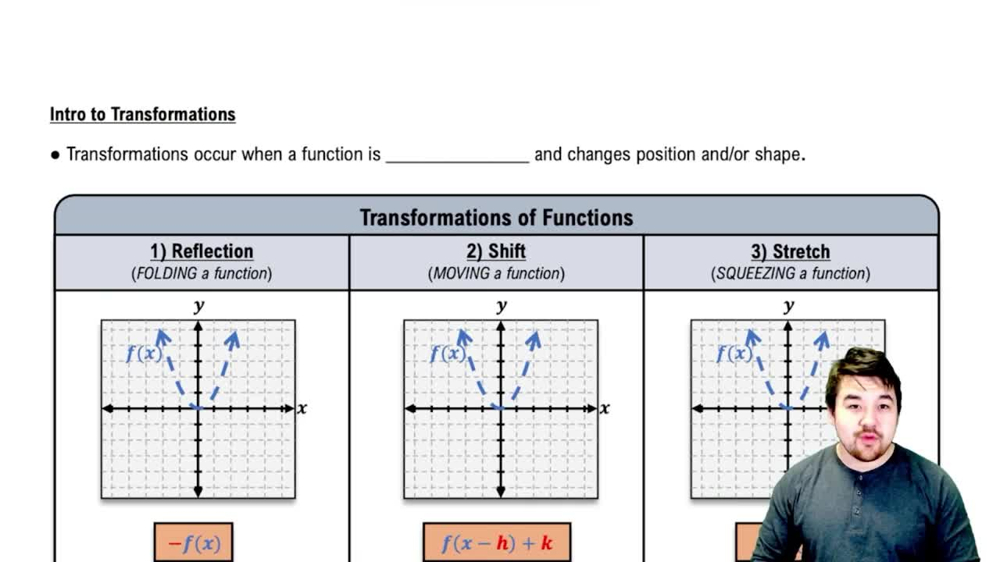
Transformations involve shifting, stretching, compressing, or reflecting the graph of a function. Common transformations include vertical and horizontal shifts, which affect the position of the graph, and vertical stretches or compressions, which alter the steepness. Mastery of these concepts allows for the manipulation of basic function graphs to create more complex representations.

 6:23 minutes
 Verified step by step guidance
 5:53
5:53