Step 1: Identify the type of limit. This is a one-sided limit as \( x \) approaches 4 from the right (denoted by \( x \to 4^+ \)).
Step 2: Substitute \( x = 4 \) into the expression \( \frac{x - 5}{(x - 4)^2} \) to check for any indeterminate forms. This results in \( \frac{4 - 5}{(4 - 4)^2} = \frac{-1}{0} \), indicating a division by zero, which suggests a vertical asymptote.
Step 3: Analyze the behavior of the numerator and denominator as \( x \to 4^+ \). The numerator \( x - 5 \) approaches \( -1 \) as \( x \to 4^+ \). The denominator \( (x - 4)^2 \) approaches 0 from the positive side because squaring a small positive number results in a small positive number.
Step 4: Determine the sign of the limit. As \( x \to 4^+ \), \( x - 5 \) is negative and \( (x - 4)^2 \) is positive, so the overall expression \( \frac{x - 5}{(x - 4)^2} \) approaches negative infinity.
Step 5: Conclude that the limit is \(-\infty\) as \( x \to 4^+ \). This indicates that the function has a vertical asymptote at \( x = 4 \) and the function decreases without bound as \( x \) approaches 4 from the right.
Verified video answer for a similar problem:
This video solution was recommended by our tutors as helpful for the problem above
Video duration:
1m
Play a video:
0 Comments
Key Concepts
Here are the essential concepts you must grasp in order to answer the question correctly.
Limits
A limit is a fundamental concept in calculus that describes the behavior of a function as its input approaches a certain value. It helps in understanding how functions behave near points of interest, including points of discontinuity or infinity. In this case, we are interested in the limit as x approaches 4 from the right (denoted as x→4^+).
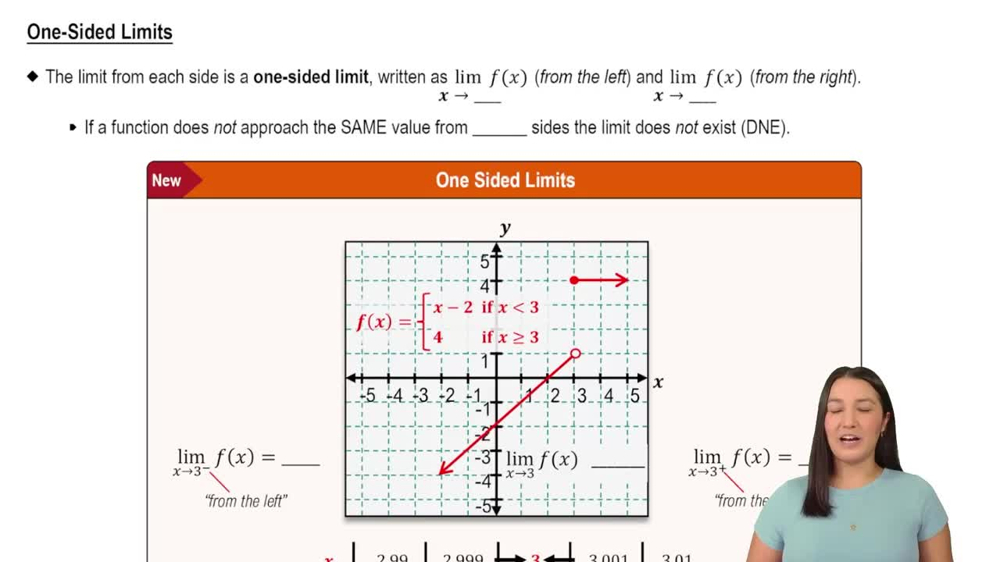
One-sided limits refer to the value that a function approaches as the input approaches a specific point from one side only. The notation x→4^+ indicates that we are considering values of x that are greater than 4. This is crucial for analyzing functions that may behave differently when approaching a point from the left versus the right.
Indeterminate forms occur in limit problems when direct substitution leads to expressions like 0/0 or ∞/∞, which do not provide clear information about the limit's value. In this question, substituting x=4 into the expression results in an indeterminate form, necessitating further analysis, such as factoring or applying L'Hôpital's Rule to resolve the limit.

 1:52 minutes
 Verified step by step guidance
 05:50
05:50