Step 1: Understand the nature of the absolute value function. The expression |x - 1| represents the distance of x from 1 on the number line. It is defined as |x - 1| = x - 1 if x >= 1 and |x - 1| = -(x - 1) if x < 1.
Step 2: Consider the limit from the right (x approaches 1 from values greater than 1). In this case, |x - 1| = x - 1, so the expression becomes x / (x - 1).
Step 3: Evaluate the limit from the right. As x approaches 1 from the right, the denominator (x - 1) approaches 0, causing the expression x / (x - 1) to approach infinity. Therefore, the right-hand limit is positive infinity.
Step 4: Consider the limit from the left (x approaches 1 from values less than 1). In this case, |x - 1| = -(x - 1), so the expression becomes x / (-(x - 1)) = -x / (x - 1).
Step 5: Evaluate the limit from the left. As x approaches 1 from the left, the denominator (x - 1) approaches 0, causing the expression -x / (x - 1) to approach negative infinity. Therefore, the left-hand limit is negative infinity.
Verified video answer for a similar problem:
This video solution was recommended by our tutors as helpful for the problem above
Video duration:
2m
Play a video:
0 Comments
Key Concepts
Here are the essential concepts you must grasp in order to answer the question correctly.
Limits
A limit is a fundamental concept in calculus that describes the behavior of a function as its input approaches a certain value. It helps in understanding how functions behave near points of interest, including points of discontinuity or infinity. Evaluating limits is essential for defining derivatives and integrals, which are core components of calculus.
The absolute value function, denoted as |x|, measures the distance of a number from zero on the number line, always yielding a non-negative result. In the context of limits, the absolute value can affect the behavior of a function as it approaches a point, particularly when the function crosses zero, leading to different left-hand and right-hand limits.
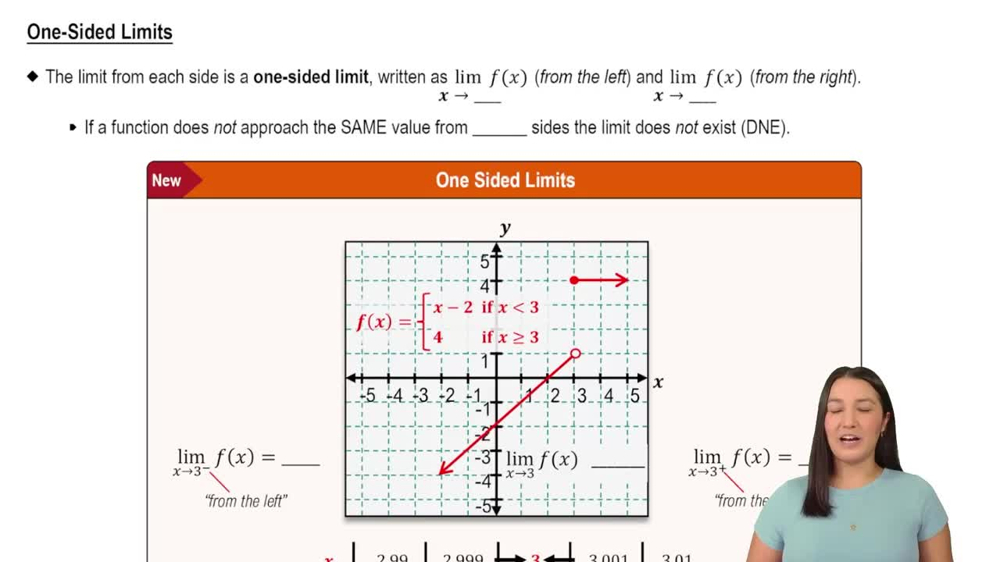
One-sided limits refer to the value that a function approaches as the input approaches a specific point from one side only, either the left (denoted as lim x→c-) or the right (denoted as lim x→c+). In the given limit problem, evaluating one-sided limits is crucial because the absolute value function creates a piecewise scenario that can lead to different outcomes depending on the direction of approach.

 2:26 minutes
 Verified step by step guidance
 05:50
05:50