Solving trigonometric equations Solve the following equations.
tan x = 1
Verified step by step guidance
1
Recognize that \( \tan x = 1 \) is a trigonometric equation where we need to find the values of \( x \) that satisfy this equation.
Recall that the tangent function, \( \tan x \), is equal to 1 at specific angles. The most common angle is \( \frac{\pi}{4} \) (or 45 degrees) in the first quadrant.
Understand that the tangent function has a period of \( \pi \), meaning it repeats every \( \pi \) radians. Therefore, the general solution for \( \tan x = 1 \) is \( x = \frac{\pi}{4} + n\pi \), where \( n \) is any integer.
Consider the domain of the problem if specified. If no domain is given, the general solution is sufficient. If a domain is specified, find the specific values of \( x \) within that domain.
Verify the solution by substituting back into the original equation to ensure that \( \tan x = 1 \) holds true for the values of \( x \) found.
Verified video answer for a similar problem:
This video solution was recommended by our tutors as helpful for the problem above
Video duration:
2m
Play a video:
0 Comments
Key Concepts
Here are the essential concepts you must grasp in order to answer the question correctly.
Trigonometric Functions
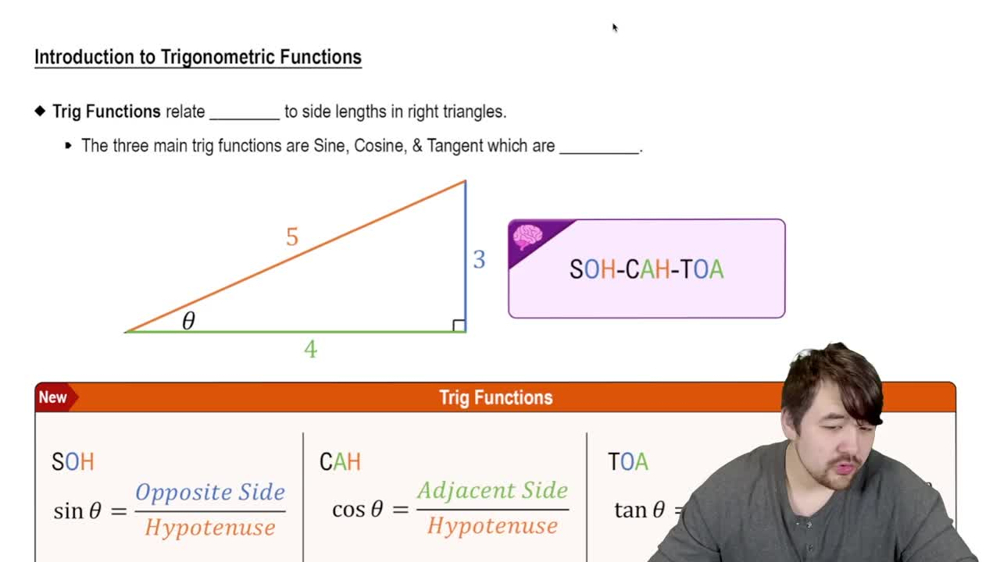
Trigonometric functions, such as sine, cosine, and tangent, relate angles to ratios of sides in right triangles. The tangent function, specifically, is defined as the ratio of the opposite side to the adjacent side. Understanding these functions is crucial for solving equations involving angles, as they provide the foundational relationships needed to manipulate and solve trigonometric equations.
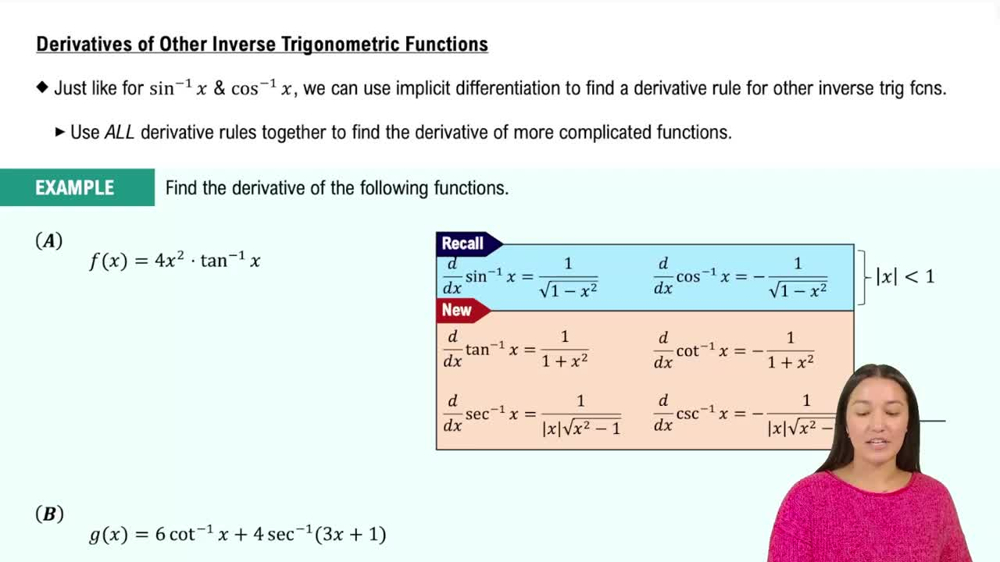
Inverse trigonometric functions, such as arctan, are used to find angles when given a ratio. For example, if tan x = 1, we can use the inverse tangent function to determine the angle x. These functions are essential for solving trigonometric equations, as they allow us to reverse the process of finding the ratio and instead find the angle that corresponds to that ratio.
Derivatives of Other Inverse Trigonometric Functions
Periodic Nature of Trigonometric Functions
Trigonometric functions are periodic, meaning they repeat their values in regular intervals. For instance, the tangent function has a period of π, which means that if tan x = 1, then x can be expressed as x = π/4 + nπ, where n is any integer. Recognizing the periodicity of these functions is vital for finding all possible solutions to trigonometric equations, as it allows us to identify multiple angles that satisfy the equation.

 2:56 minutes
 Verified step by step guidance
 6:04
6:04