Solving trigonometric equations Solve the following equations.
sin²Θ = 1/4 , 0 ≤ Θ < 2π
Verified step by step guidance
1
Step 1: Start by taking the square root of both sides of the equation. This gives you two possible equations: \( \sin \Theta = \frac{1}{2} \) and \( \sin \Theta = -\frac{1}{2} \).
Step 2: Consider the equation \( \sin \Theta = \frac{1}{2} \). Find the angles \( \Theta \) in the interval \( [0, 2\pi) \) where the sine function equals \( \frac{1}{2} \).
Step 3: Recall that \( \sin \Theta = \frac{1}{2} \) at \( \Theta = \frac{\pi}{6} \) and \( \Theta = \frac{5\pi}{6} \).
Step 4: Now consider the equation \( \sin \Theta = -\frac{1}{2} \). Find the angles \( \Theta \) in the interval \( [0, 2\pi) \) where the sine function equals \(-\frac{1}{2} \).
Step 5: Recall that \( \sin \Theta = -\frac{1}{2} \) at \( \Theta = \frac{7\pi}{6} \) and \( \Theta = \frac{11\pi}{6} \).
Verified video answer for a similar problem:
This video solution was recommended by our tutors as helpful for the problem above
Video duration:
5m
Play a video:
0 Comments
Key Concepts
Here are the essential concepts you must grasp in order to answer the question correctly.
Trigonometric Functions
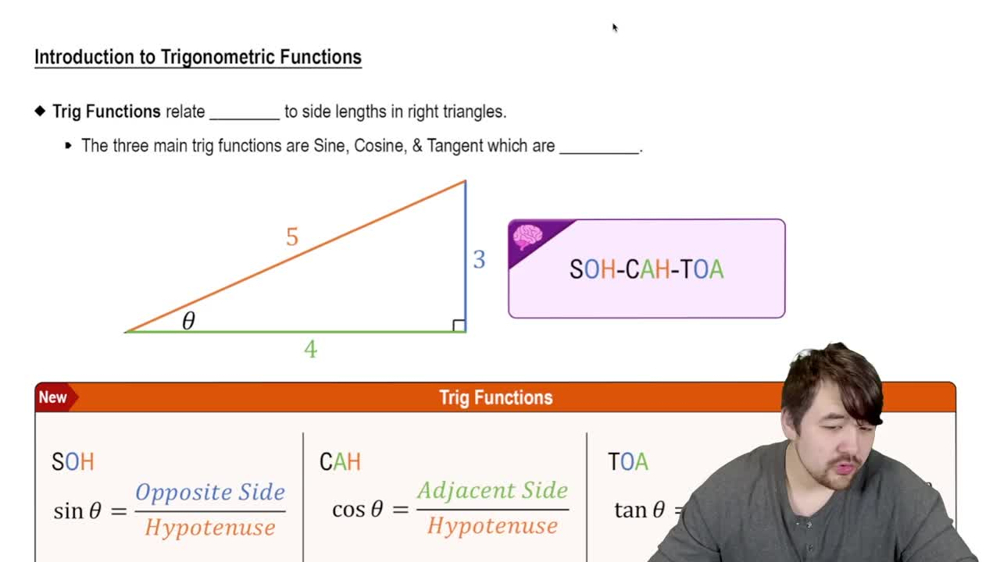
Trigonometric functions, such as sine, cosine, and tangent, relate angles to the ratios of sides in right triangles. The sine function, specifically, gives the ratio of the length of the opposite side to the hypotenuse. Understanding these functions is crucial for solving equations involving angles, as they provide the foundational relationships needed to manipulate and solve for unknowns.
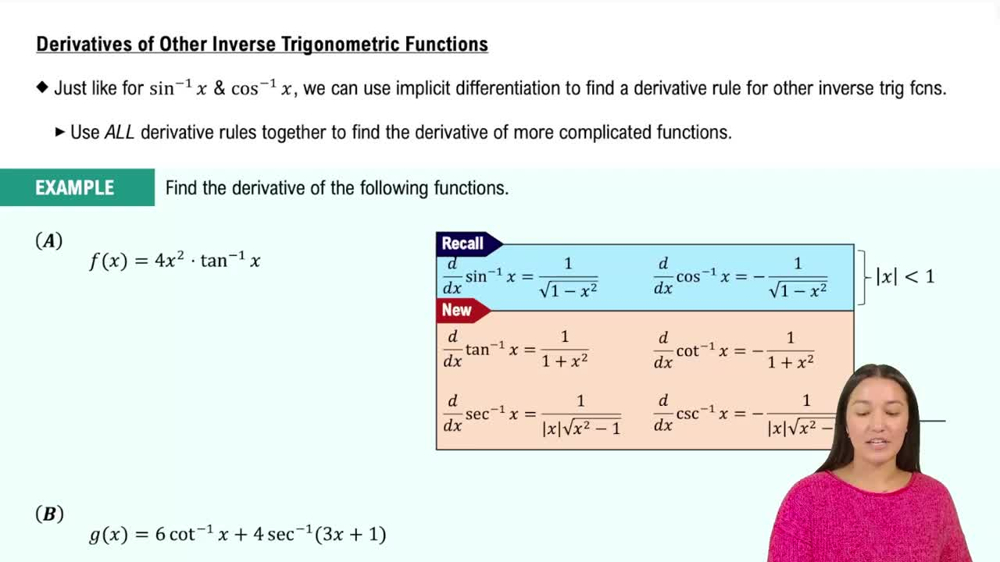
Inverse trigonometric functions, such as arcsin, arccos, and arctan, are used to find angles when the values of the trigonometric functions are known. For example, if sin(Θ) = 1/2, then Θ can be found using arcsin(1/2). These functions are essential for solving trigonometric equations, as they allow us to determine the angle corresponding to a given sine, cosine, or tangent value.
Derivatives of Other Inverse Trigonometric Functions
Periodic Nature of Trigonometric Functions
Trigonometric functions are periodic, meaning they repeat their values in regular intervals. For sine and cosine, the period is 2π, which means that the function values will repeat every 2π radians. This property is important when solving equations, as it allows for multiple solutions within a specified interval, such as 0 ≤ Θ < 2π, and helps identify all possible angles that satisfy the equation.