Find the horizontal asymptotes of each function using limits at infinity. f(x) = (2ex + 3) / (ex + 1)
Verified step by step guidance
1
Identify the dominant terms in the numerator and the denominator as x approaches infinity. In this case, both the numerator and the denominator have the dominant term e^x.
Divide every term in the numerator and the denominator by the dominant term e^x to simplify the expression.
The expression becomes (2 + 3/e^x) / (1 + 1/e^x).
Evaluate the limit of the simplified expression as x approaches infinity. As x approaches infinity, the terms 3/e^x and 1/e^x approach 0.
The limit of the expression as x approaches infinity is 2/1, which suggests that the horizontal asymptote is y = 2.
Verified video answer for a similar problem:
This video solution was recommended by our tutors as helpful for the problem above
Video duration:
3m
Play a video:
0 Comments
Key Concepts
Here are the essential concepts you must grasp in order to answer the question correctly.
Horizontal Asymptotes
Horizontal asymptotes describe the behavior of a function as the input approaches infinity or negative infinity. They indicate the value that the function approaches but does not necessarily reach. To find horizontal asymptotes, we analyze the limits of the function as x approaches infinity or negative infinity.
Limits at infinity involve evaluating the behavior of a function as the variable approaches infinity or negative infinity. This concept is crucial for determining horizontal asymptotes, as it helps identify the value that the function stabilizes at for large magnitudes of x. Techniques such as dividing by the highest power of x in the denominator are often used in this analysis.
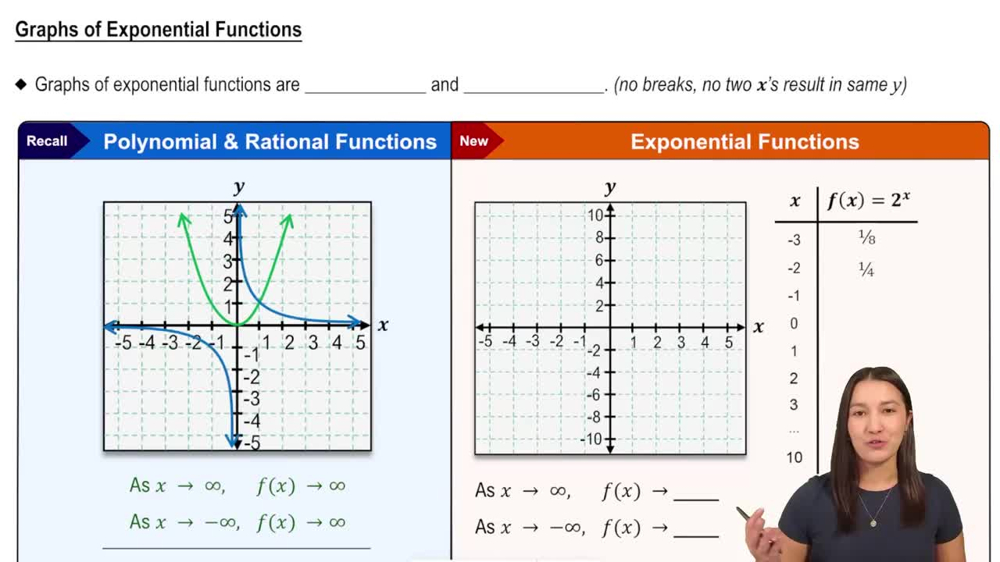
Exponential functions, such as e^x, grow rapidly as x increases. Understanding their growth rates is essential when analyzing limits at infinity, especially in rational functions where exponential terms can dominate. In the given function, recognizing how e^x behaves compared to constant terms is key to determining the horizontal asymptote.

 3:26 minutes
 Verified step by step guidance
 5:46
5:46