Substitute \( x = \frac{\pi}{2} \) into the expression to check for indeterminate form: \( \sin\left(\frac{\pi}{2}\right) = 1 \), leading to \( \frac{0}{0} \).
Apply L'Hôpital's Rule, which is used for limits of the form \( \frac{0}{0} \) or \( \frac{\infty}{\infty} \), by differentiating the numerator and the denominator separately.
Differentiate the numerator: \( \frac{d}{dx}[\sin(x) - 1] = \cos(x) \).
This video solution was recommended by our tutors as helpful for the problem above
Video duration:
3m
Play a video:
0 Comments
Key Concepts
Here are the essential concepts you must grasp in order to answer the question correctly.
Limits
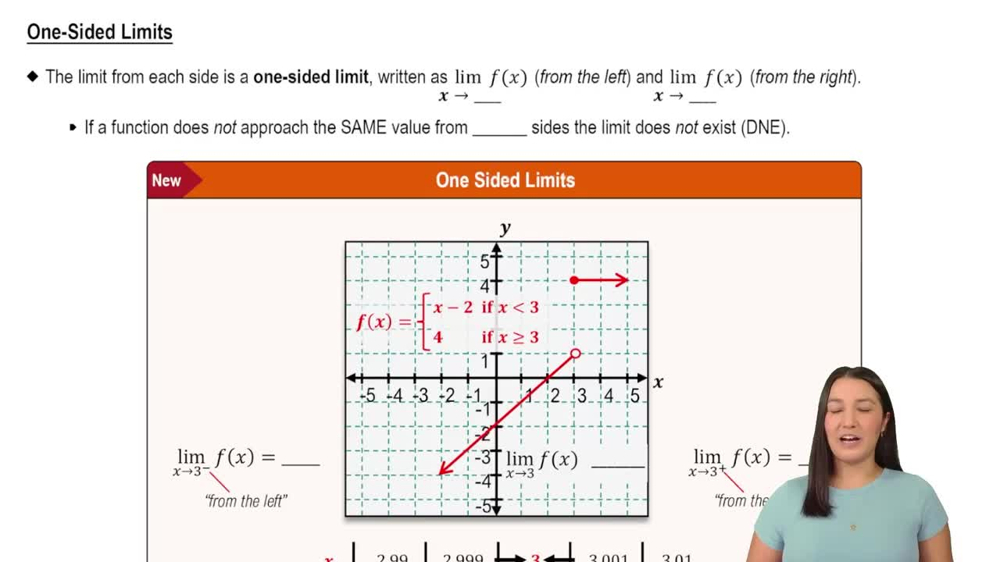
Limits are fundamental in calculus, representing the value that a function approaches as the input approaches a certain point. In this question, we are evaluating the limit of a function as x approaches π/2, which is crucial for understanding the behavior of the function near that point.
L'Hôpital's Rule is a method used to evaluate limits that result in indeterminate forms, such as 0/0 or ∞/∞. When faced with such forms, we can differentiate the numerator and denominator separately and then take the limit again, which can simplify the evaluation process.
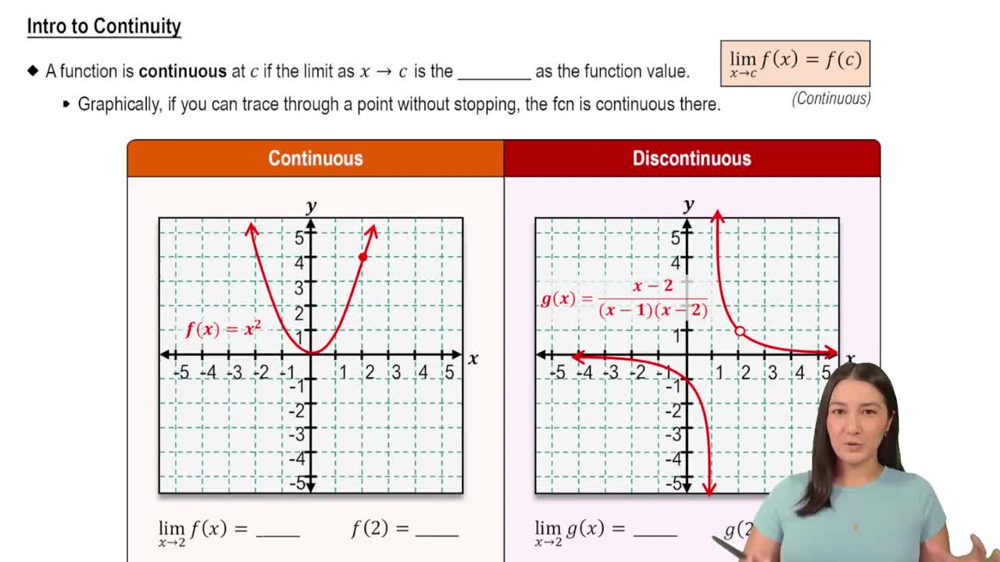
Continuity refers to a function being unbroken and having no gaps at a point, while discontinuity indicates a break or jump in the function's value. Understanding whether the function is continuous at x = π/2 helps determine if the limit can be directly evaluated or if further analysis is needed.

 3:03 minutes
 Verified step by step guidance
 05:50
05:50