Use analytical methods and/or a graphing utility to identify the vertical asymptotes (if any) of the following functions. f(x)=x^2−3x+2 / x^10−x^9
Verified step by step guidance
1
Step 1: Identify the function's denominator, which is \( x^{10} - x^9 \). Set the denominator equal to zero to find the values of \( x \) that make the function undefined: \( x^{10} - x^9 = 0 \).
Step 2: Factor the denominator. Notice that \( x^{10} - x^9 \) can be factored as \( x^9(x - 1) = 0 \).
Step 3: Solve the factored equation \( x^9(x - 1) = 0 \) to find the critical points. This gives \( x^9 = 0 \) and \( x - 1 = 0 \).
Step 4: Solve \( x^9 = 0 \) to find \( x = 0 \). Solve \( x - 1 = 0 \) to find \( x = 1 \). These are the potential vertical asymptotes.
Step 5: Verify if these points are indeed vertical asymptotes by checking the behavior of the function as \( x \) approaches these values. Since the numerator \( x^2 - 3x + 2 \) does not have \( x = 0 \) or \( x = 1 \) as roots, both \( x = 0 \) and \( x = 1 \) are vertical asymptotes.
Verified video answer for a similar problem:
This video solution was recommended by our tutors as helpful for the problem above
Video duration:
3m
Play a video:
0 Comments
Key Concepts
Here are the essential concepts you must grasp in order to answer the question correctly.
Vertical Asymptotes
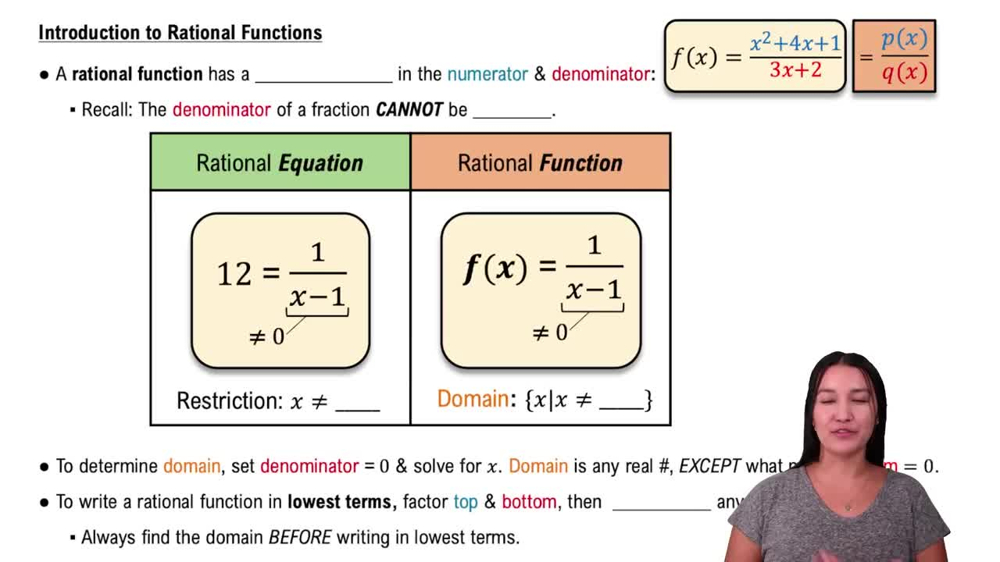
Vertical asymptotes occur in a function when the output approaches infinity as the input approaches a certain value. This typically happens at values of x that make the denominator of a rational function equal to zero, provided that the numerator does not also equal zero at those points. Identifying these points is crucial for understanding the behavior of the function near those values.
A rational function is a function that can be expressed as the ratio of two polynomials. In the given function f(x) = (x^2 - 3x + 2) / (x^10 - x^9), the numerator and denominator are both polynomials. Analyzing rational functions involves understanding how the degrees of the polynomials affect the function's behavior, particularly in terms of asymptotes and intercepts.
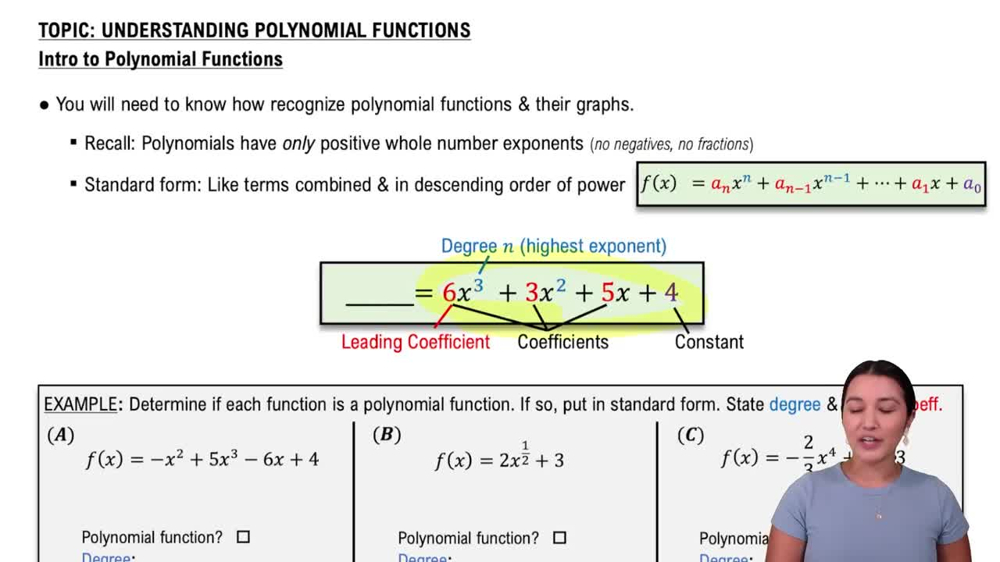
Factoring polynomials is the process of breaking down a polynomial into simpler components, or factors, that can be multiplied together to yield the original polynomial. This is essential for identifying the roots of the numerator and denominator in rational functions, which helps in determining vertical asymptotes and simplifying the function for analysis.