
Ch. 44 - Animal Sensory Systems
Freeman - Biological Science 8th Edition
Freeman8th EditionBiological ScienceISBN: 9780138276263Not the one you use?Change textbook
Chapter 44, Problem 6

Give three examples of how the sensory abilities of an animal correlate with its habitat or method of finding food and mates.

Verified step by step guidance
1
Step 1: Identify the sensory abilities of animals. These can include sight, hearing, smell, taste, touch, and other specialized senses such as echolocation in bats or electric field detection in sharks.
Step 2: Consider how these sensory abilities might be adapted to an animal's habitat. For example, animals living in dark environments (like deep sea creatures or cave dwellers) may have highly developed senses of touch or smell to compensate for lack of light.
Step 3: Think about how these sensory abilities might aid in finding food. For instance, vultures have excellent eyesight that allows them to spot carrion from high in the sky, while sharks can detect the electrical signals of their prey's heartbeat.
Step 4: Reflect on how these sensory abilities might assist in finding mates. Many birds, for example, have keen hearing to detect the songs of potential mates. Similarly, male moths can smell the pheromones released by a female moth from miles away.
Step 5: Provide specific examples. For instance, (1) Bats use echolocation, a type of sonar, to navigate and find insects in the dark. (2) Sharks have a specialized organ called the ampullae of Lorenzini that allows them to detect electric fields produced by other animals, helping them locate prey in murky waters. (3) Male moths have highly sensitive antennae that can detect the pheromones of a female moth, aiding in mate location.

Verified video answer for a similar problem:

This video solution was recommended by our tutors as helpful for the problem above.
Video duration:
2m
Was this helpful?

Key Concepts

Here are the essential concepts you must grasp in order to answer the question correctly.

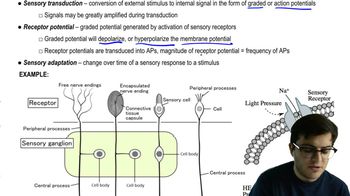
Sensory Adaptation

Sensory adaptation refers to the process by which animals develop specialized sensory abilities that enhance their survival in specific environments. For instance, nocturnal animals often have heightened vision and hearing to navigate and hunt in low-light conditions, while aquatic animals may possess enhanced olfactory senses to detect food in murky waters.
Recommended video:
Guided course
06:25
Sensory Systems

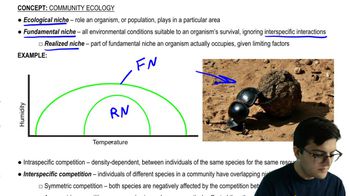
Ecological Niche

An ecological niche describes the role and position a species has in its environment, including its habitat, resource use, and interactions with other organisms. The sensory abilities of an animal are often tailored to its niche; for example, birds that feed on nectar have excellent color vision to locate flowers, while predators may have acute hearing to detect prey movements.
Recommended video:
Guided course
02:48
Ecological Niches and Competition

Mating Strategies

Mating strategies are behaviors and adaptations that animals use to attract mates and reproduce. Sensory abilities play a crucial role in these strategies; for example, male peacocks display vibrant plumage to attract females, while certain frogs use vocal calls to signal their presence, demonstrating how sensory traits are linked to reproductive success in specific habitats.
Recommended video:
04:09
Non-Random Mating
Related Practice
Textbook Question

Which of these statements about taste is true?

a. Sweetness is a measure of the concentration of hydrogen ions in food.

b. Sodium ions from foods can directly depolarize certain taste cells.

c. All bitter-tasting compounds have a similar chemical structure.

d. Sourness is detected when hydrogen ions bind to membrane receptors.

751
views
Textbook Question

What type of sensory system do migrating birds use to detect direction?

791
views
Textbook Question

Considering that sounds and odors both trigger changes in the patterns of action potentials in sensory neurons, how does the brain perceive which sense is which when the action potentials reach the brain?

a. The action potentials stimulated by sounds are different in size and shape from those stimulated by odors.

b. The axons from different sensory neurons go to different areas of the brain.

c. Mechanoreception is not consciously perceived by the brain, whereas chemoreception is.

d. Chemoreception is not consciously perceived by the brain, whereas mechanoreception is.

849
views
Textbook Question

Compare and contrast the lateral line system of fishes with electroreception in sharks.

1068
views
Textbook Question

Scientists generally think that a 'good hypothesis' is one that is reasonable and testable and inspires further research into a phenomenon. Using these criteria, explain whether Dalton's hypothesis about color vision was a good hypothesis. Was it correct?

789
views
Textbook Question

Scientists collected data on the date of onset of the menstrual cycles in a group of women who moved into a college dormitory together in the fall. The y-axis of the graph shows the mean difference (in days) between the onset of a woman's cycle and the average onset date of the rest of the women. Evaluate whether these data provide evidence for the existence of a human pheromone.

590
views