Ch.3 - Protein Structure and Function
Freeman - Biological Science 8th Edition
Freeman8th EditionBiological ScienceISBN: 9780138276263Not the one you use?Change textbook
Chapter 3, Problem 6

Explain how molecular chaperones facilitate protein folding in many different polypeptides, each with their own specific shape.

Verified step by step guidance
1
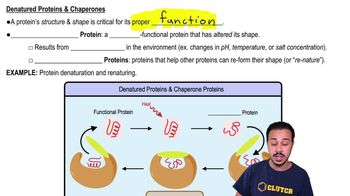
Molecular chaperones are specialized proteins that assist in the proper folding of other proteins without being part of the final structure. They prevent misfolding and aggregation that can lead to cell malfunction or disease.
Chaperones bind to nascent or partially folded polypeptides to stabilize them. This binding shields hydrophobic regions of the polypeptide that might otherwise clump together improperly.
The chaperones provide a secluded environment where the polypeptide can fold into its native structure without interference from other cellular components. This is crucial because the crowded environment of the cell can lead to incorrect protein interactions.
ATP provides the energy for the chaperones' function. The hydrolysis of ATP to ADP causes a conformational change in the chaperone protein, which can increase the efficiency of the folding process.
Once the protein is properly folded, the chaperone releases it. The protein can then go on to perform its specific function in the cell. This release is also ATP-dependent, ensuring that the process is tightly regulated.

Verified video answer for a similar problem:

This video solution was recommended by our tutors as helpful for the problem above.
Video duration:
1m
Was this helpful?

Key Concepts

Here are the essential concepts you must grasp in order to answer the question correctly.

Molecular Chaperones

Molecular chaperones are specialized proteins that assist in the proper folding of other proteins. They prevent misfolding and aggregation by binding to nascent polypeptides and stabilizing them during the folding process. Chaperones do not dictate the final structure but create an environment conducive to correct folding.
Recommended video:
Guided course
04:00
Denatured Proteins & Chaperones

Protein Folding

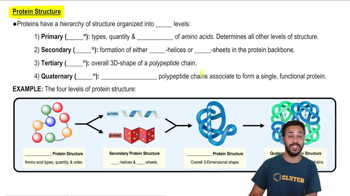
Protein folding is the process by which a polypeptide chain acquires its functional three-dimensional structure. This process is driven by the sequence of amino acids and involves various interactions, such as hydrogen bonds, hydrophobic interactions, and van der Waals forces. Proper folding is crucial for protein functionality, as misfolded proteins can lead to diseases.
Recommended video:
Guided course
08:02
Protein Structure

Polypeptide Specificity

Each polypeptide has a unique sequence of amino acids that determines its specific shape and function. The diversity in polypeptide sequences leads to a wide variety of protein structures, which are essential for different biological roles. Molecular chaperones recognize and assist in the folding of these diverse polypeptides, ensuring that each achieves its correct conformation.
Recommended video:
Guided course
10:55
Receptor Specificity
Related Practice
Textbook Question

What type of information is used to direct different polypeptides to fold into different shapes?

1670
views
Textbook Question

Which of the following correctly describe an active site? Select True or False for each statement.

T/F It is the location in an enzyme where substrates bind.

T/F It is the place where a molecule or ion binds to an inactive enzyme to induce a shape change to make it active.

T/F It is the portion of an enzyme where chaperones bind to help enzymes fold.

T/F It is the site on an enzyme where catalysis occurs.

1840
views
Textbook Question

If a cell were to use only 10 of the 20 possible amino acids, how much effect would you expect this to have on protein diversity? Calculate and compare the number of different sequences that can be generated by randomly assembling either 10 or 20 amino acids into peptides that are five residues long.

1627
views
Textbook Question

Why are proteins not considered to be a good candidate for the first living molecule?

a. Their catalytic capability is not sufficient for most biological reactions.

b. Their amino acid monomers were not likely present in the prebiotic soup.

c. They cannot serve as a template for replication.

d. They could not have polymerized from amino acid monomers under early Earth conditions.

2038
views
Textbook Question

Predict the effect on protein function if each polypeptide adopted only a single, inflexible shape based on its primary structure.

1633
views
Textbook Question

Based on what you know of the peptide bonds that link together amino acid residues, why would proline's side chain reduce the flexibility of the backbone?

1983
views