Ch. 28 - Green Algae and Land Plants
Freeman - Biological Science 8th Edition
Freeman8th EditionBiological ScienceISBN: 9780138276263Not the one you use?Change textbook
Chapter 28, Problem 1

What important role does lignin play in vascular plants?
a. It is the major component of the cuticle, which prevents plants from drying out.
b. It forms the outer layer of pollen grains.
c. It forms the tough, rigid cell walls of water-conducting cells.
d. It nourishes the embryo in seed plants.

Verified step by step guidance
1
Understand the structure and function of lignin: Lignin is a complex organic polymer found in the cell walls of many plants, particularly in wood and bark. It is known for providing rigidity and does not dissolve in water.
Identify the role of lignin in vascular plants: Lignin is crucial for the structural integrity of plants, especially in the xylem, which is responsible for water transport.
Analyze the options given: a) Cuticle component, b) Pollen grain layer, c) Cell wall component, d) Embryo nourishment.
Relate lignin's properties to the options: Lignin's rigidity and water resistance are essential for the tough cell walls of water-conducting cells, which aligns with option c.
Conclude that lignin's primary role in vascular plants is to form the tough, rigid cell walls of water-conducting cells, supporting the plant's structure and aiding in water transport.

Verified video answer for a similar problem:

This video solution was recommended by our tutors as helpful for the problem above.
Video duration:
1m
Was this helpful?

Key Concepts

Here are the essential concepts you must grasp in order to answer the question correctly.

Lignin

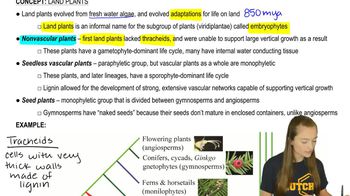
Lignin is a complex organic polymer found in the cell walls of vascular plants, particularly in wood and bark. It provides structural support and rigidity, allowing plants to grow upright and transport water efficiently. Lignin is crucial for the formation of tough, rigid cell walls in water-conducting cells, such as xylem, enhancing their ability to withstand pressure and prevent collapse.
Recommended video:

Vascular Plants

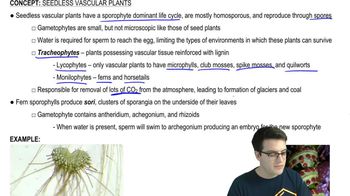
Vascular plants are a large group of plants that have specialized tissues for transporting water, nutrients, and food. These tissues include xylem and phloem, which facilitate efficient movement throughout the plant. The presence of lignin in the xylem strengthens these tissues, enabling vascular plants to grow taller and thrive in various environments by effectively distributing resources.
Recommended video:
Guided course
06:08
Seedless Vascular Plants

Xylem

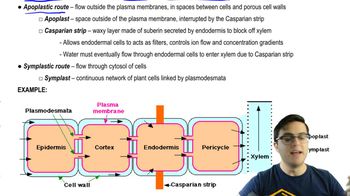
Xylem is a type of vascular tissue in plants responsible for the transport of water and dissolved minerals from the roots to the rest of the plant. It consists of hollow, tube-like structures that are reinforced with lignin, providing the necessary strength to support the plant and resist the pressure of water transport. This lignification is essential for maintaining the integrity and functionality of the xylem.
Recommended video:
Guided course
07:59
How Water Enters Xylem