Ch. 54 - Community Ecology
Campbell - Campbell Biology 11th Edition
Urry11th EditionCampbell BiologyISBN: 9789357423311Not the one you use?Change textbook
Chapter 54, Problem 1

The feeding relationships among the species in a community determine the community's
a. Secondary succession
b. Ecological niche
c. Species richness
d. Trophic structure

Verified step by step guidance
1
Understand the concept of 'feeding relationships' in a community. This refers to how energy and nutrients are transferred from one organism to another through food chains and food webs.
Recognize that 'secondary succession' (option a) involves the process of ecological recovery and development in an area where a disturbance has occurred, but it is not directly related to feeding relationships.
Consider 'ecological niche' (option b), which describes the role and position a species has in its environment, including its interactions with other species, but it is broader than just feeding relationships.
Evaluate 'species richness' (option c), which refers to the number of different species present in a community. While it can be influenced by feeding relationships, it is not a direct description of them.
Identify 'trophic structure' (option d) as the correct answer. Trophic structure specifically describes the feeding relationships and energy flow in a community, organized into different levels such as producers, consumers, and decomposers.

Verified video answer for a similar problem:

This video solution was recommended by our tutors as helpful for the problem above.
Video duration:
1m
Was this helpful?

Key Concepts

Here are the essential concepts you must grasp in order to answer the question correctly.

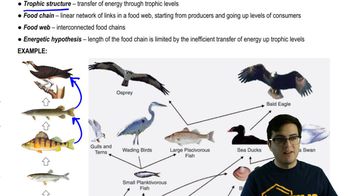
Trophic Structure

Trophic structure refers to the organization of a community based on feeding relationships. It includes different levels such as producers, consumers, and decomposers, which form a food chain or food web. Understanding trophic structure is essential for analyzing how energy and nutrients flow through an ecosystem, influencing the community's dynamics and stability.
Recommended video:
Guided course
03:14
Trophic Structure

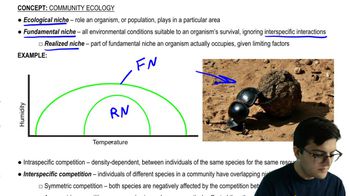
Ecological Niche

An ecological niche is the role and position a species has in its environment, including how it obtains resources, interacts with other species, and contributes to the ecosystem. It encompasses both the physical space a species occupies and its functional role, which is crucial for understanding species interactions and community structure.
Recommended video:
Guided course
02:48
Ecological Niches and Competition

Species Richness

Species richness is the number of different species present in a community. It is a key component of biodiversity and can affect ecosystem functions such as productivity and resilience. Analyzing species richness helps in understanding the complexity and health of ecological communities, as well as their ability to withstand environmental changes.
Recommended video:
03:24
Biological Species Concept