
Ch. 52 - An Introduction to Ecology and the Biosphere
Campbell - Campbell Biology 11th Edition
Urry11th EditionCampbell BiologyISBN: 9789357423311Not the one you use?Change textbook
Chapter 52, Problem 7

Suppose that the number of bird species is determined mainly by the number of vertical strata found in the environment. If so, in which of the following biomes would you find the greatest number of bird species?
a. Tropical rain forest
b. Savanna
c. Desert
d. Temperate broadleaf forest

Verified step by step guidance
1
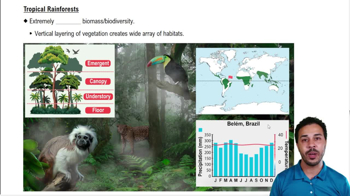
Understand the concept of vertical strata: Vertical strata refer to the different layers of vegetation in an environment, such as the canopy, understory, shrub layer, and forest floor. More strata provide more niches and resources for different species.
Consider the characteristics of each biome: Tropical rain forests have multiple vertical strata due to their dense and diverse vegetation, including tall trees, shrubs, and ground plants. Savannas have fewer strata, mainly grasses and occasional trees. Deserts have minimal vegetation and thus fewer strata. Temperate broadleaf forests have several strata but generally fewer than tropical rain forests.
Evaluate the relationship between vertical strata and bird species diversity: More vertical strata typically support a greater diversity of bird species because they offer more habitats and resources.
Compare the biomes based on their vertical strata: Tropical rain forests have the most complex vertical structure, followed by temperate broadleaf forests, savannas, and deserts.
Conclude which biome likely supports the greatest number of bird species: Based on the number of vertical strata, the tropical rain forest is expected to have the greatest number of bird species.

Verified video answer for a similar problem:

This video solution was recommended by our tutors as helpful for the problem above.
Video duration:
4m
Was this helpful?

Key Concepts

Here are the essential concepts you must grasp in order to answer the question correctly.

Vertical Strata in Ecosystems

Vertical strata refer to the layers of vegetation and habitat found in an ecosystem, ranging from the ground level to the canopy. These layers provide diverse niches and resources, supporting a variety of species. In environments with more vertical strata, such as forests, there is typically a higher biodiversity due to the increased complexity and availability of habitats.
Recommended video:
Guided course
04:07
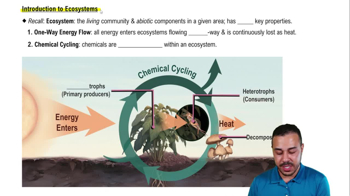
Introduction to Ecosystems

Biodiversity in Tropical Rainforests

Tropical rainforests are known for their high biodiversity, largely due to their complex vertical structure. They have multiple layers, including the forest floor, understory, canopy, and emergent layer, each offering unique habitats and resources. This complexity supports a wide range of species, making tropical rainforests one of the most species-rich biomes on Earth.
Recommended video:
Guided course
01:22
Tropical Rainforests

Bird Species Diversity

Bird species diversity is influenced by the availability of habitats and resources, which are often determined by the structural complexity of the environment. Environments with more vertical strata, like tropical rainforests, provide varied niches for birds, leading to greater species diversity. Birds exploit different layers for feeding, nesting, and protection, contributing to the high number of species in such biomes.
Recommended video:
03:24
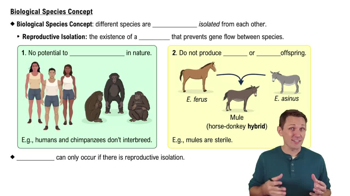
Biological Species Concept