Ch. 44 - Osmoregulation and Excretion
Campbell - Campbell Biology 11th Edition
Urry11th EditionCampbell BiologyISBN: 9789357423311Not the one you use?Change textbook
Chapter 44, Problem 6

African lungfish, which are often found in small stagnant pools of fresh water, produce urea as a nitrogenous waste. What is the advantage of this adaptation?
a. Urea takes less energy to synthesize than ammonia.
b. Small stagnant pools do not provide enough water to dilute ammonia, which is toxic.
c. Urea forms an insoluble precipitate.
d. Urea makes lungfish tissue hypoosmotic to the pool.

Verified step by step guidance
1
Understand the context: African lungfish live in small stagnant pools of fresh water, which can have limited water availability and may not be able to dilute waste products effectively.
Identify the problem with ammonia: Ammonia is a common nitrogenous waste in aquatic animals, but it is highly toxic and requires a lot of water to be safely excreted.
Consider the properties of urea: Urea is less toxic than ammonia and can be excreted with less water, making it a more suitable waste product in environments where water is scarce.
Evaluate the options: Option b suggests that small stagnant pools do not provide enough water to dilute ammonia, which aligns with the need for a less toxic waste product like urea.
Conclude the advantage: The adaptation of producing urea allows lungfish to survive in environments with limited water by reducing the toxicity of their nitrogenous waste, supporting option b.

Verified video answer for a similar problem:

This video solution was recommended by our tutors as helpful for the problem above.
Video duration:
1m
Was this helpful?

Key Concepts

Here are the essential concepts you must grasp in order to answer the question correctly.

Nitrogenous Waste Products

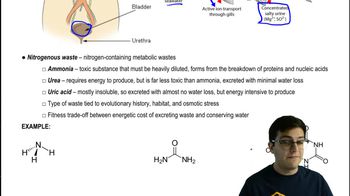
Nitrogenous waste products are byproducts of protein metabolism that need to be excreted from the body. The primary forms are ammonia, urea, and uric acid. Ammonia is highly toxic and requires a lot of water to be safely excreted, while urea is less toxic and can be excreted with less water, making it advantageous in water-limited environments.
Recommended video:
Guided course
07:16
Osmoregulation and Nitrogenous Waste

Ammonia Toxicity

Ammonia is a nitrogenous waste that is highly toxic to organisms. It requires a large amount of water to be diluted to non-toxic levels, which is why aquatic animals in water-rich environments can excrete it directly. In contrast, animals in environments with limited water, like the African lungfish, need to convert ammonia into less toxic substances like urea.
Recommended video:
Guided course
07:16
Osmoregulation and Nitrogenous Waste

Adaptation to Stagnant Water Environments

Adaptations to stagnant water environments involve physiological changes that allow organisms to survive in conditions with limited water flow and oxygen. For the African lungfish, producing urea instead of ammonia is an adaptation that reduces water dependency for excretion, allowing survival in small, stagnant pools where water is scarce and ammonia cannot be easily diluted.
Recommended video:
05:24
Adaptive Radiation