
Ch. 43 - The Immune System
Campbell - Campbell Biology 11th Edition
Urry11th EditionCampbell BiologyISBN: 9789357423311Not the one you use?Change textbook
Chapter 43, Problem 2

An epitope associates with which part of an antigen receptor or antibody?
a. The tail
b. The heavy-chain constant regions only
c. Variable regions of a heavy chain and light chain combined
d. The light-chain constant regions only

Verified step by step guidance
1
Understand the structure of an antibody: Antibodies are Y-shaped molecules composed of two heavy chains and two light chains. Each chain has constant and variable regions.
Identify the role of variable regions: The variable regions of both the heavy and light chains are responsible for binding to specific antigens. These regions are highly diverse, allowing antibodies to recognize a wide array of antigens.
Define an epitope: An epitope is the specific part of an antigen that is recognized and bound by an antibody. It is also known as an antigenic determinant.
Determine the interaction site: The epitope binds to the variable regions of the antibody, which are located at the tips of the Y-shaped structure. These regions form the antigen-binding site.
Conclude which part associates with the epitope: Since the epitope binds to the variable regions of both the heavy and light chains, the correct answer is the variable regions of a heavy chain and light chain combined.

Verified video answer for a similar problem:

This video solution was recommended by our tutors as helpful for the problem above.
Video duration:
2m
Was this helpful?

Key Concepts

Here are the essential concepts you must grasp in order to answer the question correctly.

Epitope

An epitope, also known as an antigenic determinant, is the specific part of an antigen that is recognized and bound by an antibody or antigen receptor. It is typically a small sequence of amino acids or a specific structural feature on the antigen's surface, crucial for immune recognition.
Recommended video:
Guided course
03:43
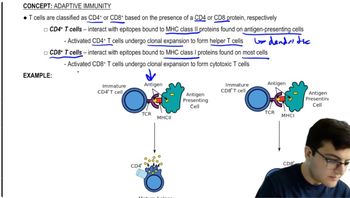
Antigen Presentation and Cytotoxic T Cells

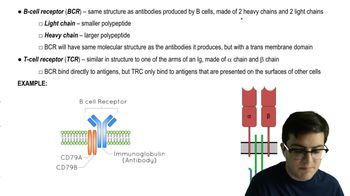
Antigen Receptor

Antigen receptors are proteins located on the surface of immune cells, such as B cells and T cells, that specifically bind to antigens. These receptors have variable regions that allow them to recognize and bind to diverse epitopes, enabling the immune system to target a wide array of pathogens.
Recommended video:
Guided course
03:50
Antigen Receptors

Variable Regions

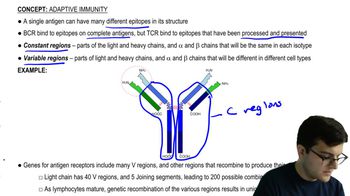
The variable regions of an antibody or antigen receptor are the parts that determine the specificity for binding to an epitope. These regions are composed of both heavy and light chains, and their unique amino acid sequences allow for the diverse recognition of different antigens, making them essential for adaptive immunity.
Recommended video:
Guided course
04:13
Constant and Variable Regions