Ch. 52 - An Introduction to Ecology and the Biosphere
Campbell - Campbell Biology 12th Edition
Urry12th EditionCampbell BiologyISBN: 9785794169850Not the one you use?Change textbook
Chapter 52, Problem 5

Which statement about dispersal is true?
a. Dispersal is not a component of the life cycles of most plants and animals.
b. Dispersal occurs only on an evolutionary time scale.
c. Colonization of devastated areas after floods or volcanic eruptions depends on dispersal.
d. The ability to disperse does not affect the geographic distribution of a species.

Verified step by step guidance
1
Understand the concept of dispersal: Dispersal refers to the movement of individuals or their propagules (such as seeds or spores) away from their origin or from high population density areas to new locations.
Evaluate statement (A): Consider whether dispersal is a common component in the life cycles of plants and animals. Many species rely on dispersal for reproduction and survival, such as seeds being carried by wind or animals.
Evaluate statement (B): Consider the time scale of dispersal. Dispersal can occur on both ecological and evolutionary time scales, as it involves immediate movement and long-term species distribution changes.
Evaluate statement (C): Consider the role of dispersal in colonization. After natural disasters like floods or volcanic eruptions, dispersal is crucial for species to reach and colonize new or disturbed areas.
Evaluate statement (D): Consider the impact of dispersal on geographic distribution. The ability to disperse affects where a species can live and thrive, influencing its geographic range and distribution.

Verified video answer for a similar problem:

This video solution was recommended by our tutors as helpful for the problem above.
Video duration:
1m
Was this helpful?

Key Concepts

Here are the essential concepts you must grasp in order to answer the question correctly.

Dispersal in Life Cycles

Dispersal is a crucial component of the life cycles of many plants and animals. It involves the movement of individuals or propagules away from their origin or from high-density areas to new locations. This process helps in reducing competition for resources, avoiding inbreeding, and colonizing new habitats, thereby playing a vital role in the survival and reproduction of species.
Recommended video:
Guided course
01:04
Protist Life Cycles

Dispersal and Evolutionary Time Scale

While dispersal can have long-term evolutionary impacts, it is not limited to evolutionary time scales. Dispersal occurs regularly and can be observed in real-time as organisms move to new areas. This movement can lead to gene flow between populations, affecting genetic diversity and potentially leading to evolutionary changes over generations.
Recommended video:

Dispersal and Geographic Distribution

The ability to disperse significantly affects the geographic distribution of a species. Dispersal allows species to expand their range, colonize new areas, and adapt to different environments. This capability is essential for species survival, especially in changing environments, as it enables them to escape unfavorable conditions and exploit new resources.
Recommended video:
Guided course
03:35
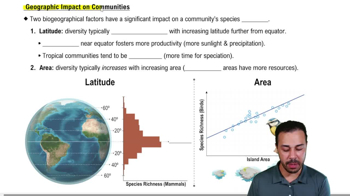
Geographic Impact on Communities