Ch. 5 - The Structure and Function of Large Biological Molecules
Campbell - Campbell Biology 12th Edition
Urry12th EditionCampbell BiologyISBN: 9785794169850Not the one you use?Change textbook
Chapter 5, Problem 1

Which of the following categories includes all others in the list?
a. Disaccharide
b. Polysaccharide
c. Starch
d. Carbohydrate

Verified step by step guidance
1
Begin by understanding the definitions of each term listed: disaccharide, polysaccharide, starch, and carbohydrate.
A disaccharide is a type of carbohydrate composed of two monosaccharide molecules. Examples include sucrose and lactose.
A polysaccharide is a carbohydrate consisting of a large number of monosaccharide units bonded together. Examples include cellulose and glycogen.
Starch is a specific type of polysaccharide that serves as a storage form of energy in plants.
Carbohydrate is the broadest category, encompassing all types of sugars and their polymers, including monosaccharides, disaccharides, polysaccharides, and starch. Therefore, carbohydrate includes all other categories listed.

Verified video answer for a similar problem:

This video solution was recommended by our tutors as helpful for the problem above.
Video duration:
2m
Was this helpful?

Key Concepts

Here are the essential concepts you must grasp in order to answer the question correctly.

Carbohydrates

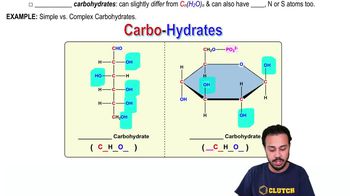
Carbohydrates are organic molecules composed of carbon, hydrogen, and oxygen, typically in a ratio of 1:2:1. They serve as a primary energy source for living organisms and are classified into monosaccharides, disaccharides, and polysaccharides based on their complexity. Understanding carbohydrates is essential for identifying their hierarchical structure in biological systems.
Recommended video:
Guided course
04:53
Carbohydrates

Disaccharides

Disaccharides are a type of carbohydrate formed by the combination of two monosaccharide molecules through a glycosidic bond. Common examples include sucrose and lactose. They are simpler than polysaccharides and serve as an intermediate energy source, highlighting their position within the carbohydrate classification.
Recommended video:
Guided course
03:08
Formation & Breakdown of Polysaccharides

Polysaccharides

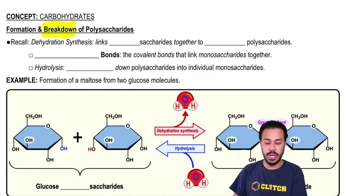
Polysaccharides are complex carbohydrates composed of long chains of monosaccharide units linked together. They function primarily as energy storage (e.g., starch in plants) or structural components (e.g., cellulose in plant cell walls). Understanding polysaccharides is crucial for recognizing their role and classification within the broader category of carbohydrates.
Recommended video:
Guided course
03:08
Formation & Breakdown of Polysaccharides