Ch. 5 - The Structure and Function of Large Biological Molecules
Campbell - Campbell Biology 12th Edition
Urry12th EditionCampbell BiologyISBN: 9785794169850Not the one you use?Change textbook
Chapter 5, Problem 2

The enzyme amylase can break glycosidic linkages between glucose monomers only if the monomers are in the α form. Which of the following could amylase break down?
a. glycogen, starch, and amylopectin
b. glycogen and cellulose
c. cellulose and chitin
d. starch, chitin, and cellulose

Verified step by step guidance
1
Understand the structure of glucose monomers: Glucose can exist in two forms, α (alpha) and β (beta). The α form has the hydroxyl group on the first carbon below the plane of the ring, while the β form has it above.
Identify the types of glycosidic linkages: Glycosidic linkages can be α or β, depending on the orientation of the glucose monomers. Amylase specifically breaks α-glycosidic linkages.
Examine the composition of each polysaccharide: Glycogen, starch, and amylopectin are composed of glucose monomers linked by α-glycosidic bonds, whereas cellulose and chitin are composed of β-glycosidic bonds.
Determine which polysaccharides amylase can break down: Since amylase can only break α-glycosidic linkages, it can break down glycogen, starch, and amylopectin.
Conclude which option is correct: Based on the ability of amylase to break α-glycosidic linkages, the correct answer is option a: glycogen, starch, and amylopectin.

Verified video answer for a similar problem:

This video solution was recommended by our tutors as helpful for the problem above.
Video duration:
2m
Was this helpful?

Key Concepts

Here are the essential concepts you must grasp in order to answer the question correctly.

Glycosidic Linkages

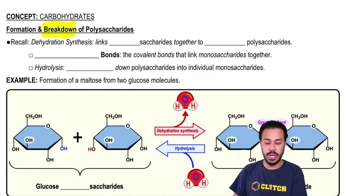
Glycosidic linkages are covalent bonds that connect carbohydrate (sugar) molecules to one another. These linkages can vary in structure, such as α (alpha) or β (beta) forms, which affect the properties and digestibility of the polysaccharides. Enzymes like amylase are specific to the type of glycosidic linkage they can cleave, with amylase specifically targeting α linkages.
Recommended video:
Guided course
03:08
Formation & Breakdown of Polysaccharides

Alpha and Beta Glucose

Glucose can exist in two different structural forms: alpha (α) and beta (β). The difference lies in the orientation of the hydroxyl group on the first carbon atom. In α-glucose, the hydroxyl group is below the plane of the ring, while in β-glucose, it is above. This distinction is crucial because it determines the type of glycosidic bonds formed and the enzyme specificity for breaking these bonds.
Recommended video:
Guided course
06:20
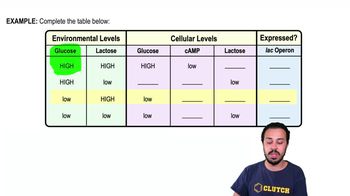
Glucose's Impact on Lac Operon Example 1

Polysaccharides: Glycogen, Starch, Cellulose, and Chitin

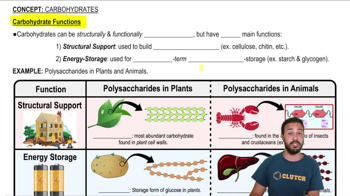
Polysaccharides are long chains of monosaccharides linked by glycosidic bonds. Glycogen and starch are composed of α-glucose units, making them substrates for amylase. In contrast, cellulose and chitin consist of β-glucose units, which amylase cannot break down. Understanding the composition of these polysaccharides is essential to determine which can be digested by specific enzymes.
Recommended video:
Guided course
05:08
Carbohydrate Functions