Ch. 49 - Nervous Systems
Campbell - Campbell Biology 12th Edition
Urry12th EditionCampbell BiologyISBN: 9785794169850Not the one you use?Change textbook
Chapter 49, Problem 7a

The reflex that pulls your hand away when you prick your finger on a sharp object relies on a neuronal circuit with two synapses in the spinal cord. Using a circle to represent a cross-section of the spinal cord, draw the circuit. Label the types of neurons, the direction of information flow in each, and the locations of synapses.

Verified step by step guidance
1
Begin by drawing a circle to represent the cross section of the spinal cord. This will serve as the central area where the neuronal circuit is located.
Identify and label the sensory neuron. This neuron detects the stimulus (e.g., the prick on the finger) and carries the information towards the spinal cord. Draw an arrow pointing towards the spinal cord to indicate the direction of information flow.
Inside the spinal cord, draw the first synapse where the sensory neuron connects to an interneuron. Label this synapse and indicate the direction of information flow from the sensory neuron to the interneuron.
Next, draw the interneuron within the spinal cord. This neuron processes the information and connects to a motor neuron. Draw an arrow from the interneuron to the motor neuron to show the direction of information flow.
Finally, draw the motor neuron, which carries the response signal away from the spinal cord to the muscles, causing the hand to pull away. Label the second synapse between the interneuron and the motor neuron, and indicate the direction of information flow towards the muscle.

Verified video answer for a similar problem:

This video solution was recommended by our tutors as helpful for the problem above.
Video duration:
1m
Was this helpful?

Key Concepts

Here are the essential concepts you must grasp in order to answer the question correctly.

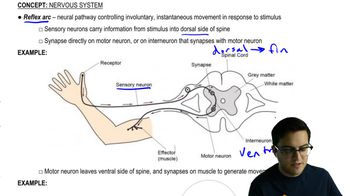
Reflex Arc

A reflex arc is a neural pathway that controls a reflex action. It involves a sensory neuron that detects a stimulus, an interneuron in the spinal cord that processes the information, and a motor neuron that triggers a response. This pathway allows for quick reactions without involving the brain, which is crucial for immediate responses to harmful stimuli.
Recommended video:

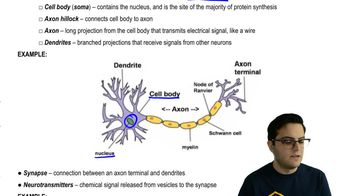
Types of Neurons

In the reflex arc, three types of neurons are involved: sensory neurons, interneurons, and motor neurons. Sensory neurons carry signals from the sensory receptors to the spinal cord. Interneurons, located within the spinal cord, process these signals and relay them to motor neurons, which then carry the response signal to the muscles, causing a reaction.
Recommended video:

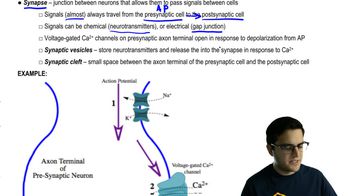
Synapses

Synapses are junctions where neurons communicate with each other. In the reflex arc, there are two synapses: one between the sensory neuron and the interneuron, and another between the interneuron and the motor neuron. These synapses facilitate the transmission of electrical impulses, allowing the reflex action to occur swiftly and efficiently.
Recommended video: