Ch. 44 - Osmoregulation and Excretion
Campbell - Campbell Biology 12th Edition
Urry12th EditionCampbell BiologyISBN: 9785794169850Not the one you use?Change textbook
Chapter 44, Problem 4

The high osmolarity of the renal medulla is maintained by which of the following?
a. Active transport of salt from the upper region of the descending limb.
b. The loose packing of juxtamedullary nephrons.
c. Diffusion of urea into the collecting duct.
d. Diffusion of salt from the descending limb of the loop of Henle.

Verified step by step guidance
1
Understand the structure and function of the nephron, particularly the loop of Henle, which plays a crucial role in concentrating urine and maintaining osmolarity in the renal medulla.
Recognize that the loop of Henle has two limbs: the descending limb and the ascending limb. The descending limb is permeable to water but not to salt, while the ascending limb is permeable to salt but not to water.
Identify that the high osmolarity in the renal medulla is primarily maintained by the countercurrent multiplier system, which involves the active transport of salt out of the ascending limb of the loop of Henle.
Consider the role of urea in maintaining osmolarity. Urea diffuses from the collecting duct into the interstitial fluid of the medulla, contributing to the high osmolarity.
Evaluate the options given: (A) is incorrect because active transport occurs in the ascending limb, not the descending limb. (B) is incorrect as the packing of nephrons does not directly affect osmolarity. (C) is partially correct as urea contributes to osmolarity, but it diffuses into the interstitial fluid, not the collecting duct. (D) is incorrect because salt does not diffuse from the descending limb.

Verified video answer for a similar problem:

This video solution was recommended by our tutors as helpful for the problem above.
Video duration:
1m
Was this helpful?

Key Concepts

Here are the essential concepts you must grasp in order to answer the question correctly.

Renal Medulla Osmolarity

The renal medulla is the innermost part of the kidney, characterized by a high osmolarity that is crucial for the kidney's ability to concentrate urine. This osmolarity gradient is maintained by the countercurrent multiplier system, which involves the loop of Henle and the vasa recta, allowing for efficient reabsorption of water and solutes.
Recommended video:
Guided course
07:59
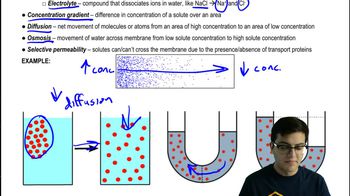
Osmosis and Osmolarity

Loop of Henle

The loop of Henle is a U-shaped tube in the nephron of the kidney that plays a key role in concentrating urine. It consists of a descending limb, which is permeable to water, and an ascending limb, which is impermeable to water but actively transports salts. This differential permeability and active transport create a concentration gradient in the medulla.
Recommended video:
Guided course
06:25
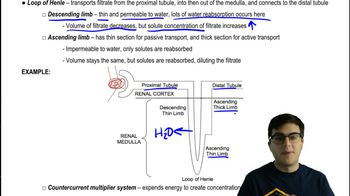
Loop of Henle

Urea Recycling

Urea recycling is a process that contributes to the high osmolarity of the renal medulla. Urea diffuses from the collecting duct into the interstitial fluid of the medulla, enhancing the osmotic gradient. This recycling helps in water reabsorption and urine concentration, as urea is reabsorbed into the loop of Henle and then secreted back into the collecting duct.
Recommended video:
Guided course
07:16
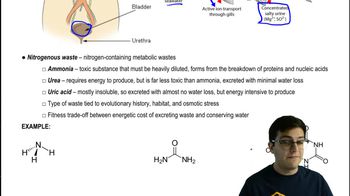
Osmoregulation and Nitrogenous Waste