Ch. 43 - The Immune System
Campbell - Campbell Biology 12th Edition
Urry12th EditionCampbell BiologyISBN: 9785794169850Not the one you use?Change textbook
Chapter 43, Problem 3

Which statement best describes the difference between responses of effector B cells (plasma cells) and those of cytotoxic T cells?
a. B cells confer active immunity; cytotoxic T cells confer passive immunity.
b. B cells respond the first time a pathogen is present; cytotoxic T cells respond subsequent times.
c. B cells secrete antibodies against a pathogen; cytotoxic T cells kill pathogen-infected host cells.
d. B cells carry out the cell-mediated response; cytotoxic T cells carry out the humoral response.

Verified step by step guidance
1
Understand the roles of B cells and cytotoxic T cells in the immune system. B cells are part of the humoral immune response and are responsible for producing antibodies. Cytotoxic T cells are part of the cell-mediated immune response and are responsible for killing infected host cells.
Analyze option a: Active immunity involves the production of antibodies by the host's immune system, while passive immunity involves the transfer of antibodies from another source. B cells are involved in active immunity, but cytotoxic T cells do not confer passive immunity.
Analyze option b: B cells can respond during both primary and secondary immune responses by producing antibodies. Cytotoxic T cells also respond during both primary and secondary responses by killing infected cells.
Analyze option c: B cells secrete antibodies that bind to antigens on pathogens, marking them for destruction. Cytotoxic T cells directly kill cells that are infected with pathogens by recognizing antigens presented on the surface of these cells.
Analyze option d: The humoral response involves B cells and the production of antibodies, while the cell-mediated response involves T cells, including cytotoxic T cells, which kill infected cells. This option incorrectly reverses the roles of B cells and cytotoxic T cells.

Verified video answer for a similar problem:

This video solution was recommended by our tutors as helpful for the problem above.
Video duration:
3m
Was this helpful?

Key Concepts

Here are the essential concepts you must grasp in order to answer the question correctly.

Effector B Cells (Plasma Cells)

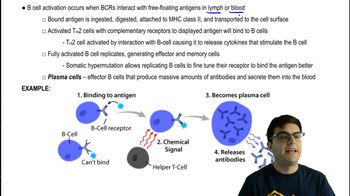
Effector B cells, also known as plasma cells, are a type of white blood cell that plays a crucial role in the humoral immune response. They are responsible for producing and secreting antibodies, which are proteins that specifically bind to antigens on pathogens, marking them for destruction by other immune cells. This process is essential for neutralizing pathogens and preventing infections.
Recommended video:
Guided course
04:06
Helper T Cells and B Cells

Cytotoxic T Cells

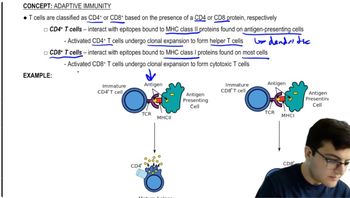
Cytotoxic T cells, or CD8+ T cells, are a subset of T cells that are essential for the cell-mediated immune response. They directly kill infected host cells by recognizing antigens presented on the surface of these cells. Once activated, cytotoxic T cells release perforin and granzymes, which induce apoptosis in the infected cells, thereby eliminating the infection source.
Recommended video:
Guided course
03:43
Antigen Presentation and Cytotoxic T Cells

Humoral vs. Cell-Mediated Immunity

The immune system employs two main strategies to combat pathogens: humoral and cell-mediated immunity. Humoral immunity involves B cells and the production of antibodies to neutralize extracellular pathogens. In contrast, cell-mediated immunity involves T cells, particularly cytotoxic T cells, which target and destroy infected host cells. Understanding these distinct pathways is crucial for comprehending how the immune system responds to different types of infections.
Recommended video:
Guided course
06:47
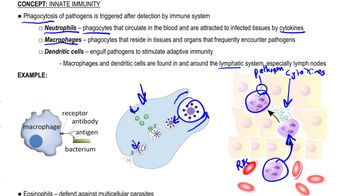
Innate Immune Cells