Ch. 4 - Carbon and the Molecular Diversity of Life
Campbell - Campbell Biology 12th Edition
Urry12th EditionCampbell BiologyISBN: 9785794169850Not the one you use?Change textbook
Chapter 4, Problem 3

Which chemical group is most likely to be responsible for an organic molecule behaving as a base?
a. Hydroxyl
b. Carbonyl
c. Amino
d. Phosphate

Verified step by step guidance
1
Understand the properties of a base: A base is a substance that can accept protons (H+) or donate a pair of valence electrons to form a bond.
Identify the chemical groups: Hydroxyl (-OH), Carbonyl (C=O), Amino (-NH2), and Phosphate (PO4^3-).
Analyze the amino group: The amino group (-NH2) contains a nitrogen atom with a lone pair of electrons, which can accept a proton (H+), making it a potential base.
Compare with other groups: Hydroxyl and carbonyl groups do not have the ability to accept protons as effectively as the amino group. The phosphate group is typically involved in energy transfer and does not act as a base in the same way.
Conclude that the amino group is most likely to be responsible for an organic molecule behaving as a base due to its ability to accept protons.

Verified video answer for a similar problem:

This video solution was recommended by our tutors as helpful for the problem above.
Video duration:
4m
Was this helpful?

Key Concepts

Here are the essential concepts you must grasp in order to answer the question correctly.

Chemical Groups in Organic Molecules

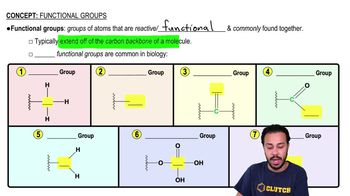
Chemical groups are specific clusters of atoms within molecules that have distinct chemical properties. They play a crucial role in determining the behavior and reactivity of organic molecules. Understanding these groups helps predict how molecules interact with each other and their environment.
Recommended video:
Guided course
06:04
Functional Groups

Amino Group

The amino group, characterized by the presence of a nitrogen atom bonded to hydrogen atoms (NH2), is known for its ability to act as a base. It can accept a proton (H+) due to the lone pair of electrons on the nitrogen, making organic molecules containing amino groups likely to behave as bases.
Recommended video:
Guided course
06:04
Functional Groups

Acid-Base Chemistry

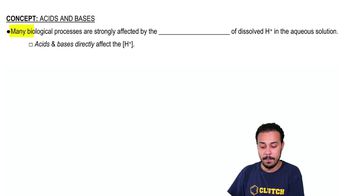
Acid-base chemistry involves the transfer of protons between molecules. Bases are substances that can accept protons, often due to the presence of lone pairs of electrons. Understanding the role of functional groups like amino groups in acid-base reactions is essential for predicting molecular behavior in biological systems.
Recommended video:
Guided course
01:29
Acids and Bases