Ch. 30 - Plant Diversity II: The Evolution of Seed Plants
Campbell - Campbell Biology 12th Edition
Urry12th EditionCampbell BiologyISBN: 9785794169850Not the one you use?Change textbook
Chapter 30, Problem 7

The history of life has been punctuated by several mass extinctions. For example, the impact of a meteorite may have wiped out most of the dinosaurs and many forms of marine life at the end of the Cretaceous period. Fossils indicate that plants were less severely affected by this mass extinction. What adaptations may have enabled plants to withstand this disaster better than animals?

Verified step by step guidance
1
Consider the differences in survival strategies between plants and animals. Plants are generally more adaptable to changes in their environment due to their ability to photosynthesize, which allows them to produce their own food from sunlight, water, and carbon dioxide.
Examine the structural adaptations of plants. Many plants have developed tough, protective outer layers such as bark or waxy coatings that can help them withstand harsh environmental conditions, including changes in climate or atmospheric composition.
Evaluate the reproductive strategies of plants. Unlike many animals, plants can reproduce both sexually and asexually. Asexual reproduction, such as through spores or vegetative propagation, allows plants to quickly repopulate an area even if individual plants are wiped out.
Analyze the role of seed dispersal and dormancy. Seeds can remain dormant for extended periods, allowing them to survive unfavorable conditions until the environment becomes suitable for growth. This ability to 'wait out' adverse conditions could have been crucial during a mass extinction event.
Consider the ecological roles of plants. Plants are primary producers in ecosystems, forming the base of the food chain. Their ability to adapt and survive would have been essential for the recovery of ecosystems after a mass extinction, providing food and habitat for surviving animal species.

Verified video answer for a similar problem:

This video solution was recommended by our tutors as helpful for the problem above.
Video duration:
2m
Was this helpful?

Key Concepts

Here are the essential concepts you must grasp in order to answer the question correctly.

Mass Extinction Events

Mass extinction events are periods in Earth's history when a significant, widespread, and rapid decrease in the biodiversity occurs. These events are often triggered by catastrophic phenomena such as meteorite impacts, volcanic eruptions, or climate changes. Understanding these events helps explain the evolutionary pressures that shape the survival and adaptation of species.
Recommended video:
04:48
Extinctions

Plant Adaptations

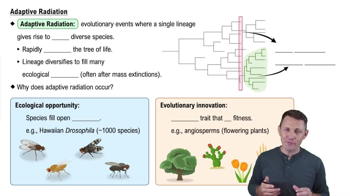
Plant adaptations refer to the evolutionary changes that enable plants to survive and thrive in various environmental conditions. These adaptations can include structural features like thick bark or deep roots, physiological mechanisms like drought resistance, and reproductive strategies such as seed dispersal. Such traits may have contributed to plants' resilience during mass extinction events.
Recommended video:
05:24
Adaptive Radiation

Cretaceous-Paleogene Extinction

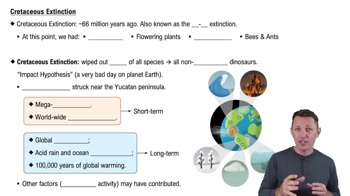
The Cretaceous-Paleogene extinction, occurring about 66 million years ago, is one of the most well-known mass extinction events, marked by the disappearance of the dinosaurs and many marine species. It is believed to have been caused by a meteorite impact, leading to drastic environmental changes. Studying this event provides insights into how different life forms, including plants, adapted to survive the aftermath.
Recommended video:
04:55
Cretaceous Extinction