
Ch. 24 - The Origin of Species
Campbell - Campbell Biology 12th Edition
Urry12th EditionCampbell BiologyISBN: 9785794169850Not the one you use?Change textbook
Chapter 24, Problem 5

Which of the following factors would be the most likely to contribute to allopatric speciation?
a. The separated population is large, and genetic drift occurs.
b. Selection pressures in the isolated population are similar to those in the ancestral population.
c. Gene flow between the two populations is extensive.
d. Different mutations begin to distinguish the gene pools of the separated populations.

Verified step by step guidance
1
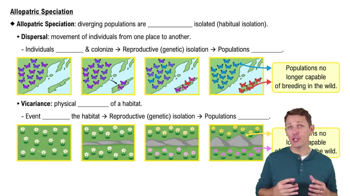
Understand the concept of allopatric speciation: Allopatric speciation occurs when populations of the same species become geographically isolated, preventing gene flow between them. Over time, genetic differences accumulate, leading to the formation of new species.
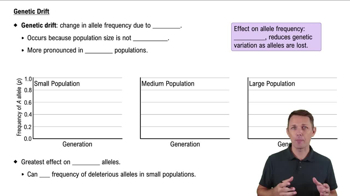
Analyze the role of genetic drift: Genetic drift is more likely to have a significant impact in small populations rather than large ones. Therefore, option A is less likely to contribute to allopatric speciation in this scenario.
Evaluate the impact of selection pressures: If selection pressures in the isolated population are similar to those in the ancestral population, there is less likelihood of divergence. Thus, option B does not strongly support allopatric speciation.
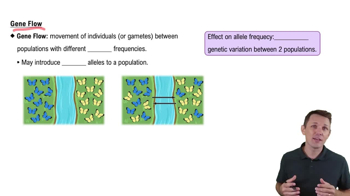
Consider the effect of gene flow: Extensive gene flow between populations would counteract the genetic divergence necessary for speciation. Therefore, option C is unlikely to contribute to allopatric speciation.
Examine the role of mutations: Mutations introduce genetic variation, and if different mutations accumulate in the isolated populations, they can lead to divergence in the gene pools. This process is a key factor in allopatric speciation, making option D the most likely contributor.

Verified video answer for a similar problem:

This video solution was recommended by our tutors as helpful for the problem above.
Video duration:
1m
Was this helpful?

Key Concepts

Here are the essential concepts you must grasp in order to answer the question correctly.

Allopatric Speciation

Allopatric speciation occurs when a population is geographically separated, leading to reproductive isolation. This separation can result from physical barriers like mountains or rivers, preventing gene flow between the groups. Over time, the isolated populations may evolve independently, potentially leading to the emergence of new species.
Recommended video:
03:53
Allopatric Speciation

Genetic Drift

Genetic drift is a mechanism of evolution that involves random changes in allele frequencies within a population. It is particularly significant in small populations, where chance events can lead to the loss or fixation of alleles. This can contribute to divergence between separated populations, enhancing the likelihood of speciation.
Recommended video:
05:06
Genetic Drift

Gene Flow

Gene flow refers to the transfer of genetic material between populations through migration and interbreeding. High levels of gene flow can counteract the effects of speciation by homogenizing genetic differences. In the context of allopatric speciation, reduced gene flow is crucial, as it allows populations to diverge genetically and adapt to their unique environments.
Recommended video:
01:43
Gene Flow
Related Practice
Textbook Question

Males of different species of the fruit fly Drosophila that live in the same parts of the Hawaiian Islands have different elaborate courtship rituals. These rituals involve fighting other males and making stylized movements that attract females. What type of reproductive isolation does this represent?

a. Habitat isolation

b. Temporal isolation

c. Behavioral isolation

d. Gametic isolation

1507
views
Textbook Question

According to the punctuated equilibria model:

a. Given enough time, most existing species will branch gradually into new species.

b. Most new species accumulate their unique features relatively rapidly as they come into existence, then change little for the rest of their duration as a species.

c. Most evolution occurs in sympatric populations.

d. Speciation is usually due to a single mutation.

1599
views
Textbook Question

Bird guides once listed the myrtle warbler and Audubon's warbler as distinct species. Recently, these birds have been classified as eastern and western forms of a single species, the yellow-rumped warbler. Which of the following pieces of evidence, if true, would be cause for this reclassification?

a. The two forms interbreed often in nature, and their offspring survive and reproduce well.

b. The two forms live in similar habitats and have similar food requirements.

c. The two forms have many genes in common.

d. The two forms are very similar in appearance.

1400
views
Textbook Question

Plant species A has a diploid chromosome number of 12. Plant species B has a diploid number of 16. A new species, C, arises as an allopolyploid from A and B. The diploid number for species C would probably be

a. 14

b. 16

c. 28

d. 56

1549
views