Ch. 13 - Meiosis and Sexual Life Cycles
Campbell - Campbell Biology 12th Edition
Urry12th EditionCampbell BiologyISBN: 9785794169850Not the one you use?Change textbook
Chapter 13, Problem 2

The two homologs of a pair move toward opposite poles of the dividing cell during
a. Mitosis
b. Meiosis I
c. Meiosis II
d. Fertilization

Verified step by step guidance
1
Understand the process of cell division: Mitosis and meiosis are two types of cell division. Mitosis results in two identical daughter cells, while meiosis results in four genetically diverse daughter cells.
Identify the stages of meiosis: Meiosis consists of two stages, meiosis I and meiosis II. Meiosis I is where homologous chromosomes are separated, and meiosis II is where sister chromatids are separated.
Focus on meiosis I: During meiosis I, homologous chromosomes (pairs of chromosomes, one from each parent) are separated and move toward opposite poles of the cell.
Compare with mitosis: In mitosis, sister chromatids are separated, not homologous chromosomes. This is a key difference between mitosis and meiosis I.
Consider the options: Given the options a. mitosis, b. meiosis I, c. meiosis II, and d. fertilization, meiosis I is the correct stage where homologous chromosomes move toward opposite poles.

Verified video answer for a similar problem:

This video solution was recommended by our tutors as helpful for the problem above.
Video duration:
1m
Was this helpful?

Key Concepts

Here are the essential concepts you must grasp in order to answer the question correctly.

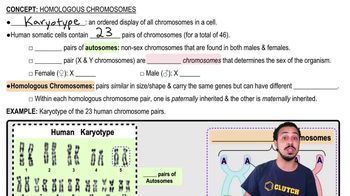
Homologous Chromosomes

Homologous chromosomes are pairs of chromosomes in a diploid organism, one inherited from each parent, that have the same genes at the same loci but may have different alleles. They are crucial in processes like meiosis where they pair up and exchange genetic material, ensuring genetic diversity.
Recommended video:
Guided course
08:09
Homologous Chromosomes

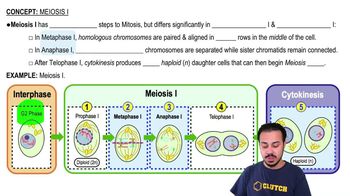
Meiosis I

Meiosis I is the first division in meiosis where homologous chromosomes are separated into two different cells. This phase includes prophase I, where crossing over occurs, and anaphase I, where homologs move toward opposite poles, reducing the chromosome number by half and creating genetic variation.
Recommended video:

Chromosome Segregation

Chromosome segregation is the process during cell division where chromosomes are distributed into daughter cells. In meiosis I, homologous chromosomes are segregated, ensuring each gamete receives one chromosome from each pair, which is essential for maintaining genetic stability across generations.
Recommended video:
Guided course
08:09
Homologous Chromosomes