Back

Introduction to Taxonomy quiz #1

3 students found this helpful
Control buttons has been changed to "navigation" mode.
1/22
  • What are the three domains of life?


    The three domains of life are Archaea, Bacteria, and Eukarya.

  • Which domains consist of prokaryotic cells?


    Domains Bacteria and Archaea consist of prokaryotic cells.

  • What is a key difference between prokaryotic and eukaryotic cells?


    Prokaryotic cells lack a nucleus, while eukaryotic cells contain a nucleus.

  • What is the term for the tree that shows the evolutionary relationships among various biological species?


    The term is phylogenetic tree, also known as the tree of life.

  • What theory suggests that all life came from a common ancestor?


    The theory of common ancestry suggests that all life came from a single common ancestor.

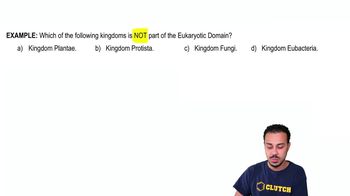
  • What are the four kingdoms within the domain Eukarya?


    The four kingdoms within the domain Eukarya are Animalia, Plantae, Fungi, and Protista.

  • Which kingdom includes multicellular organisms like tigers and humans?


    Kingdom Animalia includes multicellular organisms like tigers and humans.

  • What is the primary characteristic of organisms in Kingdom Plantae?


    Organisms in Kingdom Plantae are primarily multicellular and include flowers, plants, and trees.

  • What type of organisms are found in Kingdom Fungi?


    Kingdom Fungi includes mostly multicellular and absorptive heterotrophic organisms like mushrooms, but also some unicellular examples.

  • What are the two types of organisms that can be found in Kingdom Protista?


    Kingdom Protista includes both eukaryotic unicellular and multicellular organisms.

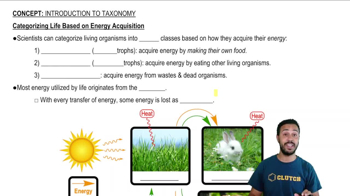
  • What are the three classes of organisms based on how they acquire energy?


    The three classes are Producers (autotrophs), Consumers (heterotrophs), and Decomposers.

  • What is the primary energy source for most living organisms?


    The primary energy source for most living organisms is the sun.

  • according to the cladogram, which characteristic was used to separate bony fish from amphibians?

    The characteristic used to separate bony fish from amphibians is the presence of limbs with digits.
  • in general, blank______ families of beetles are particularly species-rich.

    In general, Coleoptera families of beetles are particularly species-rich.
  • What defines a monophyletic group or clade?

    A monophyletic group, or clade, includes all descendants of a common ancestor. An example would be the group of all birds.
  • can you identify the animal phylum to which each example or characteristic belongs?

    Examples include: Arthropoda for insects, Mollusca for snails, and Chordata for vertebrates.
  • which relationship can be determined from this dichotomous key?

    A dichotomous key helps determine the identity of organisms by following a series of choices that lead to the correct name of a given item.
  • the study of classification is called ______, which incorporates both taxonomy and phylogenetics.

    The study of classification is called systematics, which incorporates both taxonomy and phylogenetics.
  • which molecule did carl woese study to produce his tree of life?

    Carl Woese studied ribosomal RNA (rRNA) to produce his tree of life.
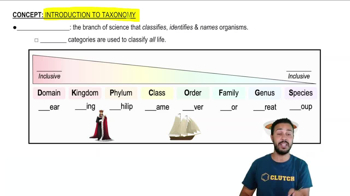
  • the ______ name is listed second in binomial nomenclature.

    The species name is listed second in binomial nomenclature.
  • What attribute is not accurate for members of the Animalia kingdom?

    An attribute not accurate for members of the Animalia kingdom is being autotrophic, as animals are heterotrophic.
  • what is the difference between the dna of a dog and the dna of a fly?

    The difference between the DNA of a dog and a fly lies in the sequence of nucleotides, which results in different genes and traits.