Draw a phylogenetic tree that represents our current understanding of evolutionary relationships between a moss, a gymnosperm, a lycophyte, and a fern. Use a charophyte alga as the outgroup. (See Figure 26.5 to review phylogenetic trees.) Label each branch point of the phylogeny with at least one derived character unique to the clade descended from the common ancestor represented by the branch point.
Ch. 29 - Plant Diversity I: How Plants Colonized Land
Chapter 29, Problem 5
Suppose an efficient conducting system evolved in a moss that could transport water and other materials as high as a tall tree. Which of the following statements about “trees” of such a species would be true?
a. Spore dispersal distances would probably decrease.
b. Females could produce only one archegonium.
c. Unless its body parts were strengthened, such a “tree” would probably flop over.
d. Individuals would probably compete less effectively for access to light.
Verified step by step guidance1
Identify the key biological functions of mosses and how they differ from trees, particularly focusing on their structure and reproductive strategies.
Consider the implications of a moss evolving a conducting system similar to that of a tall tree, which would involve the transport of water and nutrients to greater heights.
Analyze the statement (c) about the necessity for strengthened body parts if a moss were to grow as tall as a tree, considering the structural support needed for such height in comparison to typical mosses that are non-woody and low to the ground.
Evaluate how the increased height and structure might affect the moss's stability and ability to remain upright without additional support or adaptations.
Conclude whether the statement (c) is likely true based on the analysis of the structural requirements for a moss to sustain a tree-like height.

Verified video answer for a similar problem:
This video solution was recommended by our tutors as helpful for the problem above.
Video duration:
2mWas this helpful?
Key Concepts
Here are the essential concepts you must grasp in order to answer the question correctly.
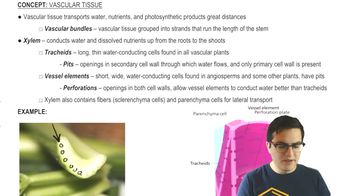
Vascular Tissue in Plants
Vascular tissue, consisting of xylem and phloem, is essential for the transport of water, nutrients, and sugars in plants. In the context of mosses evolving a conducting system akin to that of trees, the presence of efficient vascular tissue would allow for greater height and resource distribution, similar to that seen in higher plants. This adaptation would significantly impact growth patterns and ecological interactions.
Recommended video:
Guided course
Vascular Tissue
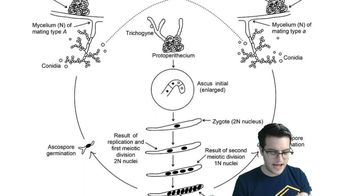
Reproductive Structures in Mosses
Mosses reproduce via spores and have structures like archegonia for gamete production. The statement regarding females producing only one archegonium highlights the reproductive limitations in mosses, which can affect spore dispersal and genetic diversity. Understanding these reproductive strategies is crucial for predicting how such a moss species might adapt to a tree-like form.
Recommended video:
Guided course
Fungi Reproduction - 3
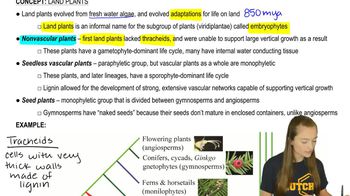
Structural Support in Tall Plants
Structural support is vital for tall plants to withstand gravity and environmental forces. In the case of a moss evolving into a tree-like structure, without adequate strengthening of its body parts, it would likely be prone to collapsing under its own weight. This concept emphasizes the importance of lignin and other supportive tissues in the evolution of plant height and stability.
Recommended video:
Guided course
Land Plants
Related Practice
Textbook Question
1818
views
Textbook Question
Which of the following characteristics of plants is absent in their closest relatives, the charophyte algae?
a. Chlorophyll b
b. Cellulose in cell walls
c. Sexual reproduction
d. Alternation of multicellular generations
1753
views
Textbook Question
Microphylls are found in which plant group?
a. Lycophytes
b. Liverworts
c. Ferns
d. Hornworts
1119
views
Textbook Question
Identify each of the following structures as haploid or diploid.
a. Sporophyte
b. Spore
c. Gametophyte
d. Zygote
1243
views
Textbook Question
In angiosperms, which of the following is correctly paired with its chromosome count?
a. Microspore—n
b. Zygote—n
c. Egg—2n
d. Megaspore—2n
1177
views
