 Back
The Endocrine System: Structure, Function, and Regulation
Study Guide - Smart Notes
 Tailored notes based on your materials, expanded with key definitions, examples, and context.
The Endocrine System
Overview of Intercellular Communication
The endocrine system is essential for maintaining homeostasis through chemical signaling. It works in concert with the nervous system, but differs in speed and duration of effects.
Homeostasis: Maintained by chemical messengers.
Nervous System: Fast, specific, and short-lived effects.
Endocrine System: Slow, widespread, and long-lasting effects via hormones in the bloodstream.
Organs and Tissues of the Endocrine System
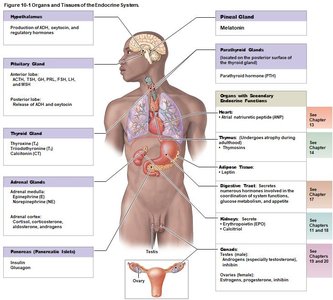
The endocrine system consists of glands and tissues that secrete hormones directly into the bloodstream, affecting distant target cells.
Major glands: Hypothalamus, pituitary, thyroid, parathyroid, adrenal, pineal, pancreas, gonads.
Hormones: Chemical messengers that regulate physiological processes.
Hormone Classification and Action
Three Groups of Hormones
Hormones are classified by their chemical structure:
Amino Acid Derivatives: Include epinephrine, norepinephrine, thyroid hormones, melatonin.
Peptide Hormones: Chains of amino acids; largest class (e.g., ADH, oxytocin, pituitary hormones).
Lipid Derivatives: Steroid hormones (cholesterol-based) and eicosanoids (fatty acid-based).
Hormone Action and Target Cell Receptors
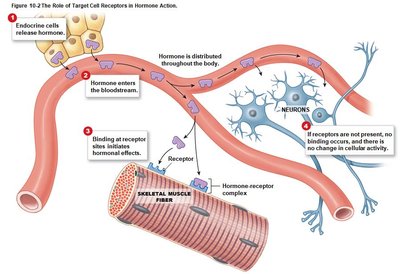
Hormones exert effects only on cells with specific receptors. The location of these receptors determines the mechanism of hormone action.
Receptors: Located on plasma membrane (for non-lipid soluble hormones) or inside the cell (for lipid-soluble hormones).
Hormone-Receptor Complex: Initiates cellular responses.
Plasma Membrane Receptors and Second Messenger Systems
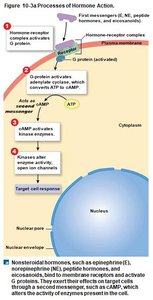
Non-lipid soluble hormones (e.g., peptide hormones) bind to membrane receptors and activate second messenger systems.
First Messenger: Hormone binds to receptor.
G Protein: Links receptor to enzyme (adenylate cyclase).
Second Messenger: cAMP, Ca2+, or cGMP amplify the signal.
Phosphorylation: Kinase enzymes add phosphate groups to proteins, altering cell activity.
Intracellular Receptors
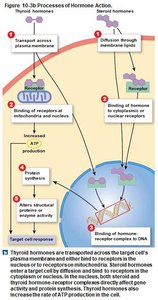
Lipid-soluble hormones (e.g., steroid and thyroid hormones) cross the plasma membrane and bind to intracellular receptors, affecting gene expression.
Hormone-Receptor Complex: Activates or inactivates specific genes.
mRNA Transcription: Alters protein synthesis and cell function.
Hormone Secretion, Distribution, and Regulation
Hormone Secretion and Distribution
Hormones are released into the bloodstream and distributed throughout the body. Their activity is regulated by binding to transport proteins and by rapid inactivation.
Freely Circulating Hormones: Short-lived, inactivated by binding, metabolism, or enzymatic breakdown.
Bound Hormones: Longer-lasting, equilibrium between bound and free forms.
Control of Endocrine Activity
Endocrine activity is regulated by negative feedback mechanisms based on three types of stimuli:
Humoral Stimuli: Changes in extracellular fluid composition (e.g., blood calcium levels).
Hormonal Stimuli: Changes in circulating hormone levels.
Neural Stimuli: Neural stimulation of glands.
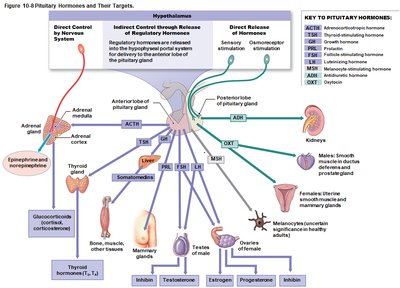
Hypothalamus and Pituitary Gland
Hypothalamic Control of Endocrine Function
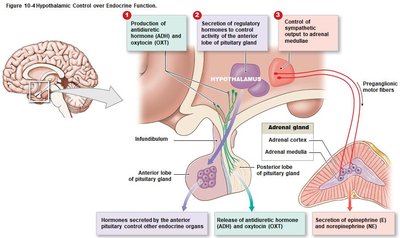
The hypothalamus is the highest regulatory center for endocrine control, integrating nervous and endocrine functions.
Regulatory Hormones: Releasing (RH) and inhibiting (IH) hormones control the anterior pituitary.
Direct Neural Control: Controls adrenal medulla via sympathetic fibers.
Direct Release: Produces ADH and oxytocin, released from posterior pituitary.
Anatomy of the Pituitary Gland
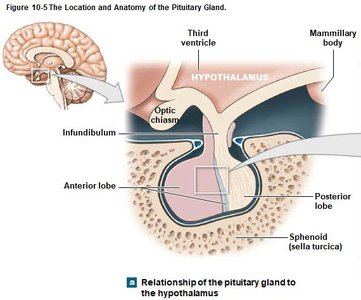
The pituitary gland (hypophysis) is located at the base of the brain, connected to the hypothalamus by the infundibulum and protected by the sella turcica.
Anterior Lobe: Endocrine cells, hypophyseal portal system.
Posterior Lobe: Contains axons from hypothalamic neurons.
The Hypophyseal Portal System
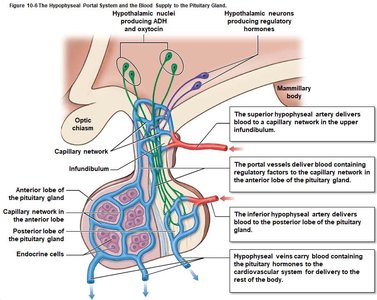
The hypophyseal portal system is a network of blood vessels connecting the hypothalamus and anterior pituitary, allowing regulatory hormones to reach target cells efficiently.
Portal System: Two capillary networks linked by portal vessels.
Tropic Hormones: Target other endocrine glands.
Negative Feedback Regulation
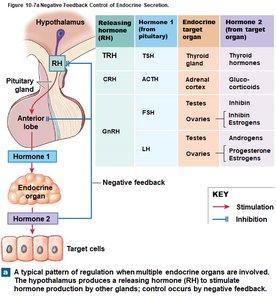
Hormone secretion is regulated by negative feedback, ensuring homeostasis and preventing overproduction.
Example: Increased thyroid hormones inhibit TRH and TSH secretion.
Pattern: Hypothalamus → Pituitary → Endocrine Organ → Target Cells.
Pituitary Hormones
Anterior Lobe Hormones
The anterior pituitary secretes seven hormones, each with specific targets and effects.
TSH: Stimulates thyroid hormone release.
ACTH: Stimulates glucocorticoid secretion from adrenal cortex.
FSH: Promotes follicle development and sperm production.
LH: Induces ovulation, stimulates androgen production.
PRL: Stimulates milk production.
GH: Stimulates growth and metabolism.
MSH: Increases melanin production.
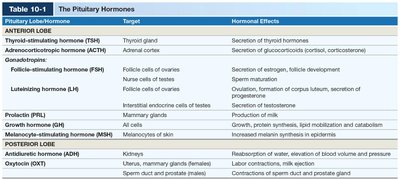
Pituitary Lobe/Hormone | Target | Hormonal Effects |
|---|---|---|
TSH | Thyroid gland | Secretion of thyroid hormones |
ACTH | Adrenal cortex | Secretion of glucocorticoids |
FSH | Ovaries/Testes | Estrogen, follicle development, sperm maturation |
LH | Ovaries/Testes | Ovulation, progesterone, testosterone |
PRL | Mammary glands | Milk production |
GH | All tissues | Growth, protein synthesis |
MSH | Melanocytes | Melanin synthesis |
ADH | Kidneys | Water reabsorption |
OXT | Uterus, mammary glands, prostate | Labor contractions, milk ejection, sperm emission |
Posterior Lobe Hormones
The posterior pituitary releases ADH and oxytocin, produced by hypothalamic neurons.
ADH: Promotes water retention and vasoconstriction.
Oxytocin: Stimulates uterine contractions and milk ejection.
The Thyroid and Parathyroid Glands
Anatomy and Histology of the Thyroid Gland
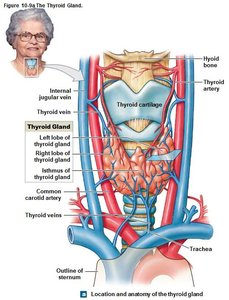
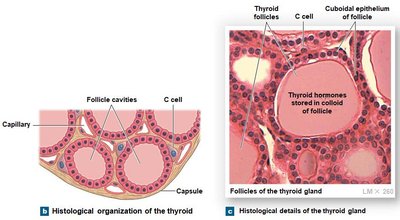
The thyroid gland is located anterior to the trachea and consists of two lobes connected by an isthmus. It contains follicles lined by cuboidal epithelium, filled with colloid.
Thyroid Hormones
Thyroid hormones (T3 and T4) are derived from tyrosine and iodine, and are essential for metabolism and development.
Thyroxine (T4): Four iodine atoms.
Triiodothyronine (T3): Three iodine atoms; more potent.
Effects: Increase ATP production, metabolic rate, calorigenic effect, and are essential for skeletal, muscular, and nervous system development.
Calcitonin and Calcium Balance
Calcitonin, produced by C cells, lowers blood calcium by inhibiting osteoclasts and increasing calcium excretion by kidneys.
Parathyroid Glands and Parathyroid Hormone (PTH)
Parathyroid glands are embedded in the posterior thyroid and secrete PTH, which increases blood calcium by stimulating osteoclasts, reducing kidney excretion, and increasing intestinal absorption.
The Adrenal Glands
Anatomy and Function
The adrenal glands sit atop the kidneys and consist of the cortex and medulla, each producing distinct hormones.
Adrenal Cortex: Produces corticosteroids (mineralocorticoids, glucocorticoids, androgens).
Adrenal Medulla: Produces epinephrine and norepinephrine, supporting sympathetic responses.
The Pineal Gland
Melatonin and Circadian Rhythms
The pineal gland produces melatonin, which regulates circadian rhythms and may protect neurons.
The Endocrine Pancreas
Pancreatic Islets and Hormones
The pancreas contains islets of Langerhans, which secrete insulin (beta cells) and glucagon (alpha cells) to regulate blood glucose.
Insulin: Lowers blood glucose by promoting uptake and storage.
Glucagon: Raises blood glucose by mobilizing reserves.
Diabetes Mellitus
Diabetes mellitus is characterized by faulty glucose metabolism, resulting in hyperglycemia and glycosuria. Type 1 is due to inadequate insulin production; Type 2 is due to insulin resistance.
Summary Table: Endocrine Glands and Their Hormones
Gland | Hormone | Function |
|---|---|---|
Pituitary | TSH, ACTH, FSH, LH, PRL, GH, MSH, ADH, OXT | Regulation of thyroid, adrenal, gonads, growth, lactation, water balance, pigmentation |
Thyroid | T3, T4, Calcitonin | Metabolism, calcium balance |
Parathyroid | PTH | Calcium regulation |
Adrenal | Corticosteroids, E, NE | Metabolism, stress response |
Pineal | Melatonin | Circadian rhythms |
Pancreas | Insulin, Glucagon | Blood glucose regulation |
Additional info: Academic context was added to clarify hormone mechanisms, feedback regulation, and clinical relevance (e.g., diabetes, hypogonadism, goiter).
