 Back
Hormonal Effects, Signaling Pathways, and Regulation in the Endocrine System
Study Guide - Smart Notes
 Tailored notes based on your materials, expanded with key definitions, examples, and context.
The Endocrine System: Hormonal Effects and Regulation
Transport of Hormones in the Body
The endocrine system utilizes hormones to regulate physiological processes. Hormones are transported in the bloodstream, and their solubility determines their mode of transport and duration of action.
Amino acid-derived hormones and peptide hormones are water-soluble and circulate freely in the blood. They act quickly but are short-lived due to rapid breakdown.
Steroid hormones are lipid-soluble and require transport proteins to travel in the blood. They are protected from degradation, resulting in longer-lasting effects (e.g., cortisol can persist for hours).
Example: Epinephrine (amino acid-derived) acts rapidly, while cortisol (steroid) acts over a longer period.
Pathways of Hormone Action
Hormones exert their effects by binding to specific receptors on or within target cells. The location and type of receptor determine the cellular response.
Intracellular Hormone Receptors
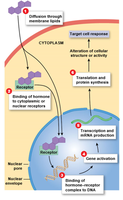
Steroid hormones, being lipid-soluble, diffuse through the cell membrane and bind to intracellular receptors. This process leads to direct gene activation and protein synthesis.
Mechanism: Steroid hormone binds to receptor in cytosol or nucleus → hormone-receptor complex binds DNA → enhances transcription of specific genes → mRNA directs protein synthesis (translation).
Result: Alters cell structure and function by changing protein types and quantities.
Example: Estrogen and testosterone regulate gene expression for reproductive functions.
Hormone Receptors on Cell Membranes
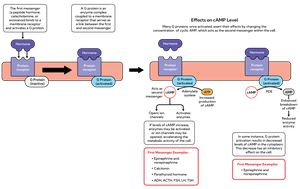
Water-soluble hormones (e.g., catecholamines, peptide hormones) cannot cross the cell membrane and bind to receptors on the cell surface. Their effects are mediated by intracellular signaling cascades, often involving second messengers.
First messenger: Hormone binds to cell membrane receptor (often a G protein-coupled receptor, GPCR).
Second messenger: Most commonly cyclic adenosine monophosphate (cAMP). Hormone binding activates G protein → adenylate cyclase converts ATP to cAMP → cAMP activates protein kinase A (PKA) → phosphorylation cascade alters cellular proteins.
Amplification: A small amount of hormone can trigger thousands of signaling events.
Termination: cAMP is degraded by phosphodiesterase (PDE), ending the signal.
Example: Calcitonin, glucagon, and thyroid-stimulating hormone use cAMP as a second messenger.
Factors Affecting Target Cell Response
The response of a target cell to a hormone depends on receptor specificity and several regulatory mechanisms.
Downregulation: High hormone levels cause cells to decrease receptor numbers, reducing sensitivity.
Upregulation: Low hormone levels cause cells to increase receptor numbers, enhancing sensitivity.
Permissive effect: One hormone enables another to act (e.g., thyroid hormones enable reproductive hormones).
Synergistic effect: Two hormones produce an amplified response (e.g., FSH and estrogen for ova maturation).
Antagonistic effect: Two hormones have opposing effects (e.g., insulin lowers blood glucose, glucagon raises it).
The Negative and Positive Feedback Systems
Hormone levels are regulated by feedback mechanisms to maintain homeostasis and prevent disease.
Negative Feedback
Most hormones are regulated by negative feedback, which inhibits further secretion once adequate levels are reached. This maintains equilibrium, similar to a thermostat.
Example: ADH release is triggered by high sodium; as blood dilutes, ADH secretion stops.
Equation:
Positive Feedback
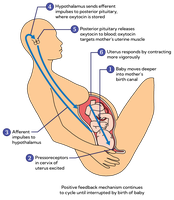
Positive feedback enhances hormone secretion until the stimulus is removed. It is less common but crucial in certain processes.
Example: Oxytocin during childbirth: cervical stretch triggers oxytocin release, causing uterine contractions, which further increase oxytocin until birth occurs.
Endocrine Reflexes
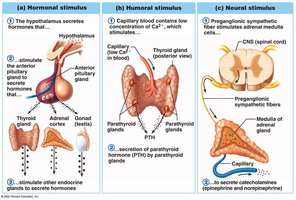
Endocrine reflexes regulate hormone secretion in response to various stimuli, maintaining homeostasis.
Humoral stimuli: Changes in blood levels of ions or nutrients trigger hormone release (e.g., osmoreceptors detect blood osmolarity, triggering ADH release).
Hormonal stimuli: Hormone release is triggered by another hormone (e.g., hypothalamic hormones control pituitary hormone secretion).
Neural stimuli: Neural input triggers hormone release (e.g., sympathetic stimulation causes adrenal glands to release epinephrine and norepinephrine).
Stimulus Type | Trigger | Example |
|---|---|---|
Humoral | Blood ion/nutrient changes | ADH release due to osmolarity; insulin release due to glucose |
Hormonal | Hormone from another gland | Hypothalamic releasing hormones → pituitary hormones |
Neural | Neural stimulation | Sympathetic nerves → adrenal medulla (epinephrine) |
Additional info: Academic context was added to clarify mechanisms, provide examples, and ensure completeness for exam preparation.
