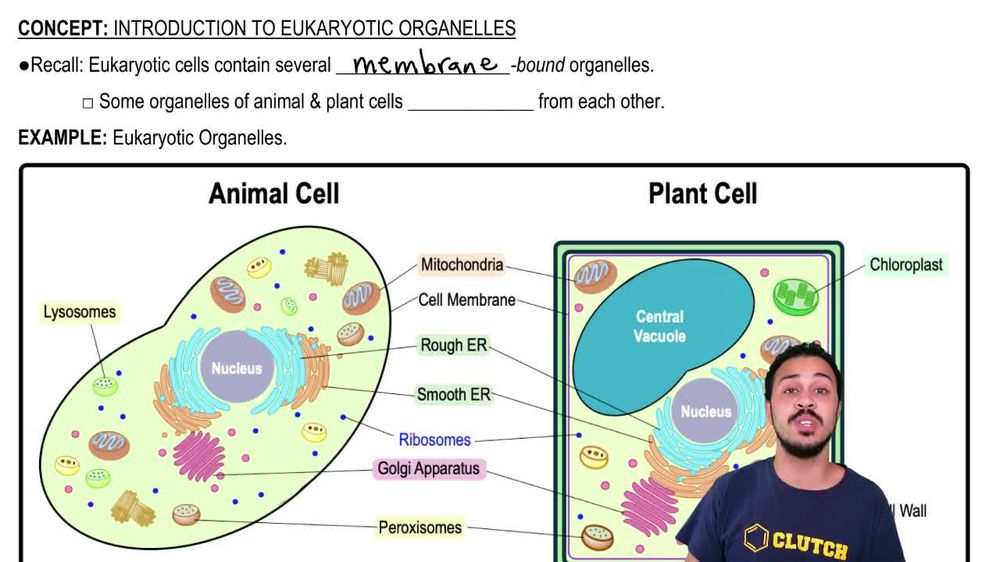
DRAW IT From memory, draw two eukaryotic cells. Label the structures listed here and show any physical connections between the internal structures of each cell: nucleus, rough ER, smooth ER, mitochondrion, centrosome, chloroplast, vacuole, lysosome, microtubule, cell wall, ECM, microfilament, Golgi apparatus, intermediate filament, plasma membrane, peroxisome, ribosome, nucleolus, nuclear pore, vesicle, flagellum, microvilli, plasmodesma.
Verified step by step guidance
1
Step 1: Identify the structures labeled in the provided image. Label A is pointing to the mitochondrion, Label B is pointing to the Golgi apparatus, and Label C is pointing to the rough endoplasmic reticulum (rough ER).
Step 2: Draw the outline of two eukaryotic cells. Start with the plasma membrane for each cell.
Step 3: Inside each cell, draw and label the nucleus, including the nucleolus and nuclear pores. The nucleus should be a large, central structure.
Step 4: Draw the rough ER near the nucleus, showing its connection to the nuclear envelope. The rough ER should have ribosomes on its surface.
Step 5: Draw the Golgi apparatus, typically depicted as a series of stacked, flattened membranes, and place it near the rough ER. Show vesicles budding off from the Golgi apparatus.
Verified video answer for a similar problem:
This video solution was recommended by our tutors as helpful for the problem above
Video duration:
3m
Play a video:
0 Comments
Key Concepts
Here are the essential concepts you must grasp in order to answer the question correctly.
Eukaryotic Cell Structure
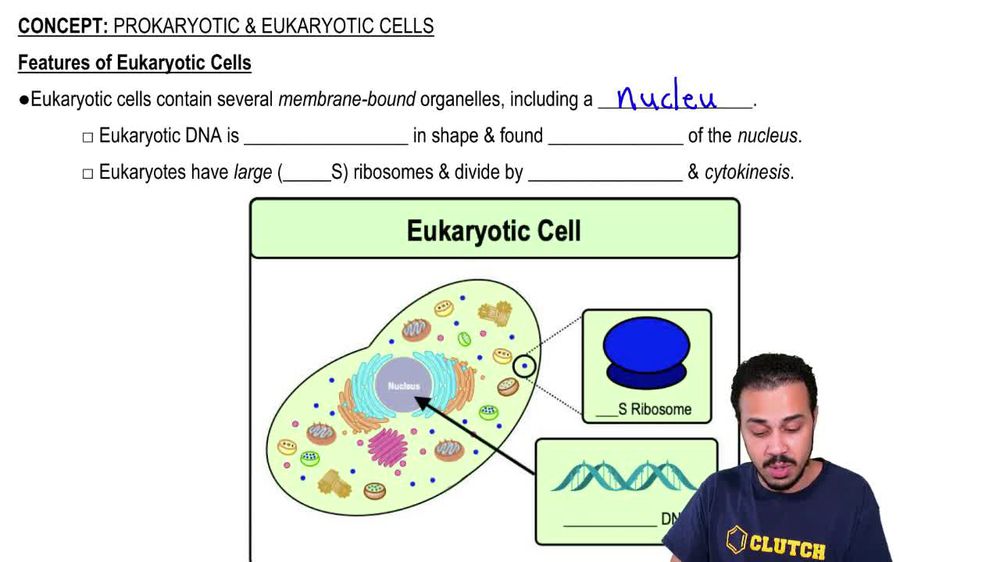
Eukaryotic cells are complex cells characterized by membrane-bound organelles, including a nucleus that houses genetic material. Key structures include the endoplasmic reticulum (both rough and smooth), mitochondria for energy production, and the Golgi apparatus for processing and packaging proteins. Understanding these components is essential for accurately drawing and labeling eukaryotic cells.
Eukaryotic cells exhibit various physical connections between their internal structures, such as microtubules and microfilaments that form the cytoskeleton, providing structural support and facilitating intracellular transport. Additionally, structures like plasmodesmata in plant cells allow for communication and transport between adjacent cells. Recognizing these connections is crucial for illustrating the functional relationships within the cell.
Each organelle within a eukaryotic cell has a specific function that contributes to the cell's overall operation. For instance, lysosomes are involved in digestion and waste removal, while chloroplasts are essential for photosynthesis in plant cells. Understanding the roles of these organelles helps in accurately depicting their locations and interactions in a drawn representation of the cell.

 3:13 minutes
 Verified step by step guidance
 04:17
04:17