

Why is autonomic tone a significant part of ANS function?
Verified step by step guidance
1
Understand that autonomic tone refers to the baseline level of activity maintained by the autonomic nervous system (ANS) even in the absence of external stimuli.
Recognize that this tone allows the ANS to regulate vital functions such as heart rate, blood vessel diameter, and digestive activity continuously and smoothly.
Note that autonomic tone provides a balance between the sympathetic and parasympathetic divisions, enabling rapid adjustments to maintain homeostasis.
Consider that without autonomic tone, the body would respond only to changes rather than maintaining stable internal conditions, leading to less efficient physiological regulation.
Summarize that autonomic tone is significant because it ensures ongoing control and fine-tuning of organ systems, supporting the body's ability to adapt to varying demands.
Verified video answer for a similar problem:
This video solution was recommended by our tutors as helpful for the problem above
Play a video:
0 Comments
Key Concepts
Here are the essential concepts you must grasp in order to answer the question correctly.
Autonomic Tone
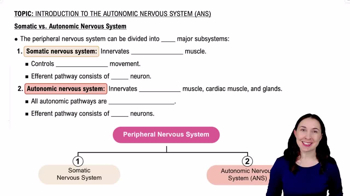
Autonomic tone refers to the baseline level of activity maintained by the autonomic nervous system (ANS) in its two branches, sympathetic and parasympathetic. It represents the continuous, steady-state influence on target organs, allowing the body to maintain homeostasis and respond quickly to changes.
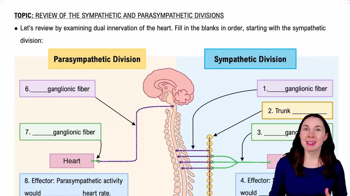
The ANS functions through a balance between sympathetic (fight or flight) and parasympathetic (rest and digest) branches. Autonomic tone reflects this balance, where one branch may dominate or both may exert influence, enabling fine-tuned regulation of physiological processes like heart rate and digestion.
Review of the Sympathetic and Parasympathetic Divisions
Homeostasis and Physiological Regulation
Autonomic tone is crucial for maintaining homeostasis by continuously adjusting organ function to meet the body's needs. This ongoing regulation ensures stability in vital parameters such as blood pressure, respiratory rate, and digestion, even in the absence of external stimuli.