VISUAL SKILLS Which functional group is not present in this molecule? a. carboxylb. sulfhydrylc. hydroxyld. amino
Verified step by step guidance
1
Identify the functional groups present in the molecule by examining the structure.
Look for hydroxyl groups (-OH) attached to the carbon atoms.
Check for the presence of a carboxyl group (-COOH), which consists of a carbon double-bonded to an oxygen and single-bonded to a hydroxyl group.
Look for a sulfhydryl group (-SH), which consists of a sulfur atom bonded to a hydrogen atom.
Check for the presence of an amino group (-NH2), which consists of a nitrogen atom bonded to two hydrogen atoms.
Verified video answer for a similar problem:
This video solution was recommended by our tutors as helpful for the problem above
Video duration:
1m
Play a video:
0 Comments
Key Concepts
Here are the essential concepts you must grasp in order to answer the question correctly.
Functional Groups
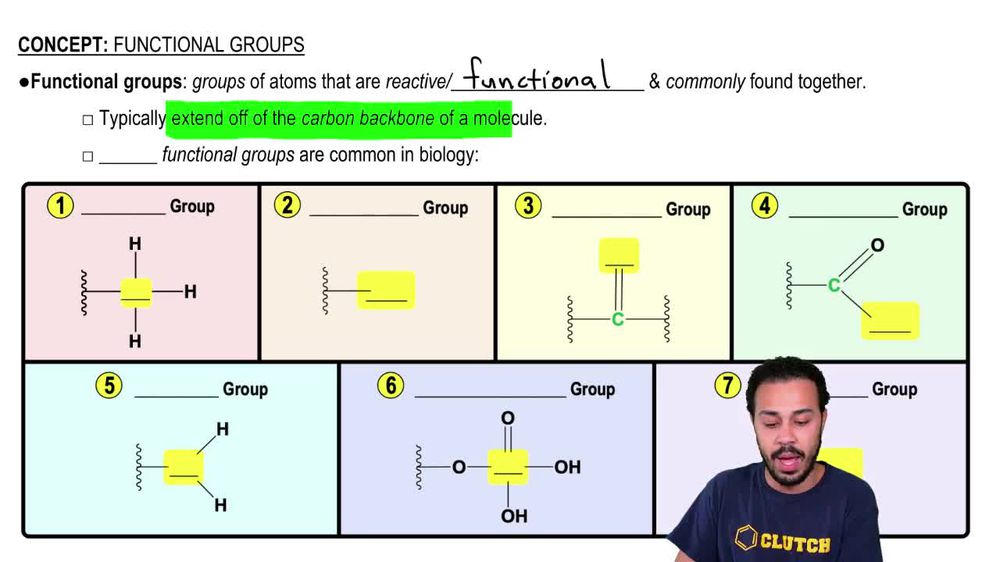
Functional groups are specific groups of atoms within molecules that are responsible for the characteristic chemical reactions of those molecules. They determine the properties and reactivity of organic compounds. Common functional groups include hydroxyl (-OH), carboxyl (-COOH), amino (-NH2), and sulfhydryl (-SH), each imparting unique features to the molecules they are part of.
The hydroxyl group (-OH) is a functional group consisting of an oxygen atom bonded to a hydrogen atom. It is commonly found in alcohols and sugars, such as mannitol, which is depicted in the image. The presence of hydroxyl groups increases the solubility of compounds in water and contributes to their reactivity, making them important in biological systems.
Identifying functional groups in a molecule involves analyzing its structure to determine which specific groups are present. This is crucial for understanding the molecule's chemical behavior and potential reactions. In the context of the question, recognizing the absence of certain functional groups, such as carboxyl, sulfhydryl, or amino groups, is essential for accurately answering which group is not present in the given molecule.

 1:56 minutes
 Verified step by step guidance
 06:04
06:04