Describe two different ways in which cilia can function in organisms.
Verified step by step guidance
1
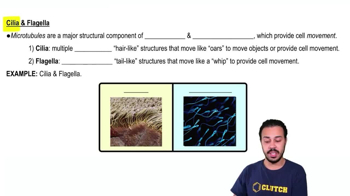
Cilia are hair-like structures that extend from the surface of many eukaryotic cells and can perform various functions depending on their location and the organism.
One function of cilia is to move fluid or mucus over the surface of a tissue. For example, in the human respiratory tract, cilia help to clear mucus and trapped particles out of the airways, protecting the lungs from infection and irritation.
Another function of cilia is to facilitate movement. In certain single-celled organisms, such as paramecia, cilia beat in coordinated waves, allowing the organism to swim through its aquatic environment.
Cilia can also play a sensory role. In some cells, they act as antennae, detecting changes in the environment and sending signals to the cell's interior to trigger a response.
In summary, cilia can function in locomotion, fluid movement, and sensory reception, highlighting their versatility and importance in various biological processes.
Verified video answer for a similar problem:
This video solution was recommended by our tutors as helpful for the problem above.
Video duration:
2m
Play a video:
0 Comments
Key Concepts
Here are the essential concepts you must grasp in order to answer the question correctly.
Cilia Structure and Function
Cilia are microscopic, hair-like structures that extend from the surface of many eukaryotic cells. They are composed of microtubules arranged in a specific pattern and are involved in various functions, including movement and sensory perception. Their coordinated beating can propel cells or move fluid across cell surfaces, playing a crucial role in maintaining homeostasis.
Motile cilia are specialized cilia that beat in a coordinated manner to facilitate movement. In organisms like paramecia, motile cilia help in locomotion, allowing the organism to swim through water. In multicellular organisms, such as humans, motile cilia line the respiratory tract, helping to move mucus and trapped particles out of the lungs, thus playing a vital role in respiratory health.
Non-motile cilia, also known as primary cilia, serve primarily as sensory organelles. They are found on nearly all cell types and play a critical role in signal transduction, allowing cells to respond to their environment. For example, primary cilia are involved in sensing fluid flow in kidney cells, which is essential for maintaining kidney function and overall fluid balance in the body.

 2:18 minutes
 Verified step by step guidance
 03:14
03:14