A hypothetical poison blocks K+ leak channels. How would this affect the resting membrane potential of skeletal muscle fibers? Explain your reasoning.
Verified step by step guidance
1
Understand the role of K+ leak channels: Potassium (K+) leak channels are responsible for allowing K+ ions to move out of the cell down their concentration gradient. This movement contributes significantly to the resting membrane potential, as the inside of the cell becomes more negative relative to the outside due to the loss of positively charged K+ ions.
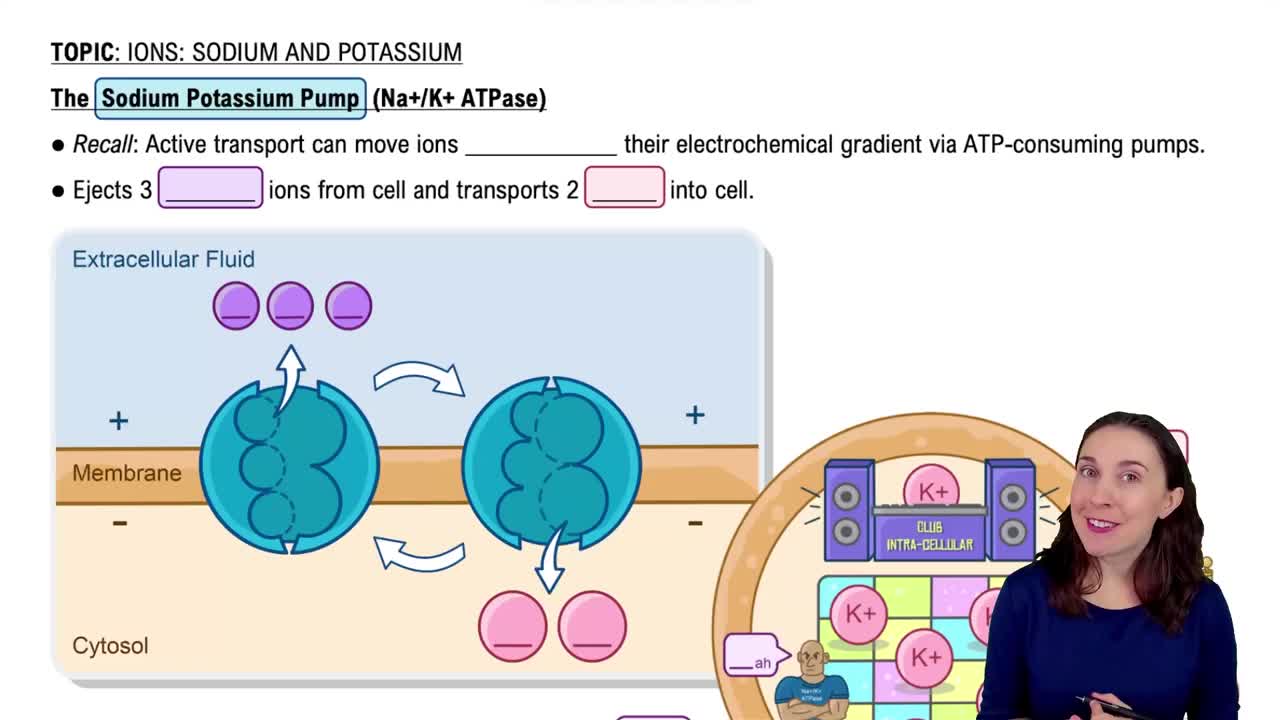
Recall the resting membrane potential: The resting membrane potential is primarily established by the unequal distribution of ions (mainly Na+, K+, and Cl-) across the cell membrane and the selective permeability of the membrane to these ions. The sodium-potassium pump (Na+/K+ ATPase) also plays a role by maintaining the ion gradients.
Analyze the effect of blocking K+ leak channels: If K+ leak channels are blocked, K+ ions will no longer be able to exit the cell as they normally would. This would reduce the outward flow of positive charges, making the inside of the cell less negative (i.e., the resting membrane potential would become less polarized or closer to zero).
Consider the implications for skeletal muscle fibers: A less negative resting membrane potential would make the muscle fibers more excitable, as the threshold for triggering an action potential would be easier to reach. However, it could also disrupt normal muscle function by altering the balance of ion gradients and excitability.
Summarize the reasoning: Blocking K+ leak channels would depolarize the resting membrane potential of skeletal muscle fibers, as the normal contribution of K+ efflux to the negative resting potential is eliminated. This highlights the importance of K+ leak channels in maintaining the resting state of excitable cells.
Verified video answer for a similar problem:
This video solution was recommended by our tutors as helpful for the problem above
Play a video:
0 Comments
Key Concepts
Here are the essential concepts you must grasp in order to answer the question correctly.
Resting Membrane Potential
The resting membrane potential is the electrical charge difference across the plasma membrane of a cell when it is not actively sending signals. In skeletal muscle fibers, this potential is typically around -70 to -90 mV, primarily determined by the distribution of ions, particularly potassium (K<sup>+</sup>) and sodium (Na<sup>+</sup>). The negative charge inside the cell is mainly due to the higher concentration of K<sup>+</sup> ions inside compared to the outside.
Potassium leak channels are specialized proteins in the cell membrane that allow K<sup>+</sup> ions to move freely across the membrane. These channels are crucial for maintaining the resting membrane potential, as they enable K<sup>+</sup> to exit the cell, which contributes to the negative charge inside. If these channels are blocked, the efflux of K<sup>+</sup> is reduced, leading to changes in the membrane potential.
The membrane potential is influenced by the concentration gradients of various ions across the membrane, particularly K<sup>+</sup> and Na<sup>+</sup>. According to the Nernst equation, the resting membrane potential can shift if the concentration of K<sup>+</sup> inside the cell increases or if the channels allowing K<sup>+</sup> to exit are blocked. This results in a less negative or depolarized membrane potential, which can affect muscle fiber excitability and contraction.

 Verified step by step guidance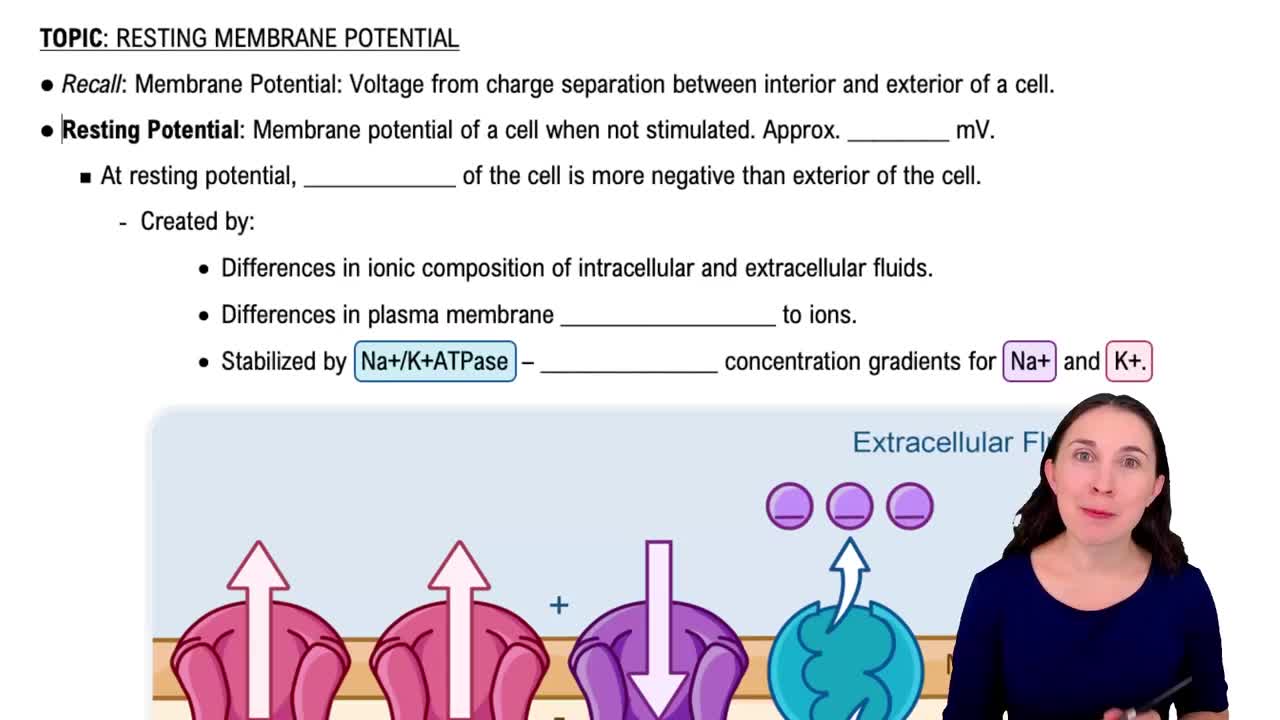
 07:53
07:53