Explain why the filtrate becomes hypotonic as it flows through the ascending limb of the nephron loop. Also explain why the filtrate at the bend of the nephron loop (and the interstitial fluid of the deep portions of the medulla) is hypertonic.
Verified step by step guidance
1
Understand that the nephron loop (Loop of Henle) has two distinct segments: the descending limb and the ascending limb, each with different permeability properties affecting filtrate concentration.
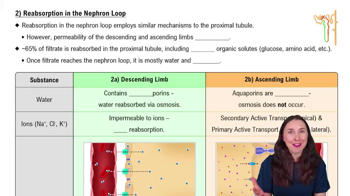
Recognize that the ascending limb of the nephron loop is impermeable to water but actively transports sodium (Na\+), potassium (K\+), and chloride (Cl\-) ions out of the filtrate into the surrounding interstitial fluid.
Because water cannot follow the ions out of the ascending limb, the removal of these solutes decreases the osmolarity of the filtrate, making it hypotonic relative to the plasma.
At the bend of the nephron loop (the tip of the loop), the filtrate has lost water in the descending limb but has not yet lost solutes in the ascending limb, so it becomes highly concentrated, or hypertonic.
The interstitial fluid in the deep medulla is hypertonic due to the accumulation of solutes actively transported from the ascending limb and the countercurrent multiplier system, which establishes a high osmolarity gradient essential for water reabsorption in the collecting ducts.
Verified video answer for a similar problem:
This video solution was recommended by our tutors as helpful for the problem above
Video duration:
1m
Play a video:
0 Comments
Key Concepts
Here are the essential concepts you must grasp in order to answer the question correctly.
Function of the Ascending Limb of the Nephron Loop
The ascending limb of the nephron loop actively transports sodium and chloride ions out of the filtrate into the surrounding interstitial fluid but is impermeable to water. This ion removal without water following causes the filtrate to lose solutes while retaining water, making it hypotonic as it ascends.
The countercurrent multiplier system in the nephron loop creates a concentration gradient in the medulla by moving ions out of the ascending limb and allowing water to leave the descending limb. This mechanism concentrates solutes in the deep medulla, resulting in hypertonic interstitial fluid and filtrate at the loop's bend.
Osmolarity varies along the nephron loop due to selective permeability: the descending limb is permeable to water but not solutes, concentrating filtrate, while the ascending limb removes solutes without water, diluting filtrate. This creates a hypertonic environment at the loop's bend and hypotonic filtrate in the ascending limb.